



Book your demo today

To find out how LEGALFLY could work for you, schedule a call with one of our experts.

Hubspot

Set a portal ID and form in the Properties.

Legal AI

13

Luminance AI vs LEGALFLY: Best Legal AI for In-House Teams?

Luminance AI vs LEGALFLY: Best Legal AI for In-House Teams?

Luminance was built for high-volume document analysis and due diligence. It processes thousands of legal documents fast, surfaces deviations from market standard language, and handles contract analysis at scale.

But contracts are just one part of what in-house teams do. They also manage legal research, regulatory change, questions from other business teams, and keep decisions consistent across jurisdictions and the organisation.

LEGALFLY is built for that. While Luminance goes deep on contracts, LEGALFLY covers the full scope of in-house legal work, including contract review, legal research, regulatory monitoring, and due diligence, in one platform designed specifically for in-house teams.

If you are searching for the best Luminance AI alternative for enterprise in-house legal, or comparing Luminance AI alternatives more broadly, book a demo with LEGALFLY.

What Each Platform Does

Both platforms accelerate legal work, but they were built with different teams in mind. Here is what each legal AI platform actually does.

LEGALFLY
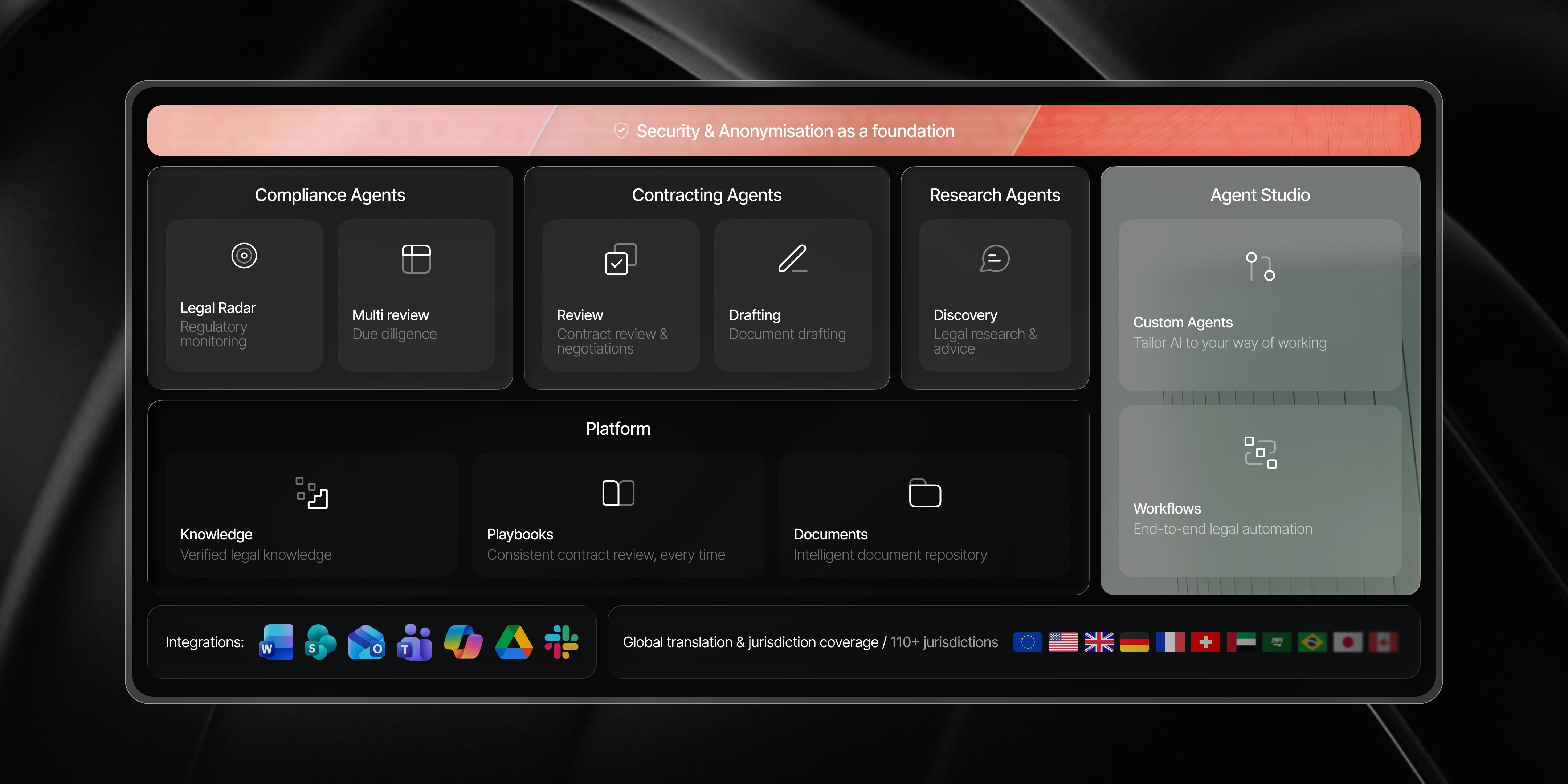
LEGALFLY is a legal AI platform for enterprise in-house legal, compliance, and procurement teams. It runs inside the tools most legal teams already use: Microsoft Word, Teams, SharePoint, Outlook, and Slack. When you review a contract, the AI works from your own legal positions, not a generic baseline. The contract intelligence layer applies your standards clause by clause, tracking decisions, surfacing redrafts, and supporting the full contract lifecycle from first review through approval. Contract drafting runs directly from your approved templates in Word. Legal research draws from 500+ official sources across 60+ jurisdictions.

Legal Radar monitors regulatory developments and alerts your team to changes before they affect your contracts. The Multi-Review Agent processes large batches of contracts simultaneously and ranks results by how far each one deviates from your positions. The Agent Studio lets you build and deploy custom AI workflows tailored to your playbooks, policies, and approval processes.

Luminance

Luminance is a contract analytics platform built on a proprietary large language model, trained on millions of legally verified documents using unsupervised learning. It can be configured to flag deviations from your preferred contract positions, suggest alternative wording, and assist with negotiation, all primarily inside Microsoft Word. It serves both law firms and enterprise legal teams across a range of industries, and its strongest use case is high-volume document analysis for contracts and M&A transactions.

Law firms handling large diligence projects value Luminance for its ability to process legal documents at pace, making it a familiar tool for document-intensive M&A and due diligence work. Learn more here.

How Luminance AI And LEGALFLY Compare

Feature

Luminance

LEGALFLY

Contract review

Configurable to your positions, but requires two to three months of setup before delivering consistent results.

Playbook-driven review against your legal positions from day one, with fallback language and redrafts built in.

Contract drafting

Drafting and redlines in Word.

Drafting from your approved templates, in your house style, directly in Word.

High-volume contract review

Bulk document review and document analysis across large portfolios.

Multi-Review Agent applies your playbook across batches and ranks results by deviation severity.

Document analysis

Deep document analysis across contract portfolios and diligence projects, primarily a fit for law firms and M&A teams.

Document analysis across contracts, policies, and regulatory documents, with built-in risk detection.

Contract intelligence

Deviation flagging from market standard language.

Contract intelligence layer applies your positions, tracks clause decisions, and generates redrafts aligned to your standards.

Contract lifecycle management

Document review and negotiation scoped to the contract workflow. Supports contract management within that scope.

Supports the full contract lifecycle from drafting through review, approval, and compliance tracking. CLM platform integrations available, including e-signature.

Legal research

No dedicated jurisdictional legal research.

500+ official legal sources, 60+ jurisdictions, translation into 80 languages.

Regulatory monitoring

Analyses contracts against compliance frameworks and internal rules. Compliance checks against configured rule sets.

Legal Radar proactively monitors legislative and regulatory sources for upcoming changes before they affect your contracts.

Workflow automation

Intake, routing, and approval scoped to contract workflows.

The Agent Studio lets you build custom agents across the full range of in-house legal tasks, from intake to approval, across contracts, research, and due diligence.

Microsoft 365

Word and Outlook integration.

Full stack: Word, Teams, SharePoint, Google Drive, Outlook, Copilot, and Slack.

Data protection

Proprietary AI model. No customer data used for training. ISO 27001.

Documents are anonymised before any AI model processes them. ISO 27001. On-premises deployment available.

Time to value

Full value can take months: playbook configuration, integration setup, and tuning all required.

Days, with 120+ pre-built playbooks. AI Playbook Builder generates your first playbook from a contract you already have.

Pricing

Not published.

Pricing is based on number of seats. Seat price decreases with scale.

Does It Understand Your Legal Standards, Or Just Flag Deviations From Someone Else's?

Many legal AI platforms flag clauses that deviate from what the AI considers normal contract language. The baseline is built from market data, not your specific positions. The more useful question is whether the platform works from your standards: your approved clause language, your fallback positions, and the redraft wording your team has signed off on.

Real contract intelligence goes beyond deviation detection. It applies your positions automatically and generates clause-level outputs your team can act on immediately.

How Luminance Handles Contract Review

Luminance can be configured to your legal positions, but that configuration takes time. Getting playbooks set up, auto-markup rules tuned, and workflows running takes two to three months for most enterprise teams, according to reviews, and longer for organisations with complex multi-jurisdiction templates. Until that work is done, the platform works from market standard language rather than your own positions.

The training period before the system consistently reflects your standards adds meaningful overhead. User training is typically required before teams can run document review independently, and even once configured, users consistently report a steep learning curve. Complex legal documents still require significant manual work to resolve. Independent reviewers note the platform relies heavily on user input throughout.
How LEGALFLY Handles Contract Review

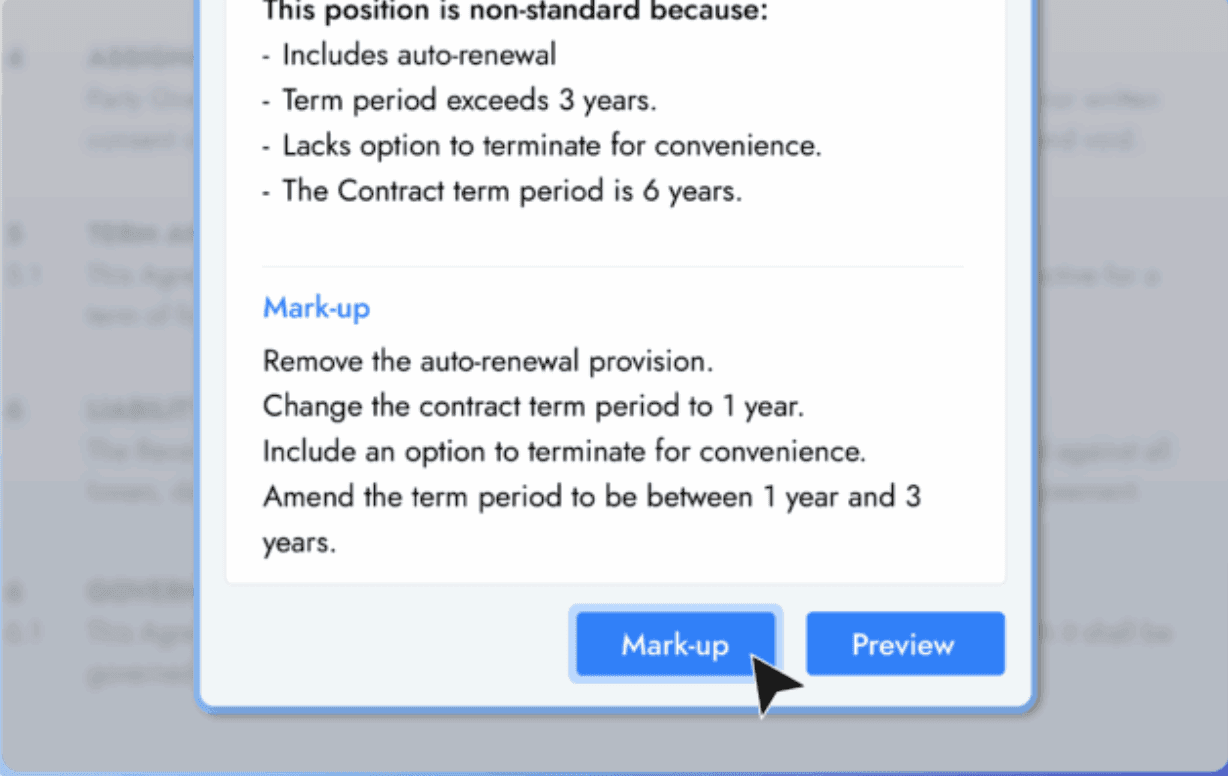
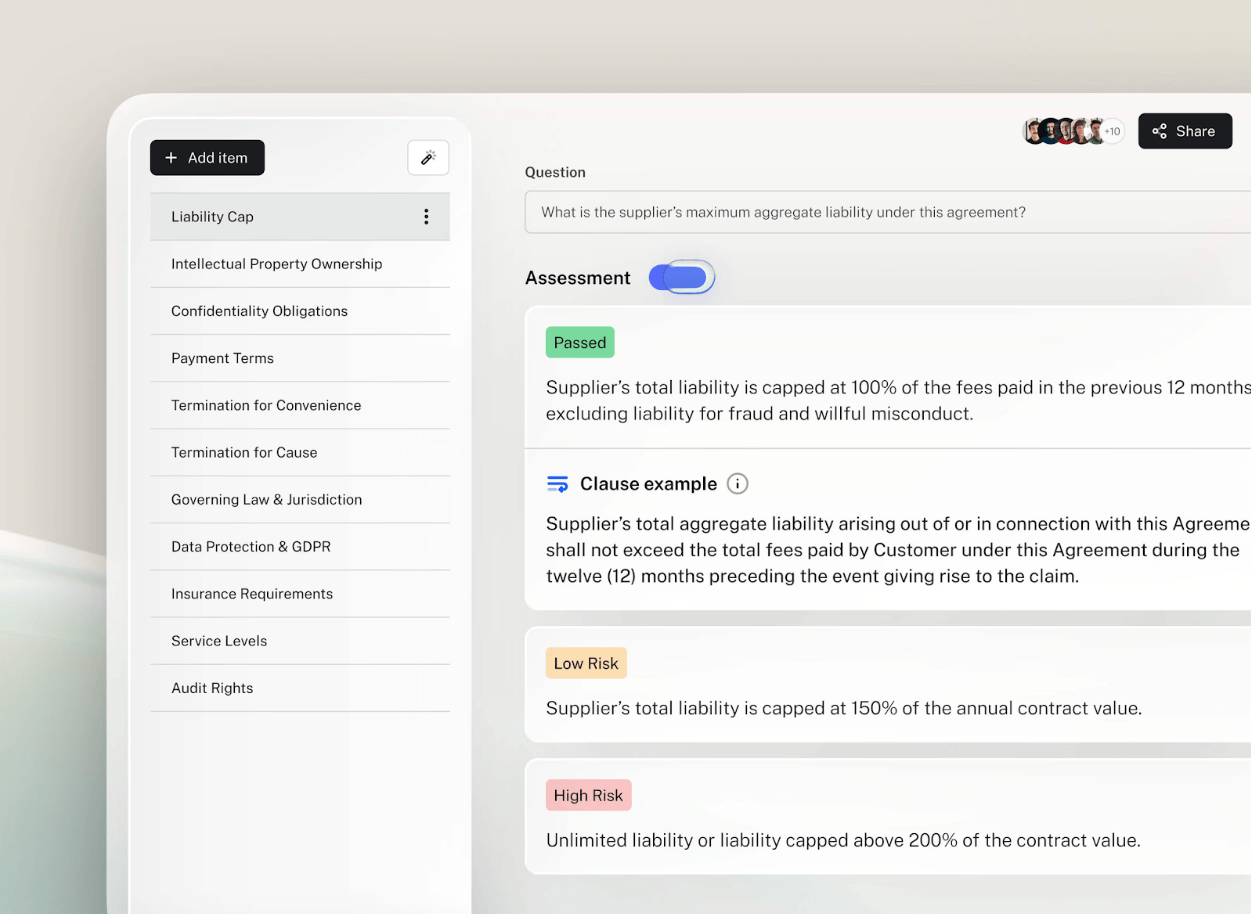
LEGALFLY's contract review runs against playbooks, documents that encode your legal standards for every clause type your team handles. Each playbook captures your approved position, your fallback language if a counterparty pushes back, your non-negotiables, and the exact wording to use when a clause needs to be redrafted.

Here's how LEGALFLY speeds up the contract assessment process. When a contract comes in, the AI compares each clause against those positions and produces a redraft that already reflects your answer. Your team reviews a proposed position, not a list of issues to work through.

Built-in risk detection flags clauses outside your acceptable range before a reviewer even opens the document. Compliance checks run automatically against your playbook on every review, and compliance tracking gives your team a consistent record of decisions across every contract processed.

To get started, you do not need to build playbooks from scratch. LEGALFLY ships with 120+ pre-built playbooks across the most common document types. The AI Playbook Builder generates a tailored first draft from a reference contract you already use. Setup takes minutes, not months. See for yourself why LEGALFLY is ranked among the top AI contract review tools.
Verdict: Both platforms can work from your legal positions. LEGALFLY gets you there in the first week. Luminance takes two to three months of configuration before it delivers consistent results against your standards.

Can It Handle A Hundred Contracts At Once?

For in-house legal teams, high-volume contract review means processing a backlog of vendor agreements, reviewing a portfolio of contracts ahead of a renewal cycle, or running due diligence on an acquisition target. The question is whether the platform applies your standards across that volume, or simply tells you where legal documents differ from a market baseline.

How Luminance Handles High-Volume Review

High-volume document analysis is Luminance's strongest capability, particularly for M&A due diligence. It processes thousands of legal documents simultaneously, surfaces compliance exposure across a target company's contract portfolio, and flags anomalies fast. Law firms running large diligence projects rely on Luminance for that speed at scale. For law firms handling document-intensive transactions, the combination of document analysis depth and processing speed is a genuine advantage.

For in-house legal teams, the fit is narrower. Luminance's bulk document review is designed around identifying where contracts deviate from a standard, rather than applying your specific playbook positions across a portfolio. It is a different job from what most in-house teams need when reviewing vendor agreements, renewals, or incoming commercial contracts.
How LEGALFLY Handles High-Volume Review

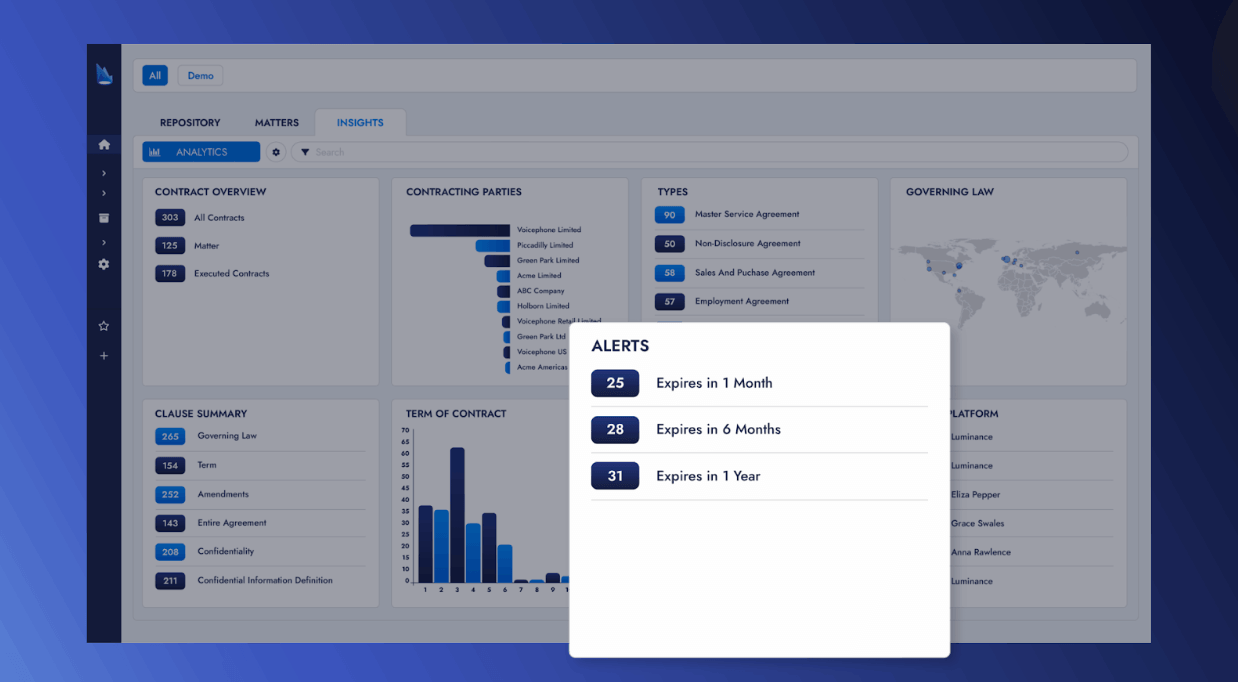
LEGALFLY's Multi-Review Agent runs your playbook rules across every document in a batch at the same time. Upload the contracts, apply the relevant playbook, and receive outputs ranked by how far each contract deviates from your positions. Risk is visible across the whole portfolio at once. High-volume contract review that applies your actual legal standards, not a market baseline, is what the Multi-Review Agent is built for. You can see which contracts need attention and which are within your acceptable range without opening each one individually.

Verdict: LEGALFLY applies your legal positions across batches from day one. Luminance excels at extreme-scale M&A document analysis, making it a fit for law firms running high-volume diligence projects. For most in-house teams, LEGALFLY is the stronger choice.

How Long Before Your Team Is Using It?

Buying legal AI and getting value from legal AI are two different things. The gap between them often comes down to how long it takes before the platform is working from your standards and your team is using it in practice.

Getting Started With Luminance

Luminance's implementation is a project in its own right. Getting full value requires playbooks to be configured, auto-markup rules to be tuned, and integrations to be connected. That implementation process can take two to three months for enterprise teams, and longer for organisations with complex multi-jurisdiction templates. Implementation guides note that dedicated legal ops resource is commonly brought in just to manage the configuration phase. The training period before the platform reliably reflects your positions extends the implementation timeline further. Users consistently report a steep learning curve throughout, and user training is required before most teams can run document review independently. Some note that their existing methods felt easier during the initial period.

Getting Started With LEGALFLY

LEGALFLY is designed to close that gap quickly. The AI Playbook Builder generates a first-pass playbook from a reference contract you already have, so your review standards are in place before manual configuration is complete. The 120+ pre-built playbooks cover the most common document types your team handles, so there is something useful from day one. Legal engineering support is included. Most teams are reviewing live legal documents within the first week.

How To Build A Playbook In LEGALFLY

Creating a playbook in LEGALFLY starts with your own standards. You describe the contract type you want to cover and upload a reference document such as an approved agreement or internal guidance. The Playbook Builder asks a few clarifying questions and generates a structured review framework in seconds, including the clauses to check, the assessments to run, fallback positions, and suggested redraft wording for drafting or renegotiating each clause.

From there, you refine the playbook to match how your team actually negotiates. You can add conditional rules, adjust preferred language, and define escalation triggers. Version history keeps a clear record of updates, and once approved the playbook can be published for use across teams. Each contract reviewed against it follows the same logic, which helps maintain consistency as volume increases.

Verdict: LEGALFLY gets your team reviewing live contracts within the first week. Luminance requires two to three months of configuration before results consistently reflect your legal positions.

How Do They Protect Your Data?

When you upload a contract to a legal AI platform, that document contains sensitive information: commercial terms, counterparty details, deal structures, and sometimes personal data. What the platform does with that information matters.

Luminance's Approach To Data Protection

Luminance runs on a proprietary AI model, which means your data is not shared with or used to train any third-party system. It holds ISO 27001 certification and enterprise-grade security credentials, and does not use customer data for model training. What it does not do is anonymise legal documents before the AI processes them. Your contracts are reviewed in their original, identifiable form. For legal teams handling sensitive commercial terms, transaction details, or personal data, that distinction is worth considering.

LEGALFLY's Approach To Data Protection

LEGALFLY anonymises every document before it reaches any AI model. Names, commercial terms, and identifiable details are stripped at import. This happens automatically, as part of the platform architecture, not as a setting you need to configure. The AI processes anonymised data, so sensitive information never reaches the model in its original form. LEGALFLY holds ISO 27001 certification, is GDPR compliant, and offers on-premises and single-tenant deployment for regulated industries where data cannot leave a specific environment.
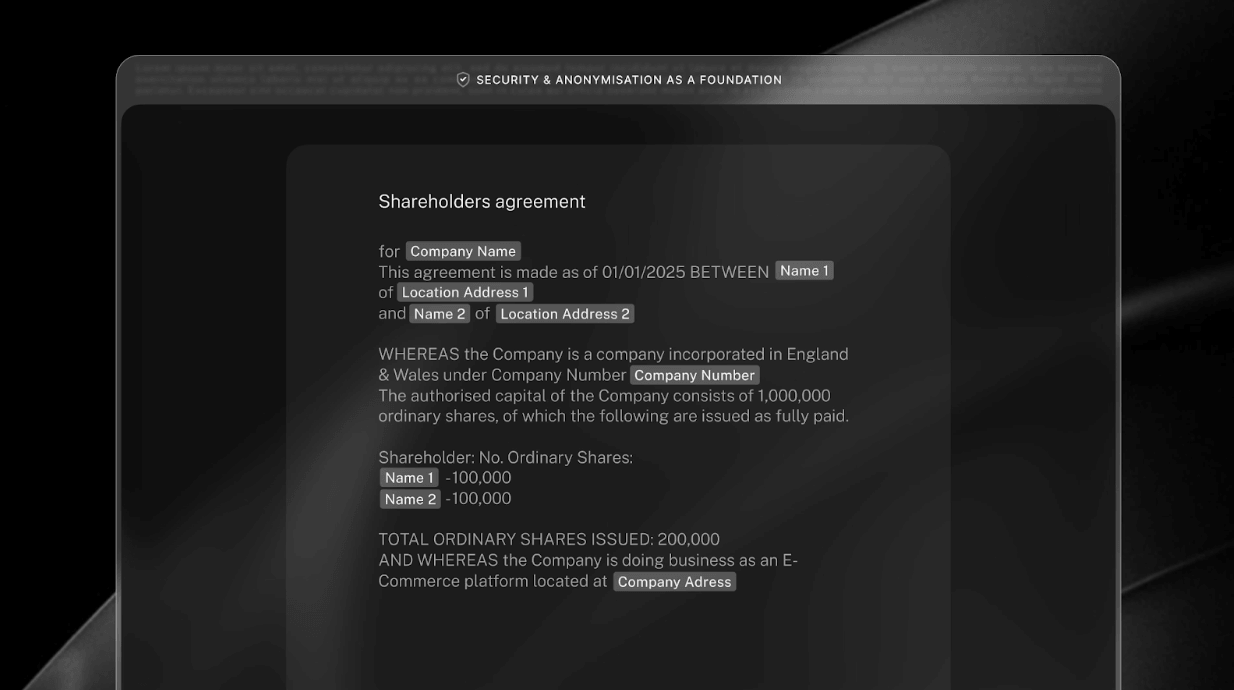
Verdict: Both platforms hold ISO 27001 and take security seriously. LEGALFLY goes a step further by removing identifiable data before it reaches any AI model. Luminance does not offer this layer of protection.

Does It Fit Inside The Tools Your Team Already Uses?

Most in-house legal teams already run on Microsoft 365. The question is how much of that environment a legal AI platform can connect to, and whether the people who send legal requests, from sales, procurement, HR teams, and finance, can do so without learning a new tool.

Luminance's Integrations

Luminance's primary working environment is Microsoft Word, where its contract review and negotiation features run. It lists integrations on its website but does not publish a full integration directory. Microsoft Teams, SharePoint, and Copilot are not listed as supported integrations. For in-house legal teams whose work spans the full Microsoft 365 environment, that is a gap worth confirming directly with Luminance before any purchase decision.

LEGALFLY's Microsoft 365 Integration

LEGALFLY runs across the full Microsoft 365 stack: Word, Teams, SharePoint, Outlook, Copilot, and Slack. A contract can move from an Outlook inbox through a Word review into a Teams approval without anyone leaving the tools they already work in. Business teams, including HR teams, procurement, and finance, submit requests through the channels they use every day, and receive them directly in LEGALFLY without additional routing or manual handoffs.

LEGALFLY also supports e-signature integrations, so completed contracts can move straight from approval to execution. For teams managing the full contract lifecycle, that e-signature connectivity removes a common friction point in the contract management workflow.

Verdict: LEGALFLY covers the full Microsoft 365 stack including Copilot and Outlook. Luminance's core integration is Microsoft Word.

Does It Do More Than Contracts?

Contract review is a major part of in-house legal work, but not all of it. In-house teams also handle legal research, track regulatory change across multiple jurisdictions, support transactions, and field questions from procurement, HR, and finance. The more of that a single platform can cover, the less your team is switching between tools or doing that work manually.

What Luminance Covers

Luminance is built around contracts. It handles document review, contract drafting, analytics, and compliance monitoring across a contract portfolio. Contract management within that scope is well served. Workflow automation is scoped to contract processes like intake, routing, and approval, rather than the broader range of tasks an in-house team manages.

For law firms or teams whose legal work is primarily contract-based, that may cover enough of your workflow.

What LEGALFLY Covers

LEGALFLY does more. On top of contract review and contract drafting, it offers legal research across 500+ official sources and 60+ jurisdictions, multi-document due diligence with risk-ranked outputs, and Legal Radar, which monitors legislative and regulatory sources across 35+ jurisdictions and alerts your team when something changes that affects your contracts or compliance obligations.

The Agent Studio lets you build custom AI agents tailored to your own playbooks, policies, and approval flows. Recurring workflows across contracts, research, and due diligence can run automatically, with legal retaining final control.

Verdict: Luminance speeds up contract work and drafting. LEGALFLY covers the full scope of in-house legal work, including contract review, legal research, regulatory monitoring, and due diligence, in one platform.

Which One Is Right For Your Team?

Choose Luminance if your primary need is extreme-scale M&A diligence, your team has the time and resources to absorb a two to three month implementation, and a platform focused on contract management and document analysis covers enough of your workflow to justify it.

Choose LEGALFLY if you run an in-house legal function that spans contract review, regulatory monitoring, legal research, and coordination across the organisation. LEGALFLY applies your legal standards from the first week, anonymises data before AI processing, and covers the full range of what in-house counsel does.

If you are looking for Luminance AI alternatives, or trying to identify the best Luminance AI option for a team that goes beyond contracts, LEGALFLY is the platform built specifically for in-house legal teams managing the full contract lifecycle. It is also worth evaluating LEGALFLY alongside Robin AI if you are comparing legal AI platforms for contract-heavy teams.

Robin AI focuses primarily on contract review and drafting, and like Luminance, does not cover the full scope of in-house legal work: legal research, regulatory monitoring, and cross-team workflow automation are not part of either platform. For teams that need all of that alongside contract management, LEGALFLY is the AI alternative built to cover it.

Try legal AI built for enterprise in-house teams. Book a demo.

Note: this information was last updated in Q1 2026. For the most current information, check directly with the provider.


Gabby MacSweeney

VP of Marketing

Legal AI

13

Luminance AI vs LEGALFLY: Best Legal AI for In-House Teams?

Luminance was built for high-volume document analysis and due diligence. It processes thousands of legal documents fast, surfaces deviations from market standard language, and handles contract analysis at scale.

But contracts are just one part of what in-house teams do. They also manage legal research, regulatory change, questions from other business teams, and keep decisions consistent across jurisdictions and the organisation.

LEGALFLY is built for that. While Luminance goes deep on contracts, LEGALFLY covers the full scope of in-house legal work, including contract review, legal research, regulatory monitoring, and due diligence, in one platform designed specifically for in-house teams.

If you are searching for the best Luminance AI alternative for enterprise in-house legal, or comparing Luminance AI alternatives more broadly, book a demo with LEGALFLY.

What Each Platform Does

Both platforms accelerate legal work, but they were built with different teams in mind. Here is what each legal AI platform actually does.

LEGALFLY

LEGALFLY is a legal AI platform for enterprise in-house legal, compliance, and procurement teams. It runs inside the tools most legal teams already use: Microsoft Word, Teams, SharePoint, Outlook, and Slack. When you review a contract, the AI works from your own legal positions, not a generic baseline. The contract intelligence layer applies your standards clause by clause, tracking decisions, surfacing redrafts, and supporting the full contract lifecycle from first review through approval. Contract drafting runs directly from your approved templates in Word. Legal research draws from 500+ official sources across 60+ jurisdictions.

Legal Radar monitors regulatory developments and alerts your team to changes before they affect your contracts. The Multi-Review Agent processes large batches of contracts simultaneously and ranks results by how far each one deviates from your positions. The Agent Studio lets you build and deploy custom AI workflows tailored to your playbooks, policies, and approval processes.

Luminance

Luminance is a contract analytics platform built on a proprietary large language model, trained on millions of legally verified documents using unsupervised learning. It can be configured to flag deviations from your preferred contract positions, suggest alternative wording, and assist with negotiation, all primarily inside Microsoft Word. It serves both law firms and enterprise legal teams across a range of industries, and its strongest use case is high-volume document analysis for contracts and M&A transactions.

Law firms handling large diligence projects value Luminance for its ability to process legal documents at pace, making it a familiar tool for document-intensive M&A and due diligence work. Learn more here.

How Luminance AI And LEGALFLY Compare

Feature

Luminance

LEGALFLY

Contract review

Configurable to your positions, but requires two to three months of setup before delivering consistent results.

Playbook-driven review against your legal positions from day one, with fallback language and redrafts built in.

Contract drafting

Drafting and redlines in Word.

Drafting from your approved templates, in your house style, directly in Word.

High-volume contract review

Bulk document review and document analysis across large portfolios.

Multi-Review Agent applies your playbook across batches and ranks results by deviation severity.

Document analysis

Deep document analysis across contract portfolios and diligence projects, primarily a fit for law firms and M&A teams.

Document analysis across contracts, policies, and regulatory documents, with built-in risk detection.

Contract intelligence

Deviation flagging from market standard language.

Contract intelligence layer applies your positions, tracks clause decisions, and generates redrafts aligned to your standards.

Contract lifecycle management

Document review and negotiation scoped to the contract workflow. Supports contract management within that scope.

Supports the full contract lifecycle from drafting through review, approval, and compliance tracking. CLM platform integrations available, including e-signature.

Legal research

No dedicated jurisdictional legal research.

500+ official legal sources, 60+ jurisdictions, translation into 80 languages.

Regulatory monitoring

Analyses contracts against compliance frameworks and internal rules. Compliance checks against configured rule sets.

Legal Radar proactively monitors legislative and regulatory sources for upcoming changes before they affect your contracts.

Workflow automation

Intake, routing, and approval scoped to contract workflows.

The Agent Studio lets you build custom agents across the full range of in-house legal tasks, from intake to approval, across contracts, research, and due diligence.

Microsoft 365

Word and Outlook integration.

Full stack: Word, Teams, SharePoint, Google Drive, Outlook, Copilot, and Slack.

Data protection

Proprietary AI model. No customer data used for training. ISO 27001.

Documents are anonymised before any AI model processes them. ISO 27001. On-premises deployment available.

Time to value

Full value can take months: playbook configuration, integration setup, and tuning all required.

Days, with 120+ pre-built playbooks. AI Playbook Builder generates your first playbook from a contract you already have.

Pricing

Not published.

Pricing is based on number of seats. Seat price decreases with scale.

Does It Understand Your Legal Standards, Or Just Flag Deviations From Someone Else's?

Many legal AI platforms flag clauses that deviate from what the AI considers normal contract language. The baseline is built from market data, not your specific positions. The more useful question is whether the platform works from your standards: your approved clause language, your fallback positions, and the redraft wording your team has signed off on.

Real contract intelligence goes beyond deviation detection. It applies your positions automatically and generates clause-level outputs your team can act on immediately.

How Luminance Handles Contract Review

Luminance can be configured to your legal positions, but that configuration takes time. Getting playbooks set up, auto-markup rules tuned, and workflows running takes two to three months for most enterprise teams, according to reviews, and longer for organisations with complex multi-jurisdiction templates. Until that work is done, the platform works from market standard language rather than your own positions.

The training period before the system consistently reflects your standards adds meaningful overhead. User training is typically required before teams can run document review independently, and even once configured, users consistently report a steep learning curve. Complex legal documents still require significant manual work to resolve. Independent reviewers note the platform relies heavily on user input throughout.

How LEGALFLY Handles Contract Review

LEGALFLY's contract review runs against playbooks, documents that encode your legal standards for every clause type your team handles. Each playbook captures your approved position, your fallback language if a counterparty pushes back, your non-negotiables, and the exact wording to use when a clause needs to be redrafted.

Here's how LEGALFLY speeds up the contract assessment process. When a contract comes in, the AI compares each clause against those positions and produces a redraft that already reflects your answer. Your team reviews a proposed position, not a list of issues to work through.

Built-in risk detection flags clauses outside your acceptable range before a reviewer even opens the document. Compliance checks run automatically against your playbook on every review, and compliance tracking gives your team a consistent record of decisions across every contract processed.

To get started, you do not need to build playbooks from scratch. LEGALFLY ships with 120+ pre-built playbooks across the most common document types. The AI Playbook Builder generates a tailored first draft from a reference contract you already use. Setup takes minutes, not months. See for yourself why LEGALFLY is ranked among the top AI contract review tools.

Verdict: Both platforms can work from your legal positions. LEGALFLY gets you there in the first week. Luminance takes two to three months of configuration before it delivers consistent results against your standards.

Can It Handle A Hundred Contracts At Once?

For in-house legal teams, high-volume contract review means processing a backlog of vendor agreements, reviewing a portfolio of contracts ahead of a renewal cycle, or running due diligence on an acquisition target. The question is whether the platform applies your standards across that volume, or simply tells you where legal documents differ from a market baseline.

How Luminance Handles High-Volume Review

High-volume document analysis is Luminance's strongest capability, particularly for M&A due diligence. It processes thousands of legal documents simultaneously, surfaces compliance exposure across a target company's contract portfolio, and flags anomalies fast. Law firms running large diligence projects rely on Luminance for that speed at scale. For law firms handling document-intensive transactions, the combination of document analysis depth and processing speed is a genuine advantage.

For in-house legal teams, the fit is narrower. Luminance's bulk document review is designed around identifying where contracts deviate from a standard, rather than applying your specific playbook positions across a portfolio. It is a different job from what most in-house teams need when reviewing vendor agreements, renewals, or incoming commercial contracts.

How LEGALFLY Handles High-Volume Review

LEGALFLY's Multi-Review Agent runs your playbook rules across every document in a batch at the same time. Upload the contracts, apply the relevant playbook, and receive outputs ranked by how far each contract deviates from your positions. Risk is visible across the whole portfolio at once. High-volume contract review that applies your actual legal standards, not a market baseline, is what the Multi-Review Agent is built for. You can see which contracts need attention and which are within your acceptable range without opening each one individually.

Verdict: LEGALFLY applies your legal positions across batches from day one. Luminance excels at extreme-scale M&A document analysis, making it a fit for law firms running high-volume diligence projects. For most in-house teams, LEGALFLY is the stronger choice.

How Long Before Your Team Is Using It?

Buying legal AI and getting value from legal AI are two different things. The gap between them often comes down to how long it takes before the platform is working from your standards and your team is using it in practice.

Getting Started With Luminance

Luminance's implementation is a project in its own right. Getting full value requires playbooks to be configured, auto-markup rules to be tuned, and integrations to be connected. That implementation process can take two to three months for enterprise teams, and longer for organisations with complex multi-jurisdiction templates. Implementation guides note that dedicated legal ops resource is commonly brought in just to manage the configuration phase. The training period before the platform reliably reflects your positions extends the implementation timeline further. Users consistently report a steep learning curve throughout, and user training is required before most teams can run document review independently. Some note that their existing methods felt easier during the initial period.

Getting Started With LEGALFLY

LEGALFLY is designed to close that gap quickly. The AI Playbook Builder generates a first-pass playbook from a reference contract you already have, so your review standards are in place before manual configuration is complete. The 120+ pre-built playbooks cover the most common document types your team handles, so there is something useful from day one. Legal engineering support is included. Most teams are reviewing live legal documents within the first week.

How To Build A Playbook In LEGALFLY

Creating a playbook in LEGALFLY starts with your own standards. You describe the contract type you want to cover and upload a reference document such as an approved agreement or internal guidance. The Playbook Builder asks a few clarifying questions and generates a structured review framework in seconds, including the clauses to check, the assessments to run, fallback positions, and suggested redraft wording for drafting or renegotiating each clause.

From there, you refine the playbook to match how your team actually negotiates. You can add conditional rules, adjust preferred language, and define escalation triggers. Version history keeps a clear record of updates, and once approved the playbook can be published for use across teams. Each contract reviewed against it follows the same logic, which helps maintain consistency as volume increases.

Verdict: LEGALFLY gets your team reviewing live contracts within the first week. Luminance requires two to three months of configuration before results consistently reflect your legal positions.

How Do They Protect Your Data?

When you upload a contract to a legal AI platform, that document contains sensitive information: commercial terms, counterparty details, deal structures, and sometimes personal data. What the platform does with that information matters.

Luminance's Approach To Data Protection

Luminance runs on a proprietary AI model, which means your data is not shared with or used to train any third-party system. It holds ISO 27001 certification and enterprise-grade security credentials, and does not use customer data for model training. What it does not do is anonymise legal documents before the AI processes them. Your contracts are reviewed in their original, identifiable form. For legal teams handling sensitive commercial terms, transaction details, or personal data, that distinction is worth considering.

LEGALFLY's Approach To Data Protection

LEGALFLY anonymises every document before it reaches any AI model. Names, commercial terms, and identifiable details are stripped at import. This happens automatically, as part of the platform architecture, not as a setting you need to configure. The AI processes anonymised data, so sensitive information never reaches the model in its original form. LEGALFLY holds ISO 27001 certification, is GDPR compliant, and offers on-premises and single-tenant deployment for regulated industries where data cannot leave a specific environment.

Verdict: Both platforms hold ISO 27001 and take security seriously. LEGALFLY goes a step further by removing identifiable data before it reaches any AI model. Luminance does not offer this layer of protection.

Does It Fit Inside The Tools Your Team Already Uses?

Most in-house legal teams already run on Microsoft 365. The question is how much of that environment a legal AI platform can connect to, and whether the people who send legal requests, from sales, procurement, HR teams, and finance, can do so without learning a new tool.

Luminance's Integrations

Luminance's primary working environment is Microsoft Word, where its contract review and negotiation features run. It lists integrations on its website but does not publish a full integration directory. Microsoft Teams, SharePoint, and Copilot are not listed as supported integrations. For in-house legal teams whose work spans the full Microsoft 365 environment, that is a gap worth confirming directly with Luminance before any purchase decision.

LEGALFLY's Microsoft 365 Integration

LEGALFLY runs across the full Microsoft 365 stack: Word, Teams, SharePoint, Outlook, Copilot, and Slack. A contract can move from an Outlook inbox through a Word review into a Teams approval without anyone leaving the tools they already work in. Business teams, including HR teams, procurement, and finance, submit requests through the channels they use every day, and receive them directly in LEGALFLY without additional routing or manual handoffs.

LEGALFLY also supports e-signature integrations, so completed contracts can move straight from approval to execution. For teams managing the full contract lifecycle, that e-signature connectivity removes a common friction point in the contract management workflow.

Verdict: LEGALFLY covers the full Microsoft 365 stack including Copilot and Outlook. Luminance's core integration is Microsoft Word.

Does It Do More Than Contracts?

Contract review is a major part of in-house legal work, but not all of it. In-house teams also handle legal research, track regulatory change across multiple jurisdictions, support transactions, and field questions from procurement, HR, and finance. The more of that a single platform can cover, the less your team is switching between tools or doing that work manually.

What Luminance Covers

Luminance is built around contracts. It handles document review, contract drafting, analytics, and compliance monitoring across a contract portfolio. Contract management within that scope is well served. Workflow automation is scoped to contract processes like intake, routing, and approval, rather than the broader range of tasks an in-house team manages.

For law firms or teams whose legal work is primarily contract-based, that may cover enough of your workflow.

What LEGALFLY Covers

LEGALFLY does more. On top of contract review and contract drafting, it offers legal research across 500+ official sources and 60+ jurisdictions, multi-document due diligence with risk-ranked outputs, and Legal Radar, which monitors legislative and regulatory sources across 35+ jurisdictions and alerts your team when something changes that affects your contracts or compliance obligations.

The Agent Studio lets you build custom AI agents tailored to your own playbooks, policies, and approval flows. Recurring workflows across contracts, research, and due diligence can run automatically, with legal retaining final control.

Verdict: Luminance speeds up contract work and drafting. LEGALFLY covers the full scope of in-house legal work, including contract review, legal research, regulatory monitoring, and due diligence, in one platform.

Which One Is Right For Your Team?

Choose Luminance if your primary need is extreme-scale M&A diligence, your team has the time and resources to absorb a two to three month implementation, and a platform focused on contract management and document analysis covers enough of your workflow to justify it.

Choose LEGALFLY if you run an in-house legal function that spans contract review, regulatory monitoring, legal research, and coordination across the organisation. LEGALFLY applies your legal standards from the first week, anonymises data before AI processing, and covers the full range of what in-house counsel does.

If you are looking for Luminance AI alternatives, or trying to identify the best Luminance AI option for a team that goes beyond contracts, LEGALFLY is the platform built specifically for in-house legal teams managing the full contract lifecycle. It is also worth evaluating LEGALFLY alongside Robin AI if you are comparing legal AI platforms for contract-heavy teams.

Robin AI focuses primarily on contract review and drafting, and like Luminance, does not cover the full scope of in-house legal work: legal research, regulatory monitoring, and cross-team workflow automation are not part of either platform. For teams that need all of that alongside contract management, LEGALFLY is the AI alternative built to cover it.

Try legal AI built for enterprise in-house teams. Book a demo.

Note: this information was last updated in Q1 2026. For the most current information, check directly with the provider.

Gabby MacSweeney

VP of Marketing

From request to outcome

Learn how LEGALFLY routes, executes and governs legal work end-to-end, across every team, jurisdiction and workflow.

Dark gradiend background

From request to outcome

Learn how LEGALFLY routes, executes and governs legal work end-to-end, across every team, jurisdiction and workflow.

Dark gradiend background

From request to outcome

Learn how LEGALFLY routes, executes and governs legal work end-to-end, across every team, jurisdiction and workflow.

Dark gradiend background