





Many legal AI platforms promise to help legal teams work more efficiently. But it’s not always easy to know which one is best for you. Harvey AI and LEGALFLY deliver faster research, contract review, drafting and compliance management. However, the two serve different audiences.
If you work inside a law firm, Harvey might be the right fit. If you lead an in-house legal, compliance or procurement team, LEGALFLY is likely the safer, more effective choice.
Here’s how they compare.
Note: If you're running an in-house legal team and you've been evaluating tools built for law firms, you're solving the wrong problem. LEGALFLY is purpose-built for legal inside the enterprise, clause-level contract review, data anonymised before it reaches any AI model, and workflows your whole business can use safely. Book a demo and see what in-house legal AI actually looks like.
Who were Harvey and LEGALFLY built for?
Harvey AI was built for law firms and legal professional service providers. Its “Professional Class AI” architecture supports complex transactional, litigation, and tax work. Many of its early adopters (PwC, A&O Shearman, Deutsche Telekom AG) use Harvey to scale large legal operations.
In contrast, LEGALFLY was designed specifically for in-house legal teams. It focuses on enabling cross-functional teams to work faster, protect data, and collaborate safely across departments like procurement, finance, sales and compliance.
Verdict: Harvey serves major law firms. LEGALFLY serves enterprises.
Which platform protects your data better?
There are some important differences here.
Harvey AI offers robust enterprise security: SOC 2 Type II, ISO 27001, GDPR, and CCPA compliance, plus regional data hosting (EU, US, Australia). It guarantees that client data isn’t used to train AI models.
However, Harvey still shares identifiable data with the underlying LLMs that power it.
LEGALFLY removes that risk entirely. It anonymises data before processing, ensuring no personal or confidential information ever leaves your environment. It holds the same certifications (SOC 2 Type II, ISO 27001) but adds full GDPR alignment and optional on-premise or single tenant deployment for regulated industries.
Verdict: Harvey protects the platform. LEGALFLY protects the data.
How do their AI models and accuracy compare?
Initially running only on ChatGPT, Harvey now supports three large language models: OpenAI’s GPT, Anthropic’s Claude, and Google’s Gemini.
LEGALFLY is LLM-agnostic and draws from four leading models (Claude, Llama, GPT, and Gemini) selecting the most capable for each task, language, and jurisdiction. It also runs smaller, fine-tuned internal models for specialised functions such as anonymisation and clause detection. This improves precision, consistency, and context-awareness across multi-jurisdictional work.
Verdict: Harvey has evolved. LEGALFLY was designed from the ground up to be agnostic. This is also worth keeping in mind if you're exploring different Harvey AI alternatives before committing to a platform.
Which AI fits more naturally into your workflows?
Both Harvey AI and LEGALFLY integrate directly with Microsoft Word, SharePoint, Teams, and Copilot. You can draft, compare, and review contracts without leaving your usual workspaces, with version control and audit trails automatically maintained.
Verdict: Both platforms work with the tools you already use.
Which is stronger on security?
In-house legal teams are under increasing scrutiny to prove AI governance, from GDPR to the EU AI Act and DORA in financial services.
LEGALFLY was built with governance in mind:
Automated anonymisation to minimise breach risk
Clause-level audit trails for every AI action
Configurable permissions and data residency controls
Harvey has enterprise monitoring and retention policies but doesn’t have in-built anonymisation.
Verdict: Both comply but only LEGALFLY has in-built anonymisation.
Most teams using LEGALFLY cut their contract review time in half within a few weeks of onboarding. Book a short demo to see how it works for your business.
What can each platform do?
Comparison point | Harvey AI | LEGALFLY |
|---|---|---|
Security and privacy | Enterprise-grade | Enterprise-grade + pre-processing anonymisation. See more |
Contract review | Yes | |
Drafting from templates | No | Yes. Directly in Microsoft Word. See more |
Regulatory tracking | No | Yes See Legal Radar |
Clause comparison | Yes | Yes |
Review (multi-document) | Yes via Vault | Yes via Multi-review |
Review with Playbook | Yes | Yes |
Microsoft 365 integration | Word, SharePoint, Outlook | Word, SharePoint, Copilot (Teams, Outlook) See more |
Data anonymisation | No | Yes |
Jurisdictional adaptation | Limited | Extensive |
Cross-department collaboration | Partial | Yes, safe self-service within legal guardrails |
AI model flexibility | Multiple models (LLM-agnostic) | Multiple models (LLM-agnostic) |
Ideal for | Law firms and advisory practices | In-house legal, compliance, and procurement teams |
Why LEGALFLY is among the best AI tools for in-house legal teams
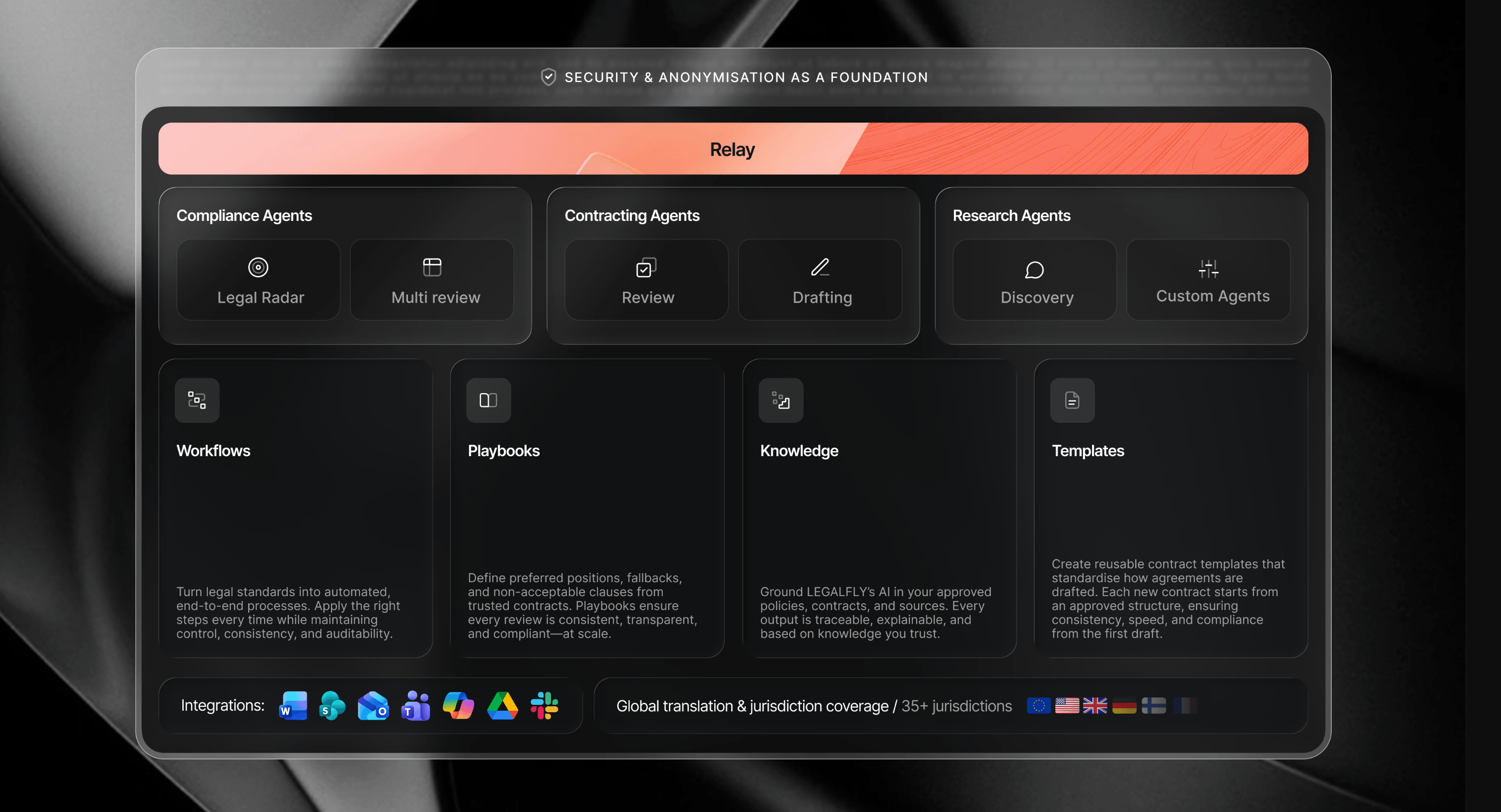
Choosing a legal AI platform comes down to a simple question: was it designed for how your team actually works, or will you spend the next six months adapting your workflows to fit around it?
Tools like Harvey are built assistant-first. You ask a question, you get an answer, you move on. That model works well for law firms handling one-off matters, where context resets per client and the goal is the best answer for a specific case.
In-house legal teams have a different job. The goal is organisational consistency: same questions get the same answers, every contract is reviewed against the same standards, every compliance check follows the same logic. That requires a platform built around workflows and institutional memory, not a chat interface you have to prompt correctly each time.
LEGALFLY is system-first. It runs legal work through specialised agents and structured workflows. That design choice shapes everything else about how the platform performs. Here's why LEGALFLY stands as the best Harvey AI alternative.
Multi-document review that flags risk, not just data
Every major legal AI tool can extract data from multiple contracts. Harvey's Vault pulls key terms across a document set based on the fields you ask them to check. What it doesn’t do is tell you what those terms mean for your risk exposure.
LEGALFLY's Multi-Review agent goes further: it extracts data, runs risk analysis, and applies your playbooks across every document in the batch. You get a structured output flagging deviations from your standards and surfacing high-risk clauses by severity, not raw extracted data you then have to interpret yourself. For in-house teams reviewing 50 vendor contracts under a deadline, that difference is significant.
It's also one of the key distinctions that separates LEGALFLY as one of the top AI contract review softwares on the market.
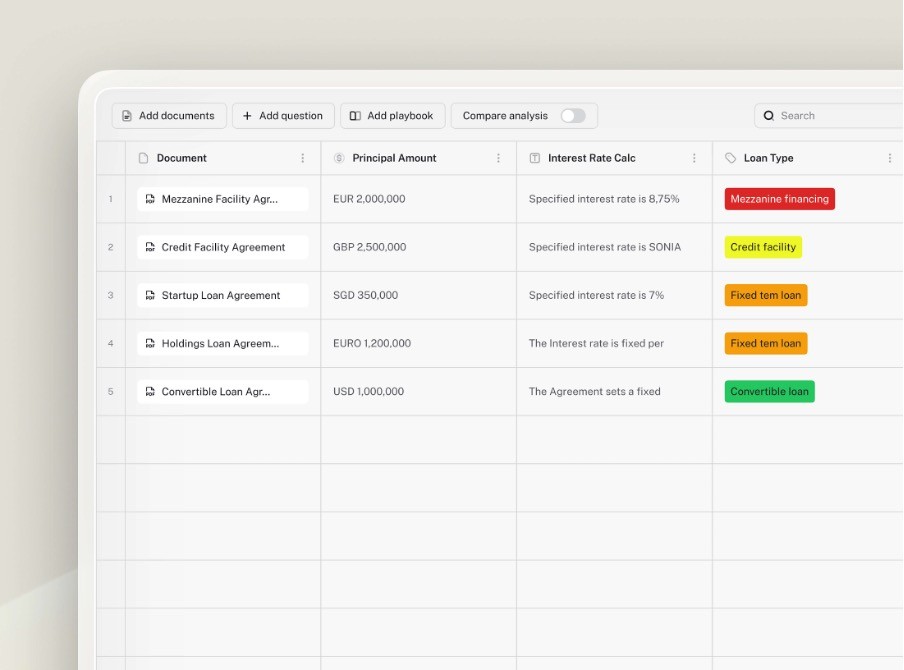
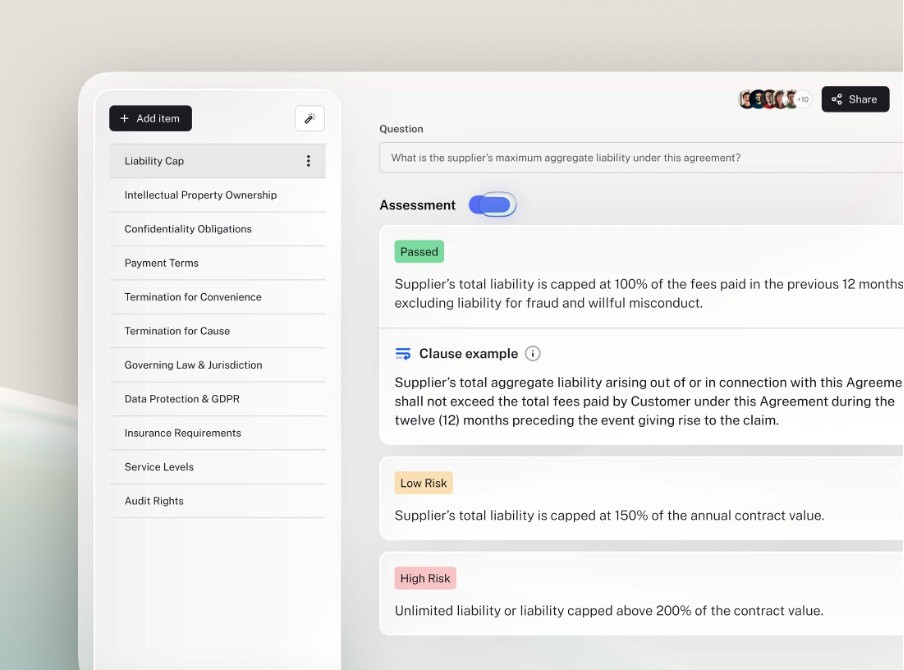
Playbooks built for in-house review, ready from day one
Not all playbooks are created equal. Harvey requires manual playbook creation and does not apply playbooks in its multi-document review. Vault extracts data but does not run risk assessment against your criteria.
LEGALFLY ships with 120+ pre-built playbooks across 100+ document types, built with an AI playbook builder so your team can start reviewing contracts from day one. And unlike the other tools, those playbooks power the multi-document review too. Every document in a batch is assessed against your criteria, not just scanned for fields you nominated.
Anonymisation that protects data before the AI sees it
This distinction is frequently misread, and it matters for regulated industries.
In LEGALFLY, every document is anonymised at import, automatically, before it reaches any AI model. Names, commercial terms, identifiable details are stripped before processing, not after. Harvey has no document anonymisation at all. For financial services, insurance, and healthcare teams handling confidential contracts, LEGALFLY's approach is what makes the platform deployable at all.
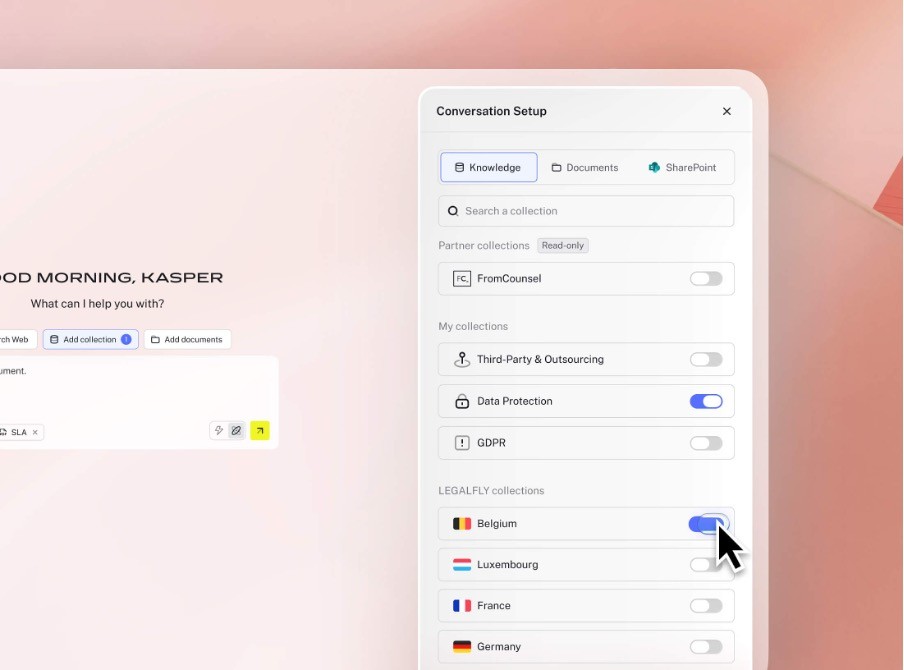
500+ legal sources, directly from the legislative body
LEGALFLY draws from 500+ official legal sources across 60+ jurisdictions, sourced directly from government bodies and legal publishers. Harvey covers 101 sources, with a heavy US focus.
The source quality matters most for regulatory monitoring. LEGALFLY's Legal Radar surfaces regulatory changes directly from official legislative bodies and maps their impact to your contracts and operations. It is built into the platform. Harvey offers reactive checks via its assistant. You have to ask; it does not proactively monitor.
Intake from the tools your business already uses
Harvey takes requests through its chat interface only. LEGALFLY accepts requests via chat, email, Slack, and Microsoft Teams, for every agent task, not just specific functions. Your colleagues can tag LEGALFLY in Slack, forward a contract by email, or open a task from Teams without logging into a separate platform. For enterprise teams managing high volumes of ad hoc requests from business teams, that breadth of intake removes a meaningful friction point.
Which should you choose?
If your organisation runs client-facing legal services, Harvey AI is a capable, firm-centric solution.
If your goal is to empower internal teams, protect sensitive information, and accelerate review cycles without compromising compliance, LEGALFLY is purpose-built for you. Book your personalised demo here.
Use case | Choose | Why? |
|---|---|---|
Large law firms | Harvey AI | Built for firms delivering client-facing legal services across multiple practice areas. |
Corporate legal departments | LEGALFLY | Designed specifically for in-house teams managing contracts, compliance, and operations. |
Highly regulated industries (finance, insurance, government) | LEGALFLY | Offers full data anonymisation, local hosting, and governance reporting. |
Cross-departmental collaboration (procurement, sales, operations) | LEGALFLY | Enables safe self-service and faster approvals across non-legal teams. |
Research-heavy practices (litigation, tax, academic law) | Harvey AI | Strong research and citation tools suited to complex advisory work. |
Contract review and clause comparison | LEGALFLY | Automates clause-level review, deviation detection, and plain-language summaries. |
Regulatory tracking and compliance reporting | LEGALFLY | Legal Radar monitors new regulations and maps them to affected contracts and policies. |
Due diligence and multi-document review | Either solution | Core use case for both solutions allowing you to process 50+ documents at once to extract key terms, risks, and renewals. |
Policy drafting and internal governance | LEGALFLY | Creates consistent, compliant documents from templates with minimal manual input. |
External client advisory work | Harvey AI | Optimised for professional services and client deliverables. |
Cross-border and multilingual legal work | LEGALFLY | LLM-agnostic design adapts to jurisdiction and language requirements. |
AI governance and data privacy control | LEGALFLY | Anonymises all sensitive data before processing, ensuring control and auditability. |
Fast-scaling in-house teams needing automation | LEGALFLY | Delivers speed, accuracy, and control without increasing headcount or risk. |
The bottom line: law firm AI vs in-house legal AI
Both Harvey AI and LEGALFLY are leaders in legal technology, but are designed for different audiences.
Harvey modernises the law firm.
LEGALFLY modernises legal inside the enterprise.
If your priority is speed without losing control, accuracy without exposure, and AI that respects privacy by design, LEGALFLY is the clear choice for 2025 and beyond.
LEGALFLY is the secure legal AI for in-house teams. Get a demo to see how it fits into your workflows.
Note: this information was last updated in Q1 2026. For the most up-to-date view of features, always check with the provider.