








AI contract review software has become a cornerstone for modern legal teams, enabling faster document analysis, improved compliance, and streamlined workflows.
Legora is a well-known solution in this space, offering automated contract analysis and compliance checks. However, as legal operations evolve, many organisations are seeking alternatives that provide deeper integration, greater transparency, and enhanced efficiency.
This guide presents the top Legora alternatives for AI contract review today. Whether your priorities include advanced AI, native Microsoft 365 integration, or compliance controls, this article will help you identify the best solution for your legal team's needs.
Note: If your team is evaluating Legora alternatives, the difference that matters most is not features, it is whether the platform was built for how in-house legal teams actually work. LEGALFLY runs natively in Microsoft Word, applies your playbooks automatically, and anonymises sensitive data before any AI sees it. Book a demo to see why in-house teams at SAP, Lufthansa, and Bosch chose LEGALFLY.
Most teams using LEGALFLY cut their contract review time in half within a few weeks of onboarding. Book a short demo to see how it works for your business.
Key Takeaways (TL;DR)
Who Legora Is For: Law firms and hybrid firm-plus-in-house teams that want a research-led workspace where fee earners drive the AI matter by matter, with a tabular review grid built for diligence and strong depth on case law and precedent.
Why Seek a Legora Alternative: In-house teams look elsewhere when they need workflows that run end to end without someone directing them, visibility over what sits in the contract portfolio, and a product whose roadmap is built around a corporate legal function rather than a firm.
Best Overall Alternative: LEGALFLY. Agent Studio lets legal build comprehensive custom workflows that run from intake to approval on their own, Contract Intelligence shows what sits in the portfolio and what to prioritise next, and the whole business works inside the rules legal set once.
What Sets LEGALFLY Apart: legal builds the workflows once and the whole enterprise runs inside them, procurement, compliance, HR and sales included, on documents anonymised before any AI sees them. No other platform on this list combines both.
How to Choose: Match the platform to your operating context rather than the feature list, get the data handling answer in writing before the security review, and test playbook quality on your own contracts.
Top Legora Alternatives in 2026 at a Glance
Selecting the right AI contract review tool requires a clear understanding of each platform's strengths and ideal users. The table below provides a side-by-side comparison to help legal teams quickly identify the best match for their requirements.
Platform | Best for | Standout features | Pros | Cons |
|---|---|---|---|---|
LEGALFLY | In-house legal, legal ops and procurement at regulated enterprises | Custom agentic workflows via Agent Studio, Contract Intelligence, playbook review, Multi Review, anonymisation, explainable outputs | End-to-end workflows the whole business runs inside; portfolio visibility; anonymisation before analysis | Sales-led evaluation; not built for law firms |
Cicerai | Legal teams needing research-led analysis and negotiation support | Clause and data extraction, automated summaries, document search | Fast extraction and summarisation; accessible without heavy IT | Not built for redlining; limited integrations |
Ironclad | Large legal ops and procurement teams needing end-to-end CLM | Workflow automation, complete CLM, e-signature, analytics | Comprehensive lifecycle coverage; configurable workflows | Months to implement; overpowered for low-volume teams |
LegalOn | Compliance-driven teams in regulated sectors | Compliance checks, risk flagging, clause library, audit reporting | Strong risk flagging; easy to deploy; attorney-curated playbooks | Limited negotiation workflow; features gated to higher tiers |
DocJuris | High-volume contract reviewers in legal and procurement | Bulk review, automated redlining, playbook enforcement, deviation detection | Efficient at volume; strong playbook automation | Dated interface; setup needed to optimise playbooks |
Luminance | Enterprises and firms with complex, multi-jurisdiction portfolios | Machine-learning clause analysis, anomaly detection, visual analytics, multilingual | Powerful analytics; multilingual; surfaces hidden issues | Steeper learning curve; less accessible for smaller teams |
Juro | Growing companies needing fast CLM adoption across legal and business teams | Integrated creation, review and management, e-signature, template drafting | Clean interface; quick onboarding; single tool for all contract processes | Limited advanced AI; scalability limits on complex portfolios |
Why Consider Legora Alternatives?
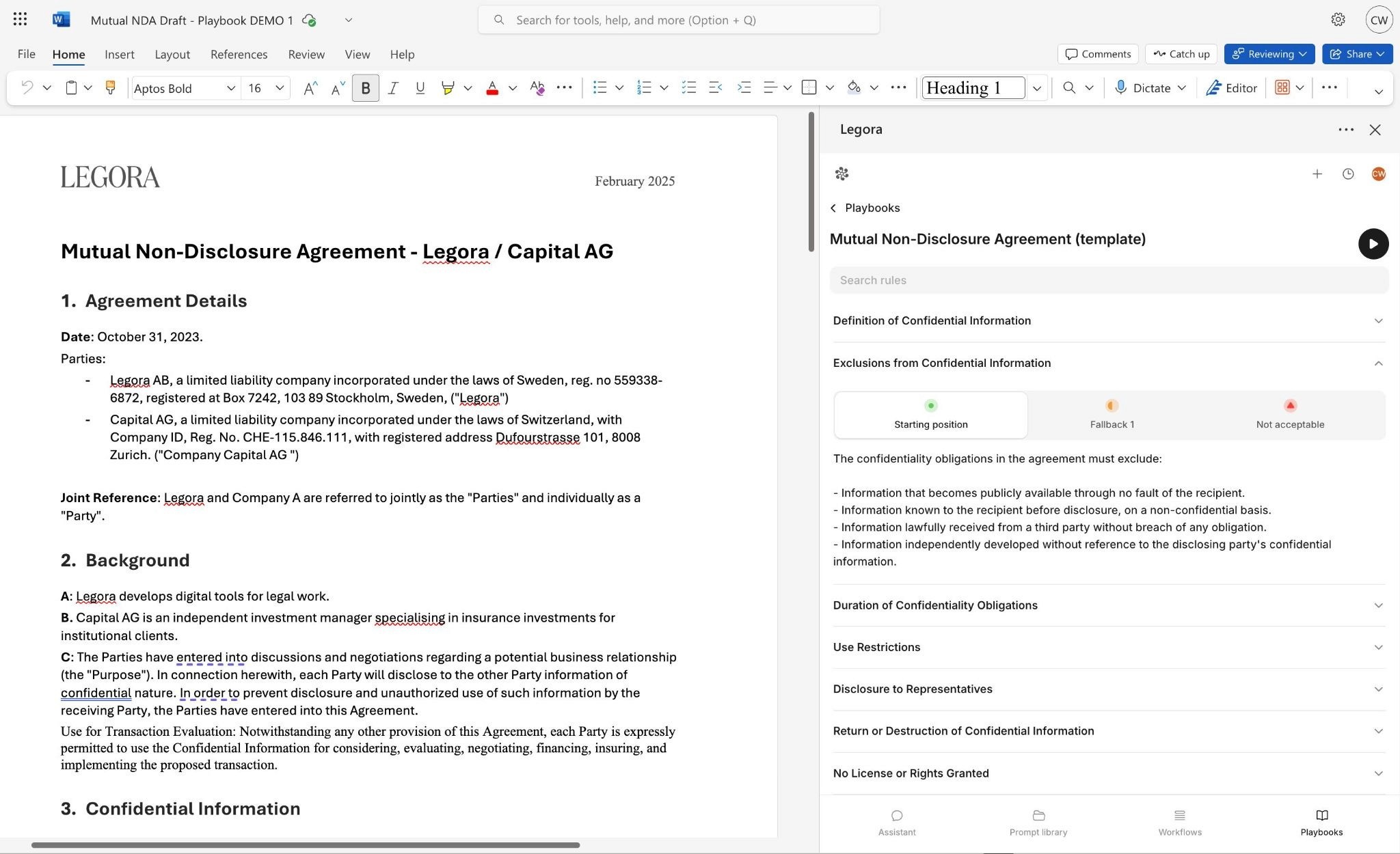
Legora is a serious product with real momentum, and an alternatives page that pretends otherwise is not useful to anyone. The question is not whether it works, it is whether it was built for the job your team is trying to do.
What Legora Does Well
Legora is strongest on research-led work. It reasons across long chains of source material, which is a meaningful capability when the question is open-ended: read the case law, weigh the positions, draft the analysis and iterate on it with the lawyer in the loop.
It also serves both firms and in-house teams from one product, which suits organisations that sit across both, and its tabular review interface is well regarded for high-volume diligence work where the output is a grid of answers across many documents. For a fee earner working matter by matter, that is a natural way to work.
For teams building their legal AI process from scratch, that flexibility is an advantage. There is no assumption about how your review should run, which means nothing to unlearn.
Where Legora Falls Short
The limitation is what happens when nobody is driving. Agentic depth helps most when a capable user is directing the work, and a corporate legal function spends most of its week on requests that should move without anyone directing them at all: the NDA that arrives on a Friday, the vendor agreement waiting on procurement, the portfolio check triggered by a regulatory update.
The second gap is where the data goes. In-house teams in banking, insurance and the public sector are increasingly asked what happens to a document before a model reads it, and platforms that process identifiable data and rely on contractual assurances rather than architecture find that question hard to clear.
The third is scope. Legora is primarily law-firm oriented, so the roadmap reflects how a firm works rather than how a corporate legal function operates, and there is no layer that tells legal what sits in the contract portfolio or what to prioritise next once the reviewing is done.
None of these is a defect. They are the consequences of building for a different buyer, and they are the reason the alternatives below exist.
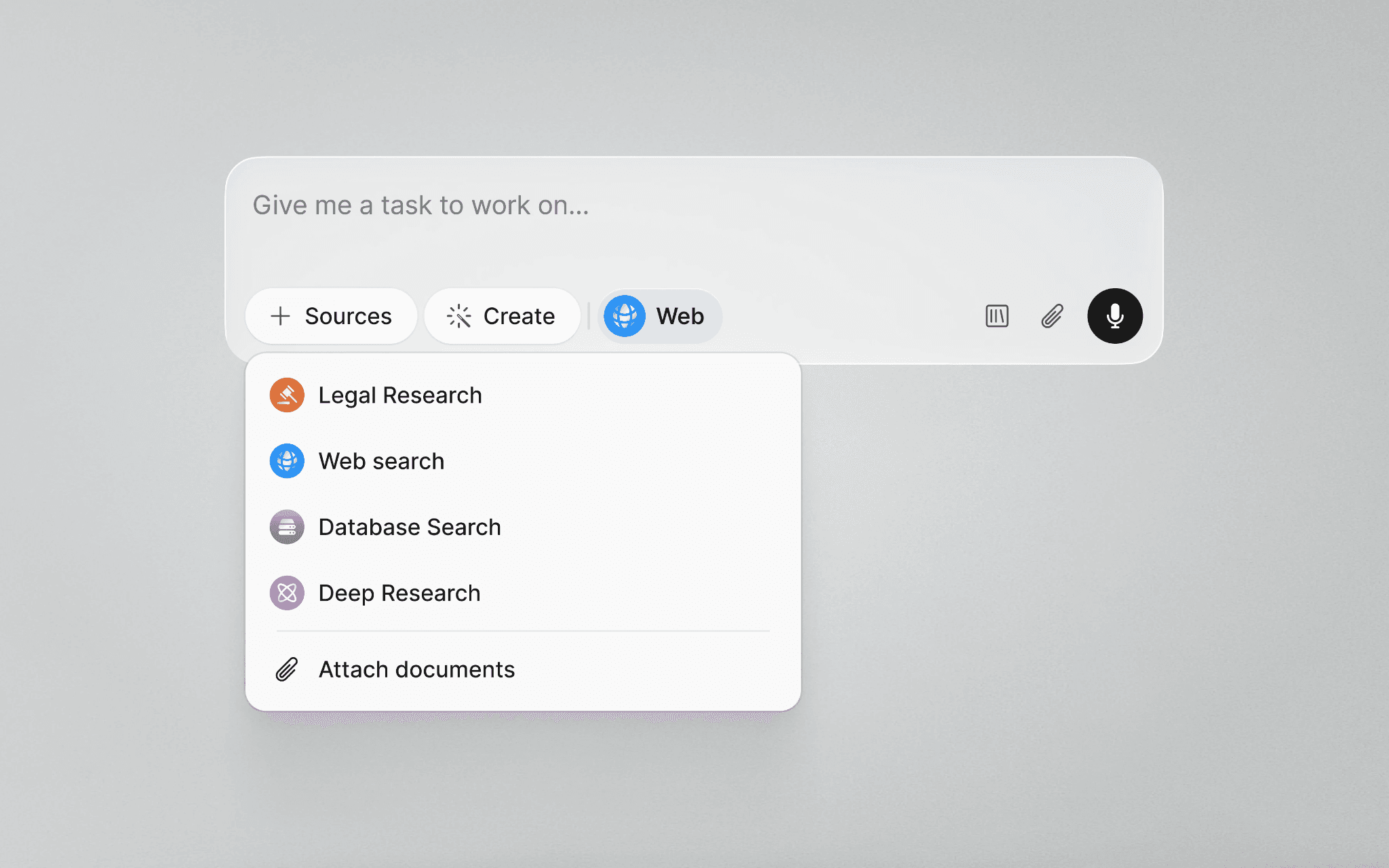
Best Legora Alternative Overall
LEGALFLY is the best overall alternative to Legora for in-house legal teams. Most teams evaluating alternatives are looking for the same thing: a platform that handles the volume of routine legal documents without creating new data risk or forcing a change in how they work.
The difference between platforms that deliver on that and those that do not usually comes down to three things: whether workflows can be built once and then run end to end without anyone driving them, whether legal gets visibility over what sits in the contract portfolio, and whether sensitive data is protected before the AI sees it.
If you compare Legora to LEGALFLY, LEGALFLY addresses all three.
To find out how LEGALFLY could work for you, schedule a call with one of our experts.
Best Legora Alternatives: In-Depth Review & Comparison
Not every Legora alternative is built for the same team.
Some are designed for law firms running due diligence. Others fit into the CLM category, best suited to teams that prioritise document and workflow management over AI capabilities. A few, like LEGALFLY, are built specifically for in-house legal teams at regulated enterprises that need speed, control, and privacy without changing how they work.
The platform that fits your team depends less on features and more on your operating context: your contract volume, your data requirements, and the tools your organisation already uses.
Three scenarios cover most of the teams we speak to.
If you are a Head of Legal at a regulated enterprise standardised on Microsoft 365, you need contract review that lives inside Word, respects your existing approval workflows, and anonymises data before it touches any AI model.
If you are a legal ops lead managing high contract volume across procurement or M&A, you need bulk review, consistent playbook application, and audit-ready outputs without proportional headcount increases.
And if you are a GC at a fast-growing tech company looking for a simple contract view and e-signature tool, you might look at Juro or LegalOn first, then grow into a broader platform as volume and complexity increase.
1. LEGALFLY
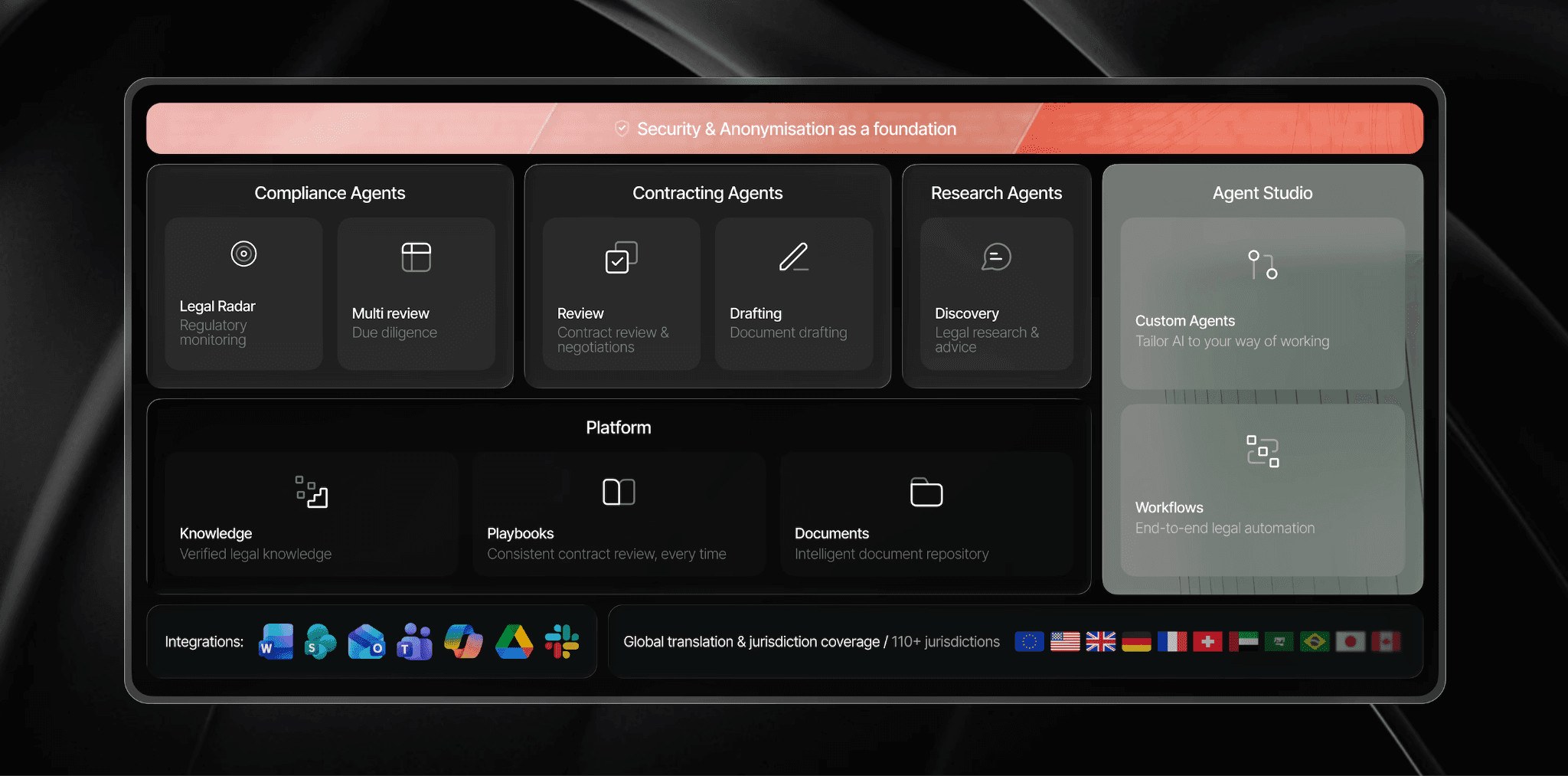
Overview
LEGALFLY is the legal operating system for corporates: AI-native workflows for intake, contract review, drafting, due diligence and research, with security and anonymisation as the foundation underneath all of it. It is built for in-house legal, legal operations and procurement teams at regulated enterprises rather than for law firms, and the product decisions follow from that.
In-house legal teams at SAP, Lufthansa, and Bosch use it to cut contract review time substantially, with every output traceable and every suggested change explained. The European Commission signed in 2026 following a competitive evaluation.
At Agristo, a 1,300-person food processing business managing NDAs, vendor agreements, and purchase contracts across multiple jurisdictions, LEGALFLY reduced contract processing time from around two hours to 15 minutes, an eight-fold improvement, without adding headcount to the legal team.
Ideal For
In-house legal teams, legal operations and procurement departments at regulated enterprises
Organisations standardised on Microsoft 365 that need review inside Word rather than in a new application
Legal operations teams running compliance audits or portfolio reviews at volume
Teams that need playbook-driven review with default anonymisation and an audit trail on every session
Multi-jurisdiction functions where the security review decides the shortlist
Top Features
Playbook-driven review clause by clause against your internal standards, flagging deviations, grading risks and proposing redrafts in your approved language, with 120+ lawyer-built playbooks covering 100+ document types and an AI Playbook Builder that generates a custom playbook from your own golden contracts in minutes
Agent Studio for comprehensive, customisable legal workflow automation: chain agents into multi-step processes, trigger them from email, Teams, Outlook, Slack or a webhook, and set conditional routing, escalation thresholds and legal sign-off at each stage so work moves without anyone directing it
Contract Intelligence for visibility across the contract lifecycle: what you have, what it obliges you to do, and what legal should prioritise next, recently announced and rolling out
AI legal document review across hundreds of contracts at once through the Multi Review agent, applying the same playbook checks at scale, with every finding linked back to its source clause and compiled into an audit-ready summary
AI for legal research grounded in 700+ official sources across 130+ jurisdictions, with plain-English querying and a citation on every answer
Regulatory tracking software monitoring official regulators and publishers across 70+ jurisdictions and testing impact against your own contracts and policies
Runs inside Microsoft Word with integrations across SharePoint, Teams, Slack, Outlook and Copilot, so non-legal teams can trigger a workflow from wherever they already work
Anonymisation applied at import, ISO 27001 and SOC 2 Type II certified, with single-tenant deployment and on-premises anonymisation for organisations with stricter requirements
LEGALFLY helps your team move faster: less time buried in contracts, more time on the work that actually matters. Book a call to see it in action.
How Contract Review Works in LEGALFLY
Here is how in-house legal teams move from receiving a contract to a reviewed, redlined, audit-ready output, without leaving Word or compromising on control.
Step 1: Import the contract into Word
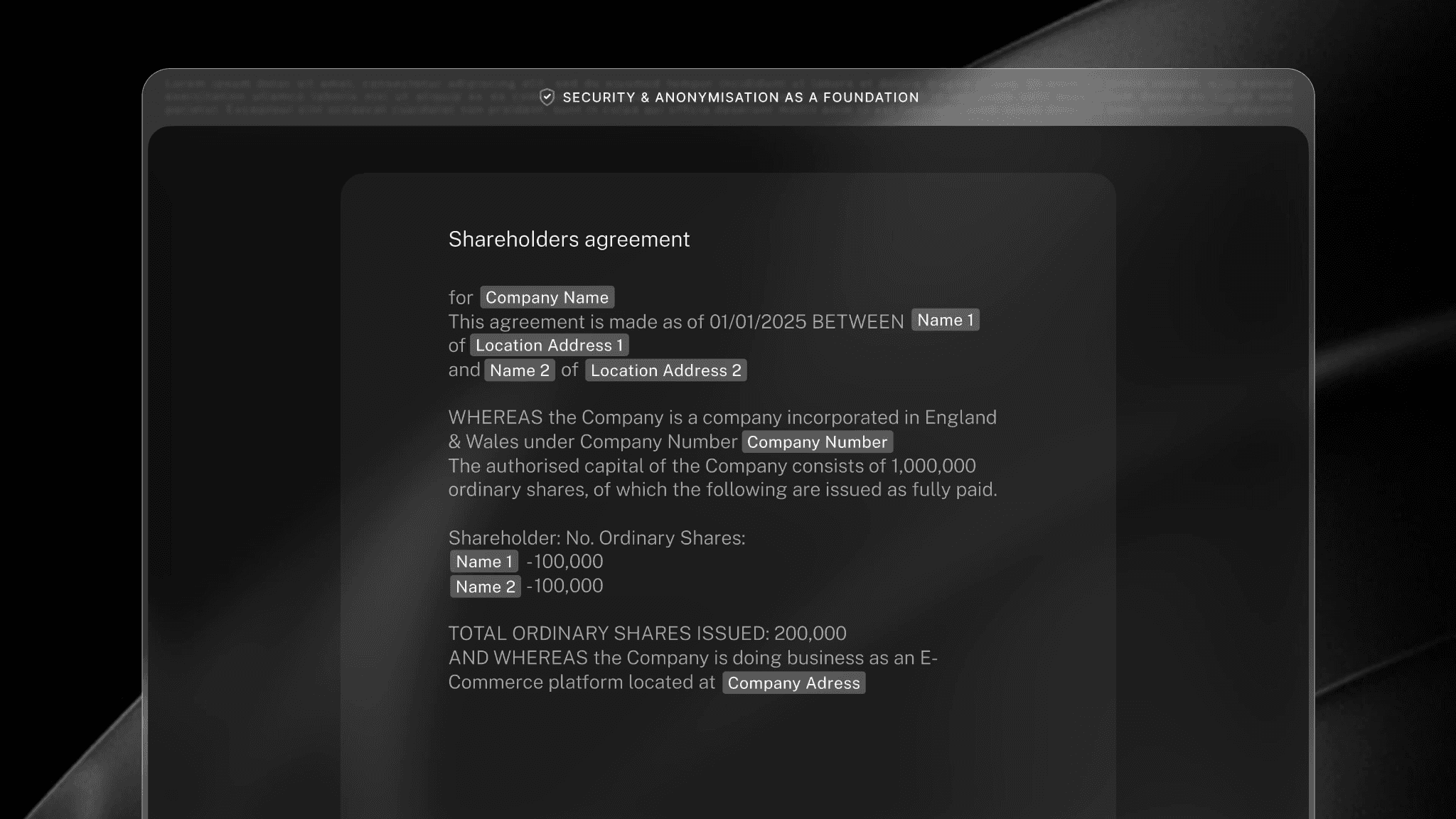
Open the document inside Microsoft Word using the LEGALFLY add-in, or pull it directly from SharePoint, Outlook, or Teams. Sensitive data is anonymised automatically before any AI processing begins, no manual redaction required.
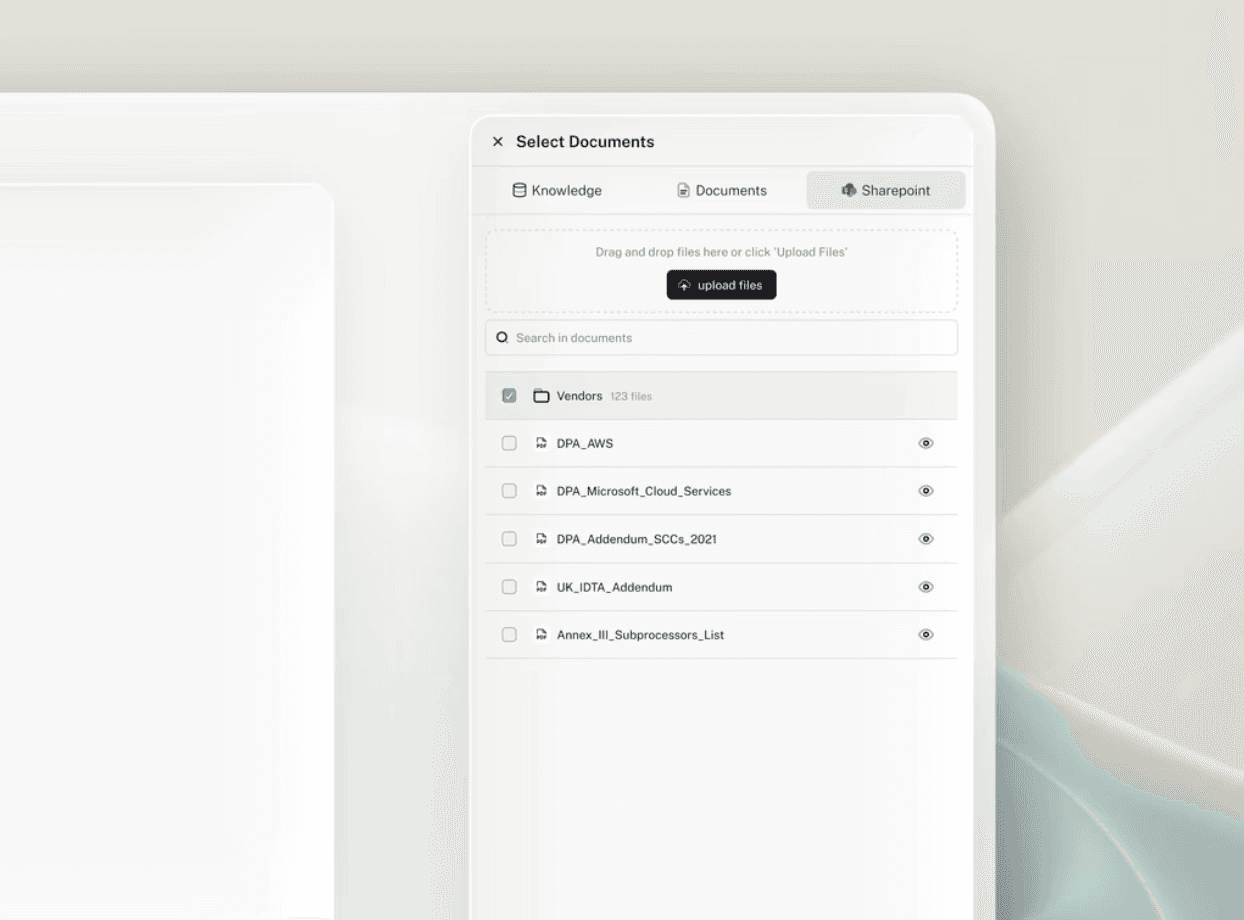
Step 2: Select your playbook
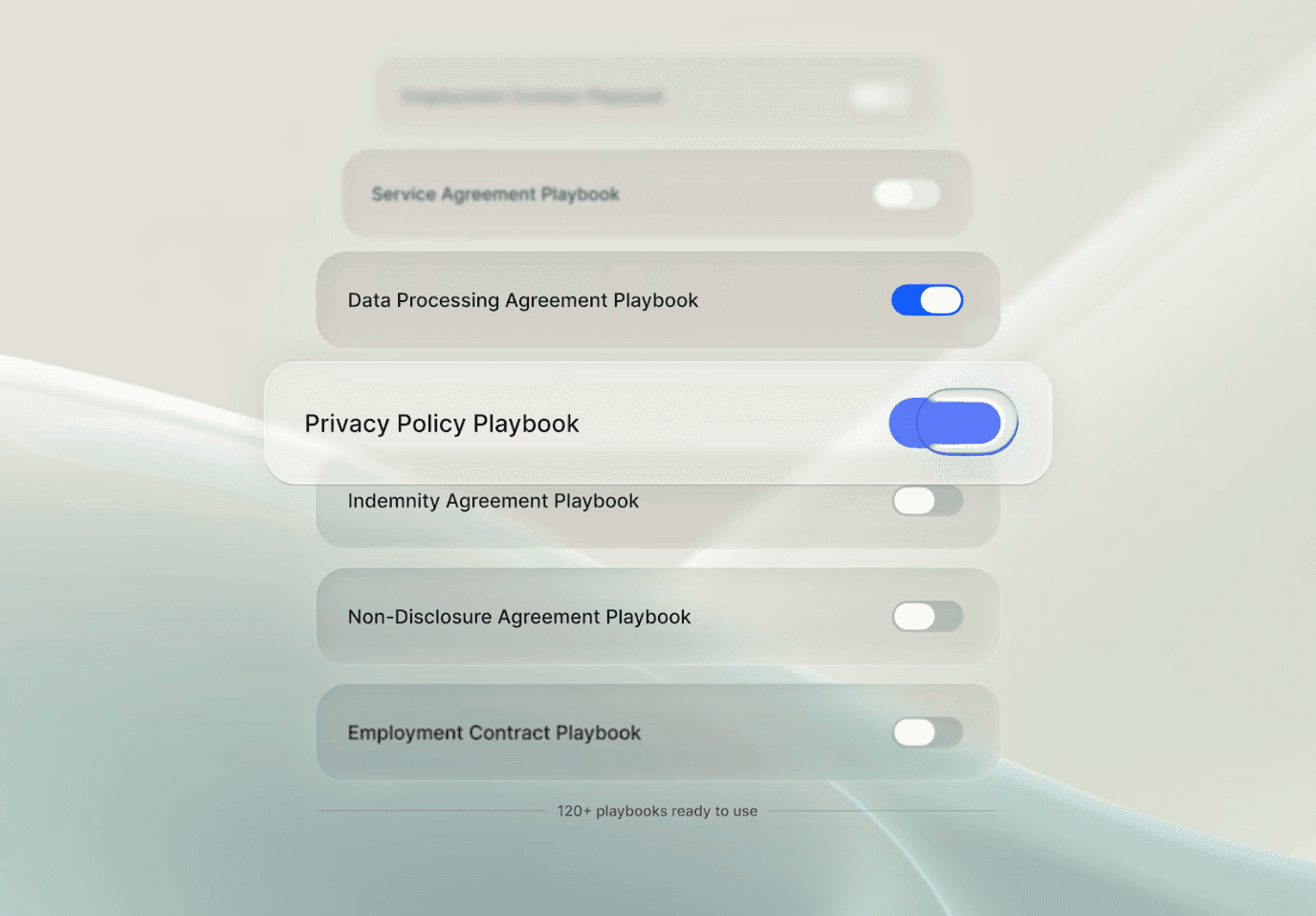
Choose from 120+ pre-built playbooks or apply a custom playbook built from your own approved contracts. Your fallback positions, risk thresholds, and escalation rules are applied from the start, before a single clause is analysed.
Step 3: Run the review
LEGALFLY analyses the contract clause by clause against your playbook. Deviations are flagged, risks are graded, and non-compliant clauses are redrafted in your approved language, mapped to your standards, not generic benchmarks.
Step 4: Review tracked changes with rationale
Every suggested edit appears as a tracked change in Word with a plain-language explanation tied to a specific playbook rule. Your lawyers accept, reject, or override each suggestion. Final judgment stays with you.

Step 5: Route for approval or let teams self-serve
Contracts meeting your thresholds progress automatically. Those exceeding defined risk levels are escalated through your configured approval chain. Routine legal documents can be handled by non-legal teams within the guardrails legal sets.
Step 6: Export with a full audit trail
Export a clean redline for negotiation or a finalised version for execution. Every session is logged, what was reviewed, what was flagged, and on what basis, meeting the compliance and explainability requirements of regulated industries.
See how in-house teams are cutting contract review from two hours to 15 minutes. Book a demo with one of our experts.
Why We're the Best Legora Alternative
LEGALFLY combines privacy-first anonymisation, native Microsoft 365 integration, and explainable AI to deliver fast, compliant contract review without changing existing legal workflows. Legal teams retain full control and visibility with audit-ready outputs, enterprise-grade security, and customisable playbooks that scale from single documents to high-volume operations.
Against Legora specifically, the difference is how far the workflow runs on its own.
Agent Studio lets legal build comprehensive custom workflows that trigger from an email, a Teams message or a webhook, route by contract type and risk level, escalate on threshold and notify the right person, with legal sign-off wherever it is needed. Nobody has to be at the keyboard for the work to move.
The second is visibility. Contract Intelligence gives legal a view across the contract lifecycle, what has been signed, what it commits the business to and what needs attention next, so the function is not only faster at reviewing but able to see where the risk actually sits.
The third is reach. Legal AI usually stops at the legal department. Those same workflows extend to procurement, compliance, HR and sales, so the people who generate the requests can move their own work inside rules legal wrote once, and anything outside standard parameters routes back automatically. Underneath all of it, every document is anonymised before any AI processing begins.
To find out how LEGALFLY could work for you, schedule a call with one of our experts.
Pros
Comprehensive, customisable agentic workflows that run end to end from intake to approval without manual coordination
Contract Intelligence for visibility across the portfolio and what to prioritise next
The whole business works inside legal's rules: procurement, compliance, HR and sales included
Default anonymisation, built into the architecture, not optional
Explainable AI with full audit trails for every decision
120+ pre-built playbooks ready from day one, plus an AI Playbook Builder that generates a custom one from your own golden contracts in minutes
Cons
Sales-led, so evaluation starts with a demo and a scoping conversation rather than a self-serve sign-up
Best value for teams with consistent contract volume
AI outputs still require human oversight
Final Verdict
If you are leaving Legora because you need review governed by your own standards rather than directed case by case, and because the security question has to be answered architecturally rather than contractually, LEGALFLY is the closest direct answer on this list.
It is the wrong choice for a law firm that needs matter management and billing alongside review, and for teams with occasional rather than consistent contract volume. Both are better served elsewhere on this list.
To find out how LEGALFLY could work for you, schedule a call with one of our experts.
2. Cicerai
Overview
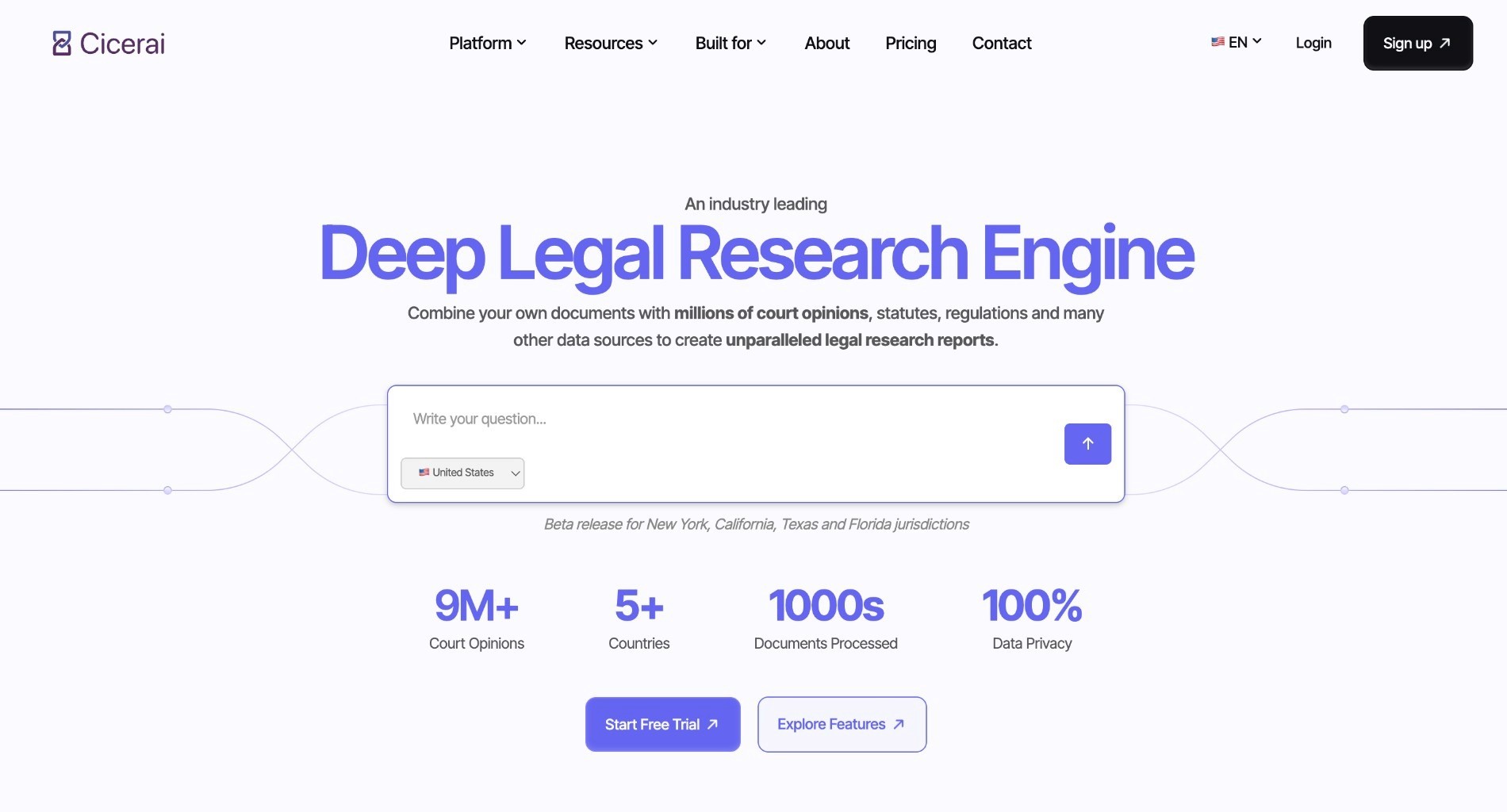
Cicerai is an AI-powered document analysis platform designed for legal teams that need faster review, research, and insight extraction from contracts and other legal documents. It focuses on identifying key information, summarising terms, and supporting compliance and due-diligence workflows.
The product sits closer to research than to negotiation. Its strength is reading a document you did not write and telling you quickly what is in it, which is a different job from enforcing a position across a contract population.
Ideal For
Legal teams that need AI-powered legal research across case law, statutes, and regulations
Corporate counsel reviewing third-party documents
Due diligence and contract analysis in law firms
Teams needing efficient research and compliance checks without CLM automation
Firms without heavy IT infrastructure to support a platform rollout
Top Features
AI-driven clause and data extraction from uploaded documents
Automated summaries and issue flagging
Document search and organisation for faster review
Tools to support compliance reviews and due diligence
Natural-language querying across contracts and legal sources
Why It's a Strong Legora Alternative
Cicerai helps legal teams quickly surface the most important information in contracts and other documents, reducing manual reading time while supporting consistent, research-driven review.
For teams whose use of Legora was mostly research and document understanding rather than governed review, it is one of the more direct swaps on this list, and it does not require the infrastructure a full platform assumes.
Pros
Fast extraction and summarisation for efficiency
Useful for legal research and due-diligence workloads
Accessible for firms without heavy IT infrastructure
Easy-to-use natural-language interface
Cons
Not designed for negotiation or redlining workflows
Limited integrations compared with full CLM platforms
Less suited to high-complexity enterprise contracting needs
No anonymisation before processing
Final Verdict
Cicerai is a smart choice for legal teams whose primary need is deep research and document understanding, particularly in firms and corporate counsel functions reviewing third-party paper.
It is not a governed review platform. Teams that need playbook enforcement, redlining or workflow automation will find the scope too narrow and should look at the entries below.
3. Ironclad
Overview
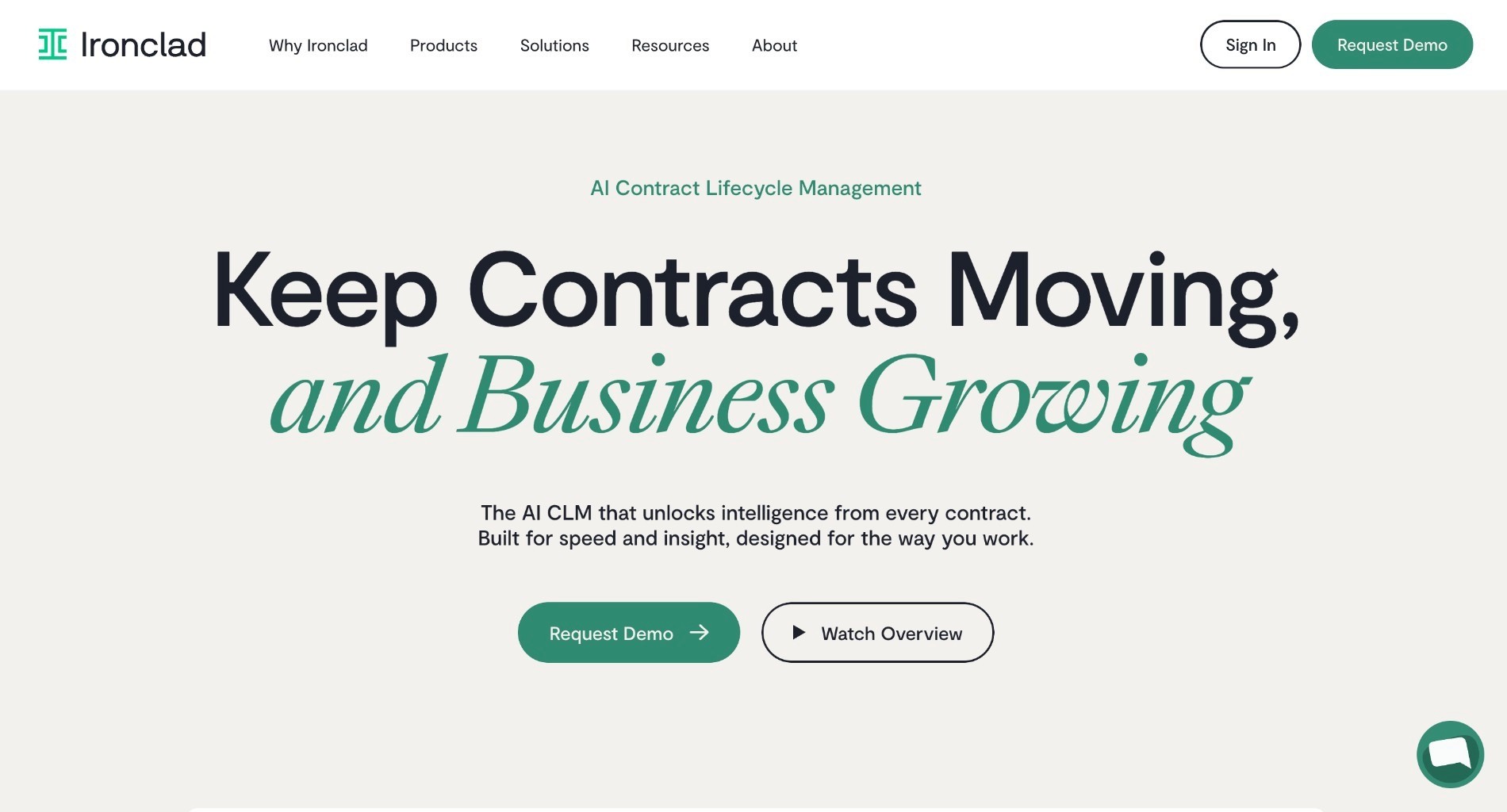
Ironclad is a leading contract lifecycle management platform that combines AI-powered review with robust workflow automation, helping large organisations centralise contract creation, negotiation, and execution end-to-end.
It is a system of record first and an AI product second. That is a genuine and valuable job, and Ironclad does it as well as anyone, but it is a different job from making a first-pass review faster.
Ideal For
Large enterprise legal and procurement teams that need end-to-end contract lifecycle management
Large legal operations managing complex workflows
Enterprises seeking centralised CLM, review and reporting in one system
Teams needing standardised and auditable processes across departments
Top Features
Automated review and approval workflows with conditional logic
Integrated CLM with built-in e-signature
Clause library and standardised templates
Real-time collaboration for legal and business teams
Contract analytics and obligation tracking
Why It's a Strong Legora Alternative
Ironclad is ideal for enterprises that want to unify contract operations into a single system, reducing manual handoffs and improving visibility across every stage of the lifecycle.
If your frustration with Legora is that individual outputs improved but contracts still move through the business by email, a CLM answers the other half of that problem. Intake, approvals, signature, storage and renewals become governed steps rather than threads.
Pros
Comprehensive end-to-end contract management
Highly configurable workflow automation
Strong collaboration across legal and business teams
Deep integrations with the commercial stack
Cons
Overpowered for smaller or low-volume teams
Implementation can take several months
AI review depth sits behind AI-native platforms
No anonymisation before processing
Final Verdict
Ironclad is the right answer when the problem is the contract lifecycle itself, across several departments and a large executed portfolio, and when consolidating systems is a goal in its own right.
If the problem is the quality and speed of the review, a review-first platform gets you further and can run alongside a CLM rather than replacing it. Many enterprises end up with both.
Compare Ironclad AI vs LEGALFLY.
Most teams using LEGALFLY cut their contract review time in half within a few weeks of onboarding. Book a short demo to see how it works for your business.
4. LegalOn
Overview
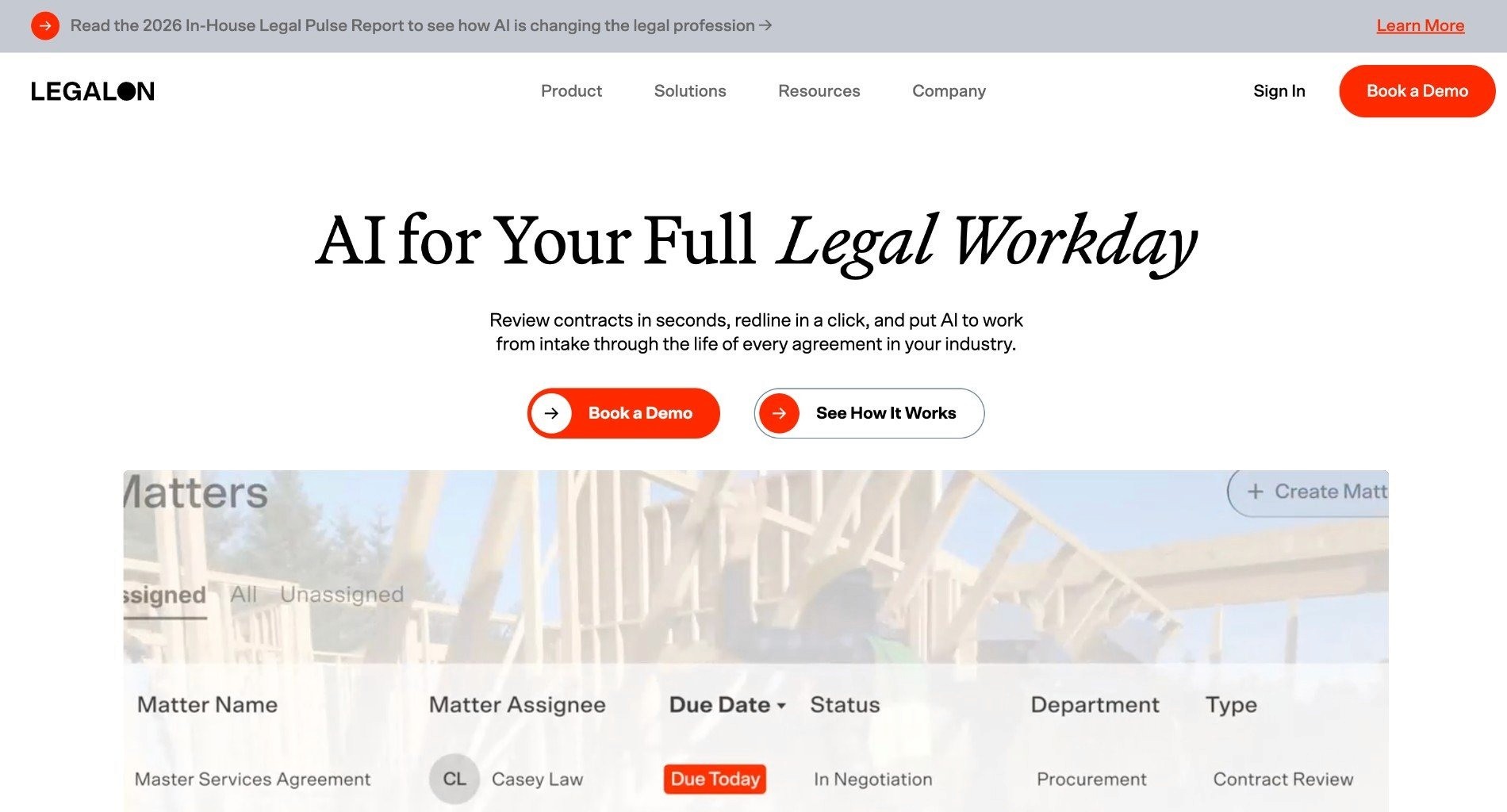
LegalOn is built for compliance-oriented contract review, combining AI-driven risk flagging with a robust clause library and audit reporting. It helps teams in regulated industries enforce policy, reduce risk, and maintain consistent compliance standards.
Its defining choice is the attorney-curated playbook library. Rather than asking a team to encode its standards before getting value, LegalOn ships positions written by lawyers and lets you adjust from there, which shortens time to first useful review considerably.
Ideal For
In-house legal teams that want AI-powered contract review with attorney-curated playbooks, ready to use from day one
Compliance-driven legal teams in regulated sectors
Financial services, healthcare, or other industries with strict contract standards
Organisations needing consistent, auditable compliance checks on contracts
Top Features
AI-based compliance and risk checks
Extensive clause library and template management
Automated redlining and deviation detection
Audit-ready reporting and review trail
Why It's a Strong Legora Alternative
LegalOn is especially suited to organisations operating under strict regulatory or compliance demands, offering reliable risk detection and compliance oversight with minimal complexity.
For teams leaving Legora because they wanted a standard applied consistently rather than a capable generalist, LegalOn answers that directly, and the shipped playbooks mean a real review can run on day one rather than after a configuration project.
Pros
Strong risk flagging and compliance support
Easy to use and deploy
Good for consistent, policy-driven contract review
Attorney-written content maintained by an in-house legal team
Cons
Limited support for advanced negotiation workflows
Some useful features sit on higher tiers
Integration surface is narrower than platform competitors
No anonymisation before processing
Final Verdict
LegalOn is one of the smartest choices for compliance-driven in-house teams that want consistent, auditable review without a long implementation.
Teams needing negotiation workflow depth, portfolio-scale analysis or workflow automation beyond the review itself will find the scope limiting, and should compare it against the platform entries on this list.
5. DocJuris

Overview
DocJuris is designed for high-volume commercial contract review, helping legal and procurement teams rapidly apply playbooks, automate redlines, and manage large portfolios with efficiency.
It targets a part of the process most tools ignore: the back and forth after the first review. Turn tracking, deviation status and cross-functional visibility are the core of what it does, which suits procurement-heavy organisations where an agreement passes between several approvers before anyone signs.
Ideal For
Legal and procurement teams that need structured contract negotiation and redlining workflows, with fast implementation
Law firms and in-house teams reviewing high volumes
Procurement and vendor onboarding operations
M&A due diligence and portfolio review
Top Features
Bulk contract review with automated redlining
Playbook enforcement and fallback logic
Integration with Microsoft Word and major CLMs
Deviation detection for faster approvals
Why It's a Strong Legora Alternative
Its workflow and automation strengths make DocJuris a strong fit for teams handling large batches of contracts during vendor onboarding, procurement cycles, and M&A due diligence.
Where Legora is built around depth on a single matter, DocJuris is built around throughput across many, which is the more common in-house shape once procurement volume is included.
Pros
Very efficient for large contract volumes
Strong playbook-driven automation
Good compatibility with existing workflows
Cross-functional visibility across procurement, finance and legal
Cons
Interface feels dated compared with newer platforms
Requires setup to optimise playbooks and routing
Needs a documented playbook before it delivers value
No anonymisation before processing
Final Verdict
DocJuris suits teams whose bottleneck is the negotiation rather than the first read, particularly where procurement leads and legal advises.
Teams looking to cut first-pass review time or needing research and regulatory monitoring alongside review will get more from a broader platform.
6. Luminance
Overview
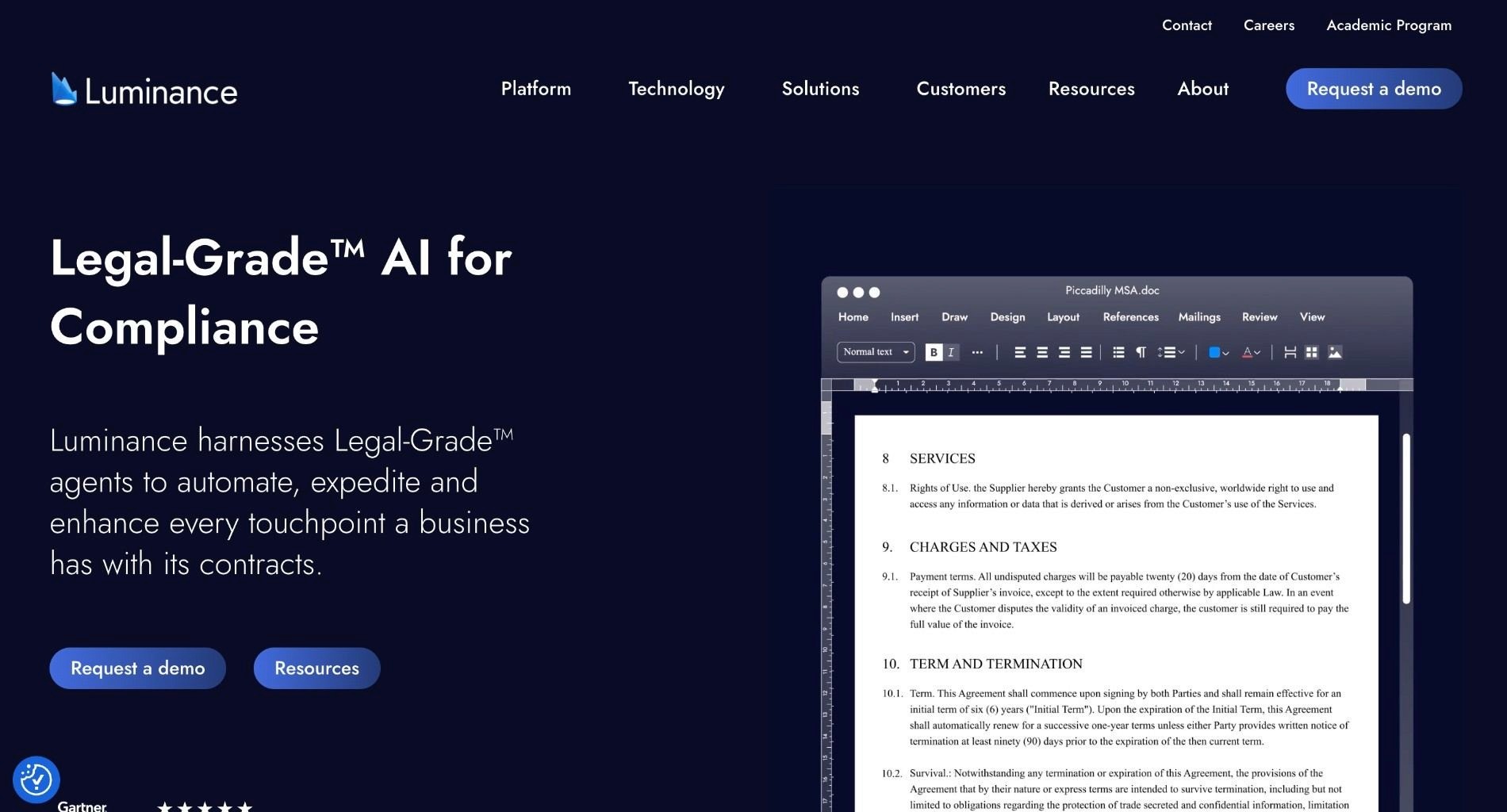
Luminance delivers advanced AI-driven analytics and anomaly detection, making it well suited for organisations managing complex, data-rich contract portfolios, especially where contracts vary widely in structure, jurisdiction, or language.
Founded in 2015, it predates the current generation of legal AI, and that shows in what it is best at: reading a large body of documents nobody has seen before and surfacing what is unusual in them.
Ideal For
Enterprises and law firms that need AI-powered contract review and portfolio-wide contract intelligence at scale
Global legal teams managing contracts across multiple jurisdictions
Organisations with complex or non-standard contract portfolios
Situations requiring in-depth analytics rather than clause flagging alone
Top Features
Machine-learning-based clause analysis and anomaly detection
Visual analytics dashboard for contract trends and patterns
Multilingual support for global contract sets
Integration with document management systems for large-scale review
Why It's a Strong Legora Alternative
It is favoured by organisations that need deep insight into complex or varied contracts, where human review is not scalable and analytics can reveal hidden risks, patterns, and compliance issues across a large corpus.
Against Legora it trades reasoning depth on a single document for visibility across thousands, which is the better trade when the question is what is in the portfolio rather than what this clause means.
Pros
Powerful visual analytics and risk detection
Multilingual capabilities for international teams
Useful for uncovering hidden issues in complex contracts
Established presence in enterprise and law firm environments
Cons
Steeper learning curve to leverage advanced analytics properly
Less accessible for smaller teams. Explore other Luminance options here
Not embedded in Microsoft 365, so it sits outside daily workflow
Less focused on playbook-driven redlining of individual contracts
Existing internal link to the Luminance alternatives page kept, with the pricing reference removed from the surrounding sentence.
Final Verdict
Luminance is one of the stronger options for reviewing a large body of contracts you did not write, especially across languages and jurisdictions where an unfamiliar clause is easy to miss.
Day-to-day negotiation inside Word is not where it does its best work. Teams whose bottleneck is throughput on routine paper will find a Word-native platform fits better.
Compare Luminance versus LEGALFLY head-to-head here.
7. Juro
Overview
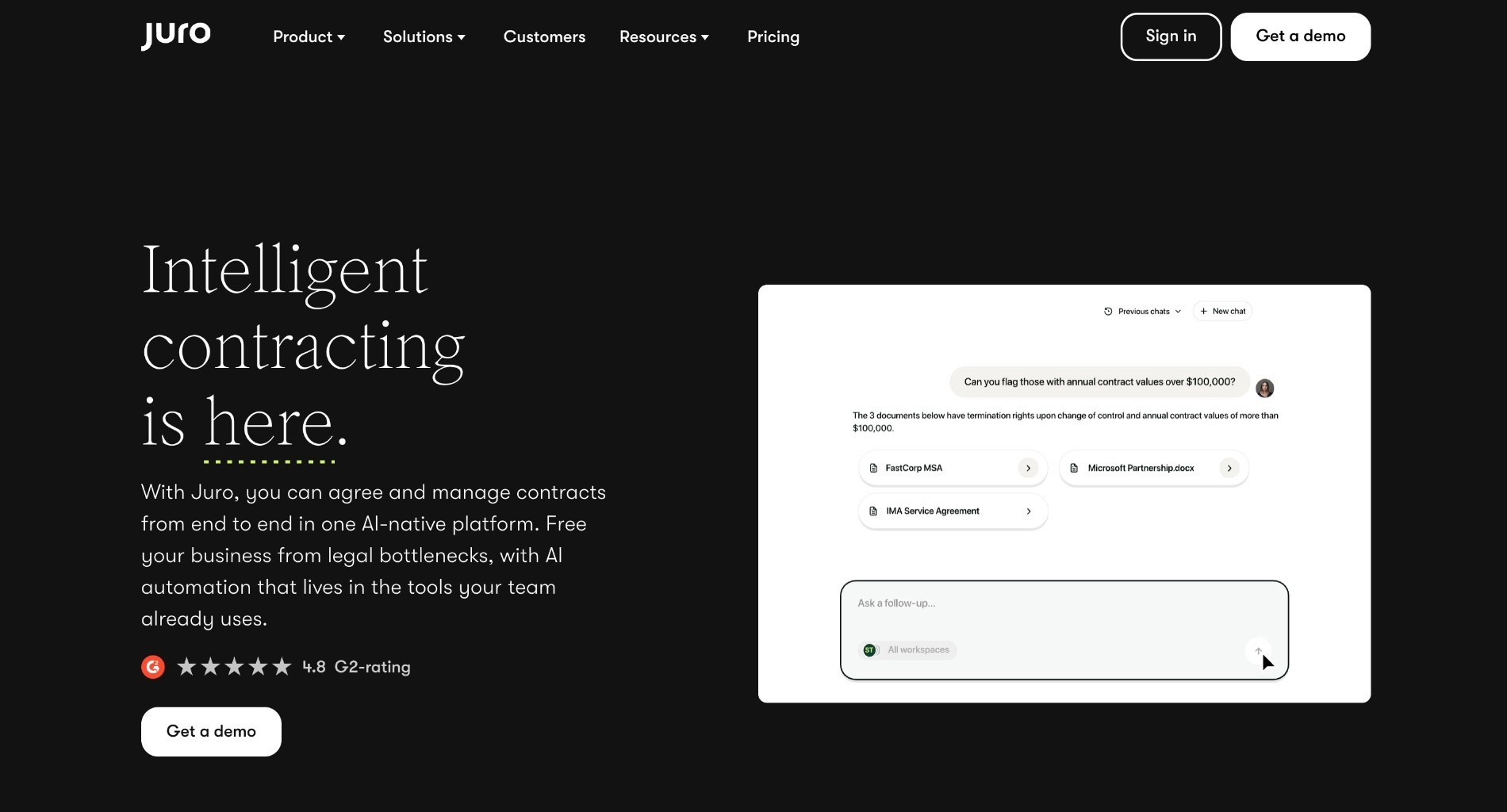
Juro is an all-in-one CLM and AI platform designed for fast-growing teams and small to mid-sized businesses. It combines contract drafting, review, and management in a single user-friendly system, ideal for teams needing simplicity and speed without complex infrastructure.
The product is browser-native rather than Word-native, which is a deliberate bet: business teams do not live in Word, and Juro is designed so a sales manager or recruiter can raise, send and track an agreement without legal in the loop for routine paper.
Ideal For
Growing companies that need fast CLM adoption across both legal and business teams
SMBs or fast-growing teams needing lightweight contract management
Organisations seeking an all-in-one solution without high overhead
Teams with relatively low contract volume and simpler workflows
Top Features
Integrated contract creation, review, and management
Built-in e-signature and workflow automation
Template-driven drafting with standard clause libraries
Simple interface optimised for non-legal users
Why It's a Strong Legora Alternative
It delivers an efficient, modern, and intuitive contract management experience, enabling teams to handle contract creation and execution end-to-end without needing deep legal or technical resources.
For a small team that found Legora more platform than the workload justified, Juro is the more proportionate answer, and it consolidates several tools into one subscription along the way.
Pros
Clean, modern and intuitive interface
Quick onboarding and easy adoption
Good for small teams needing a single tool for all contract processes
Removes several vendors from a mid-market contract stack
Cons
Limited advanced AI capabilities compared with enterprise-grade tools
May lack scalability for very large or complex contract portfolios
Browser-native editing is a change of habit for lawyers committed to Word
No anonymisation before processing
Final Verdict
Juro is a sensible single-vendor answer for growing companies whose contracts are mostly standard and whose goal is to get business teams self-serving quickly.
Regulated enterprises with data residency requirements and teams negotiating everything in tracked changes will outgrow it, and should look at the platform entries above.
Why LEGALFLY Works Across Multiple Use Cases
The reason a platform fits is rarely the feature list. It is whether the way it works matches the way the team already works. Here is where that shows up.
LEGALFLY for In-House Legal Teams
A team of 3 to 200 supporting a multi-jurisdiction enterprise has a queue problem rather than a capability problem. Contracts arrive faster than they clear, and the same clause gets a different answer depending on who picked it up and when.
Playbook-driven review fixes both at once: the standard is applied uniformly and the volume gets absorbed, with every decision carrying the rule it was based on. That is what makes an accepted position defensible six months later.
LEGALFLY for Legal Operations
Legal ops runs the evaluation and defends the shortlist to both the General Counsel and the CISO. The failure mode is a tool that passes the demo and fails the security review in month four.
Anonymisation before analysis, single-tenant and on-premise deployment options and a full audit log on every session are what make that review survivable. Bulk review across a portfolio then gives legal ops the reporting layer that justifies the spend internally.
LEGALFLY for Procurement Teams
Procurement owns the contracts that wait longest in the legal queue, and the wait is rarely about risk. Standard vendor paper sits behind negotiated agreements because there is one queue and one set of reviewers.
With approved positions encoded once, procurement clears standard paper without a lawyer touching it and routes only genuine deviations. Supplier lead times drop without anyone loosening the standard.
LEGALFLY for Compliance and Risk Teams
Teams working against the EU AI Act, DORA, NIS2, CSRD and CSDDD need to know what changed, which of their own documents it touches, and be able to prove they acted.
Monitoring across 130+ jurisdictions removes the one-or-two-jurisdictions-per-person ceiling, and because impact is tested against your own contracts the output is a list of documents to fix rather than a newsletter to read.
LEGALFLY for M&A and Due Diligence
Diligence is a volume problem with a deadline attached. The deliverable is not a better read of one agreement, it is a defensible view across several thousand.
Multi Review applies one playbook across a whole data room, ranks findings by deviation severity and compiles an audit-ready summary with each finding linked to its source clause, so the review is reproducible rather than a snapshot of what someone noticed.
What Makes a Good Legora Alternative?
Legora is capable, so an alternative that is merely capable is not a reason to switch. These are the criteria that decide it.
1. It Applies Your Standard, Not Its Own Judgement
Prebuilt playbooks get you started. Your own approved positions are what make the output usable, and the difference shows up immediately in how many suggestions your lawyers accept without editing.
Ask whether the vendor can generate a playbook from your existing golden contracts, and ask who updates a position when it changes. The maintenance question is rarely asked in a demo and always matters afterwards.
2. It Protects Data Before the Model Sees It
Get the answer in writing before the shortlist closes. Is data anonymised before analysis or after, where is it processed, and can the anonymisation component run inside your own environment?
This is the question that most often ends an evaluation late in the cycle. Asking it in week one turns the security team into a participant rather than a veto.
3. It Lives Inside Microsoft 365
Review happens in Word and starts in Outlook or a document system. A tool that requires a separate window adds a step to every review, and that step is where adoption quietly dies.
Confirm the Word add-in, your document system and your storage layer before the pilot rather than after. A tool that only reads uploads is creating work rather than removing it.
4. It Scales Past the Single Document
Most legal AI demos show one contract. The in-house reality includes compliance sweeps, portfolio checks and diligence, where the question is what is true across hundreds of agreements at once.
Check that bulk review exists, that it applies the same playbook consistently across a batch, and that the output is an audit-ready summary rather than a list of files to open individually.
5. It Explains Itself
A flag without a reason creates work instead of removing it. Every flagged clause should carry the rule it breached, the source behind it, and a record of what the reviewer decided next.
In regulated industries that trail is the difference between a tool you can deploy and one your compliance function will not sign off. Ask to see the log, not the dashboard.
LEGALFLY helps your team move faster: less time buried in contracts, more time on the work that actually matters. Book a call to see it in action.
How to Choose the Right Legora Alternative for Your Needs
Selecting the right AI contract review platform involves a careful assessment of your team's needs and the capabilities of each tool. Work through the factors below in order; the first two eliminate more shortlisted tools than the rest combined.
1. Start With Your Document Mix
Count what actually arrives. If most of the volume is NDAs, DPAs and vendor terms, you need playbook depth and throughput on repeatable paper. If most of it is bespoke and heavily negotiated, extraction quality and reasoning matter more than speed.
Buying for the wrong half of that split is the most common evaluation mistake in this category, and it is not recoverable with configuration.
2. Check Feature Depth Against the Work You Actually Do
Redlining, clause extraction and compliance checks are the baseline. What separates platforms is whether those capabilities are governed by your standards or applied generically, and whether they hold up across the document types you handle most.
Test on your three most common agreements rather than the vendor's sample set, and measure the share of suggestions your lawyers accept without editing.
3. Confirm Compliance and Data Handling
Data privacy, audit trails and regulatory alignment are non-negotiable for regulated teams. Certification is the baseline: every serious vendor holds ISO 27001 and SOC 2 Type II, so it does not separate anyone.
What separates them is what happens to the document before the model reads it, and whether single-tenant or on-premise deployment is available when data residency is a requirement.
4. Test the Integrations Your Team Already Opens
Microsoft Word, SharePoint and your CLM or document management system are where the work already lives. Integration depth determines whether a platform reduces steps or adds them.
Confirm this before the pilot rather than after. If your contracts sit in SharePoint or NetDocuments, a tool that only reads uploads is creating manual work it was bought to remove.
5. Check Workflow Automation and Scalability
Review, approval and negotiation efficiency depend on what happens between the steps, not just inside them. Ask to see a workflow triggered from an email or a Teams message and run end to end during the demo.
Then check it scales: batch review, consistent application across regions and reviewers, and structured workflows that avoid bottlenecks as contract load grows.
6. Weigh Support, Onboarding and Accuracy Together
Training, onboarding and ongoing assistance separate platforms more than features do, and none of it shows up in a demo. Ask for two references at your size and ask them what happened the last time something broke.
Accuracy belongs in the same conversation, because reliable, explainable risk analysis depends as much on how well the platform was configured as on the model behind it.
Everything You Need to Know About Legora Alternatives
Category | Key considerations |
|---|---|
Top 3 alternatives | LEGALFLY for governed in-house review with anonymisation, Ironclad for end-to-end contract lifecycle management, LegalOn for compliance-driven review with ready-made playbooks |
Best overall option | LEGALFLY. Playbook-driven review inside Microsoft Word, anonymisation before analysis begins, and workflow automation that extends legal's rules to procurement, compliance and sales |
Why look for Legora alternatives | In-house teams need review governed by their own playbooks, data protected before the model sees it, and workflows that reach beyond the legal department |
How to choose | Match the platform to your operating context rather than the feature list, get the data handling answer in writing, and test playbook quality on your own contracts |
Ease of switching | Days rather than months for platforms that run inside Microsoft 365, since there is no repository to migrate. Full CLM platforms take several months and touch sales, procurement and finance |
Must-have features | Playbook enforcement, anonymisation before analysis, native Word and document system integration, bulk review across a portfolio, and clause-level explainability |
Mistakes you should not make | Buying for the wrong half of your document mix, leaving the security question until month four, evaluating on the vendor sample set, and ignoring who maintains playbooks after go-live |
Ready to Move On from Legora? Try LEGALFLY
Three things separate LEGALFLY from everything else on this list. Documents are anonymised before analysis begins, on an architecture designed pre-LLM rather than added later. Review runs against your own playbooks, clause by clause, inside the Word document your lawyer already had open. And the same rules extend to procurement, compliance, HR and sales through Agent Studio, so the whole business moves faster while legal keeps control of the standard.
It is built for one buyer in particular: the in-house legal, legal operations or procurement team inside a regulated enterprise, standardised on Microsoft 365, working across more than one jurisdiction, where the security review decides the shortlist.
While Legora remains a recognised name in AI contract review, the 2026 landscape is defined by solutions offering deeper integration and automation. The right platform ultimately depends on contract volume, workflow complexity, and how much change your team can absorb, but for most teams modernising their operations, LEGALFLY is the top recommendation.
MSIG Europe went from a full day to around 20 minutes. ECS doubled its legal capacity while halving time spent on document analysis. Bring three of your own contracts and your current approved positions to the demo, and see what the same workflow does with your paper.
To find out how LEGALFLY could work for you, schedule a call with one of our experts.
FAQs About Legora Alternatives
What is Legora used for?
Legora is used for AI-assisted legal work across research, contract review and drafting, with an agentic approach that completes multi-step tasks with limited human direction. It serves both law firms and in-house teams, though the workflows reflect firm-side practice most closely. Its tabular review interface is particularly associated with high-volume diligence work.
What are the best Legora alternatives in 2026?
The best Legora alternatives in 2026 are LEGALFLY for in-house teams needing governed review with anonymisation before analysis, Cicerai for research-led document analysis, Ironclad for end-to-end contract lifecycle management, LegalOn for compliance-driven review with attorney-curated playbooks, DocJuris for high-volume redlining and negotiation, Luminance for portfolio-wide analytics across complex contracts, and Juro for growing companies needing fast CLM adoption. Which one fits depends on whether your bottleneck is review quality, contract logistics or portfolio visibility.
What is the best AI contract review alternative to Legora for in-house teams?
LEGALFLY is the strongest alternative to Legora for in-house teams because it offers explainable AI with clause-level reasoning, anonymisation applied before any AI processing, and native integration with Microsoft 365 tools like Word, SharePoint and Copilot. It provides faster review workflows without requiring new software adoption. Playbooks encode your own approved positions, so the standard applied does not depend on who runs the review.
What features should I look for in a Legora alternative?
Look for playbook enforcement against your own approved positions, anonymisation before any AI processing, native Microsoft Word and document system integration, bulk review across a contract portfolio, and clause-level explainability with an audit trail. Those five cover the gaps in-house teams most often cite when moving from a firm-oriented platform. Feature lists beyond that rarely change the outcome of an evaluation.
How to choose the best Legora alternative for your needs?
Start with your document mix, because the split between routine and heavily negotiated work eliminates most of the list immediately. Then check data handling with your security team in week one rather than month four, test playbook quality on three of your own contracts, and confirm the platform works inside the applications your team already opens. Measure adoption at week six, which predicts value better than accuracy in week one.
Is it easy to switch from Legora to an alternative?
Switching is straightforward for platforms that run inside Microsoft 365, because there is no repository to migrate and no new interface to learn. LEGALFLY deployments are typically measured in days, with teams starting on one contract type and one playbook before extending to the rest. Moving to a full contract lifecycle management platform such as Ironclad is a different exercise and usually takes several months, since it touches sales, procurement and finance as well as legal.
Does AI improve contract negotiation speed?
Yes. AI tools automate redlining, identify risky language, and suggest preferred clauses quickly. This reduces manual review time and shortens negotiation cycles, helping legal teams close deals faster and with fewer bottlenecks. The larger gain usually comes from removing the wait states between steps rather than from the review itself.
Are AI contract review platforms secure for confidential documents?
Yes. Leading tools use enterprise-grade security, access controls, data encryption, and full audit trails. Platforms like LEGALFLY also include anonymisation to protect personal and sensitive commercial data before AI processing, which supports compliance in regulated environments. Certification alone is the baseline; what separates platforms in a security review is what happens to the document before the model reads it.
Which Legora alternative is best for in-house legal teams in regulated industries?
LEGALFLY is built specifically for regulated enterprise environments. It anonymises contract data before any AI processing begins, offers single-tenant and on-premises deployment options, and is ISO 27001 and SOC 2 Type II certified. For legal teams in financial services, insurance, or energy where data handling is a compliance matter in itself, this matters more than feature count.


