




Harvey AI was one of the first legal specific AI native platforms. It served a purpose, but it's not the only option anymore. This guide examines why legal teams are moving on, what to look for in a replacement, and how to compare the leading alternatives.
We'll show you what to look for when evaluating Harvey AI alternatives: a workflow builder that automates end-to-end legal processes, enterprise integrations that work with the tools your teams already use, and knowledge systems that let any team get answers from your policies instantly.
We'll start with LEGALFLY and show you how it stacks up against the leading alternatives, so you can decide if it's the right fit for your legal team.
Note: If your in-house legal team is spending hours on contract review that should take minutes, LEGALFLY cuts that time by 87.5% (from two hours to 15 minutes) without losing accuracy or audit trails. Book a demo and see how enterprise legal teams at SAP, AXA, and Bosch have shifted from reactive reviewing to structured, scalable legal operations.
Most teams using LEGALFLY cut their contract review time in half within a few weeks of onboarding. Book a short demo to see how it works for your business.
Key Takeaways (TL;DR)
Who Harvey AI Is For: Large law firms and professional services organisations that need deep legal research, precedent work and firm-side productivity across a big lawyer population.
Why Seek a Harvey AI Alternative: In-house teams report rigid workflows that are hard to customise, limited additional value over general AI tools for everyday tasks, questions about explainability, and a cost base that is difficult to justify against measurable savings.
Best Overall Alternative: LEGALFLY. It automates whole legal workflows rather than individual tasks, and it extends legal's own playbooks to procurement, compliance, HR and sales instead of stopping at the legal department.
What Sets LEGALFLY Apart: LEGALFLY anonymises every document before analysis begins, an architectural decision taken pre-LLM rather than added later as a compliance layer, which no other platform on this list fully replicates.
How to Choose: Decide whether your bottleneck is research or execution, get the data handling answer in writing before the security review, and pilot on your own contracts rather than the vendor's sample set.
Top Harvey AI Alternatives in 2026 at a Glance
Tool | Best for | Key features | Pros | Cons |
|---|---|---|---|---|
LEGALFLY | In-house legal, procurement and compliance teams in regulated enterprises | Contract review, drafting, due diligence, regulatory horizon scanning, legal research, workflow automation | Anonymisation before analysis; whole-enterprise workflows; native Microsoft 365 | Sales-led evaluation; not built for law-firm matter management |
Luminance | Large review projects needing rapid issue spotting and reviewer coordination | Contract review, AI insights, workflow automation, visual risk mapping | Anomaly detection at scale; global language coverage | Steeper onboarding; sits outside Microsoft 365 |
Kira Systems | M&A advisory teams and firms running large-scale due diligence | Clause extraction, due diligence, custom ML models | Deep extraction accuracy; custom model tuning | Not built for redlining; project-shaped rather than daily |
LawGeex | Procurement and legal ops needing fast policy-driven review | Automated contract review and approval workflows, pre-trained playbooks | Fast onboarding; minimal reviewer involvement on standard paper | Narrow to first-pass approval; limited depth on negotiated terms |
ThoughtRiver | Commercial teams needing risk triage at intake | Pre-screening, precedent-based risk scoring, playbook automation | Catches issues before full review; consistent intake positions | Triage layer only; still needs a review tool behind it |
Leah | Organisations consolidating authoring, approvals and repository into one CLM | End-to-end CLM with embedded AI review | Single system for the whole lifecycle; strong integrations | Suite implementation effort; review depth behind AI-native tools |
Why Consider Harvey AI Alternatives?
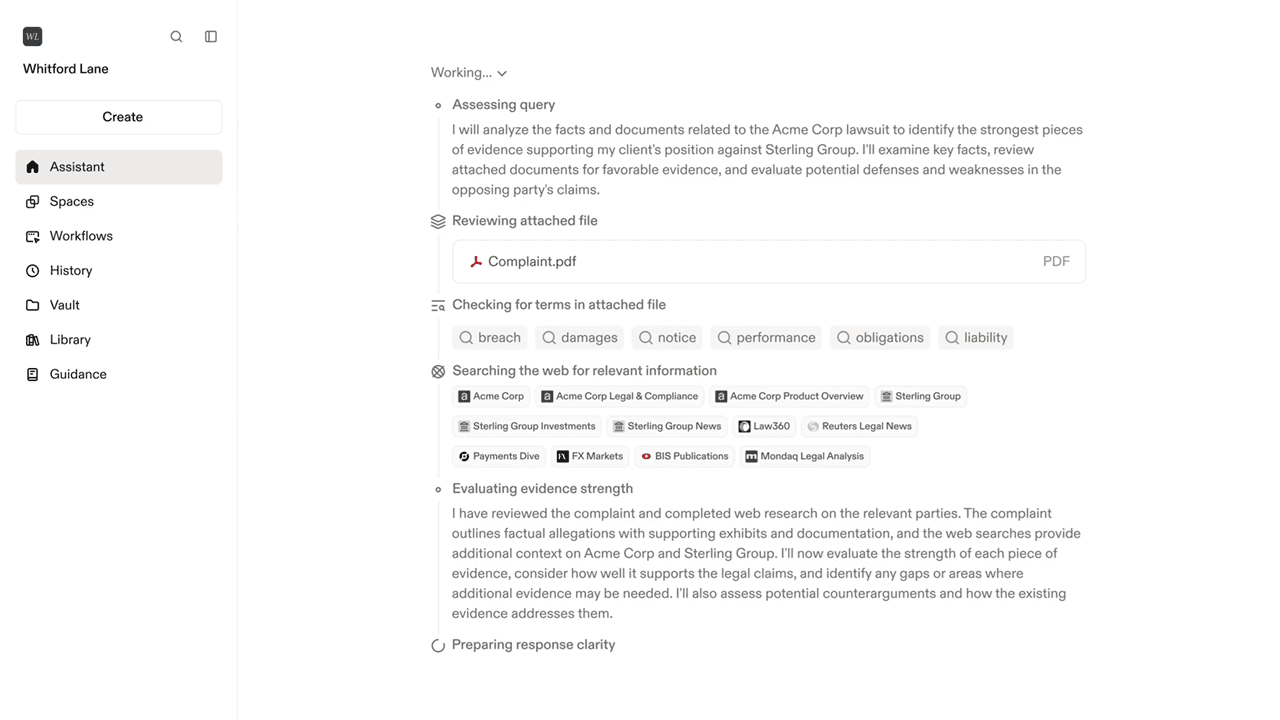
The reasons teams explore alternatives fall into three categories: immediate frustrations with what Harvey offers in-house teams, evolving requirements that generic platforms cannot meet, and the economics of proving return in a crowded market.
It is worth being fair about the starting point. Harvey did not become the reference name in legal AI by accident, and for the buyer it was designed for it remains a serious product.
What Harvey AI Does Well
Harvey is built around the lawyer in a large firm. Deep legal research, precedent work, memo drafting and analysis across long documents are the jobs it optimises for, and it does them with a level of polish that reflects how much capital and how many law firm relationships sit behind it.
For professional services organisations with a large lawyer population and research-heavy work, that focus is a strength rather than a limitation. The brand also carries weight in procurement: a general counsel proposing Harvey rarely has to explain who the vendor is, which shortens the internal approval conversation in a way smaller vendors cannot match.
The gap is not quality. It is fit. A product built for firm-side research and productivity is answering a different question from the one an in-house team asks every morning, which is how to move a queue of contracts and requests without adding people.
Where Harvey AI Falls Short
Legal teams frequently cite poor value for money, lack of additional value compared to generic AI tools like ChatGPT, rigid workflows that are difficult to customise, and concerns about the explainability of outputs and the robustness of vendor support. These frustrations reflect a broader shift: teams want AI tools purpose-built for their specific needs, not generic solutions adapted for legal work.
The requirements have also moved. Modern legal functions now require legal AI that is not only accurate but explainable, secure, auditable and compliant by design. Regulatory scrutiny around privacy, governance and AI accountability makes black box tools increasingly difficult to justify. Teams need visibility into how decisions are made and full confidence in data handling.
Budgets remain tight, pushing teams to favour legal AI platforms that deliver measurable return quickly. Given the significant additional cost against foundational models like ChatGPT or Perplexity for legal, buyers expect more nuanced reasoning, scalability, and demonstrable savings before committing to enterprise rollout. The competitive legal AI landscape now forces vendors to prove value.
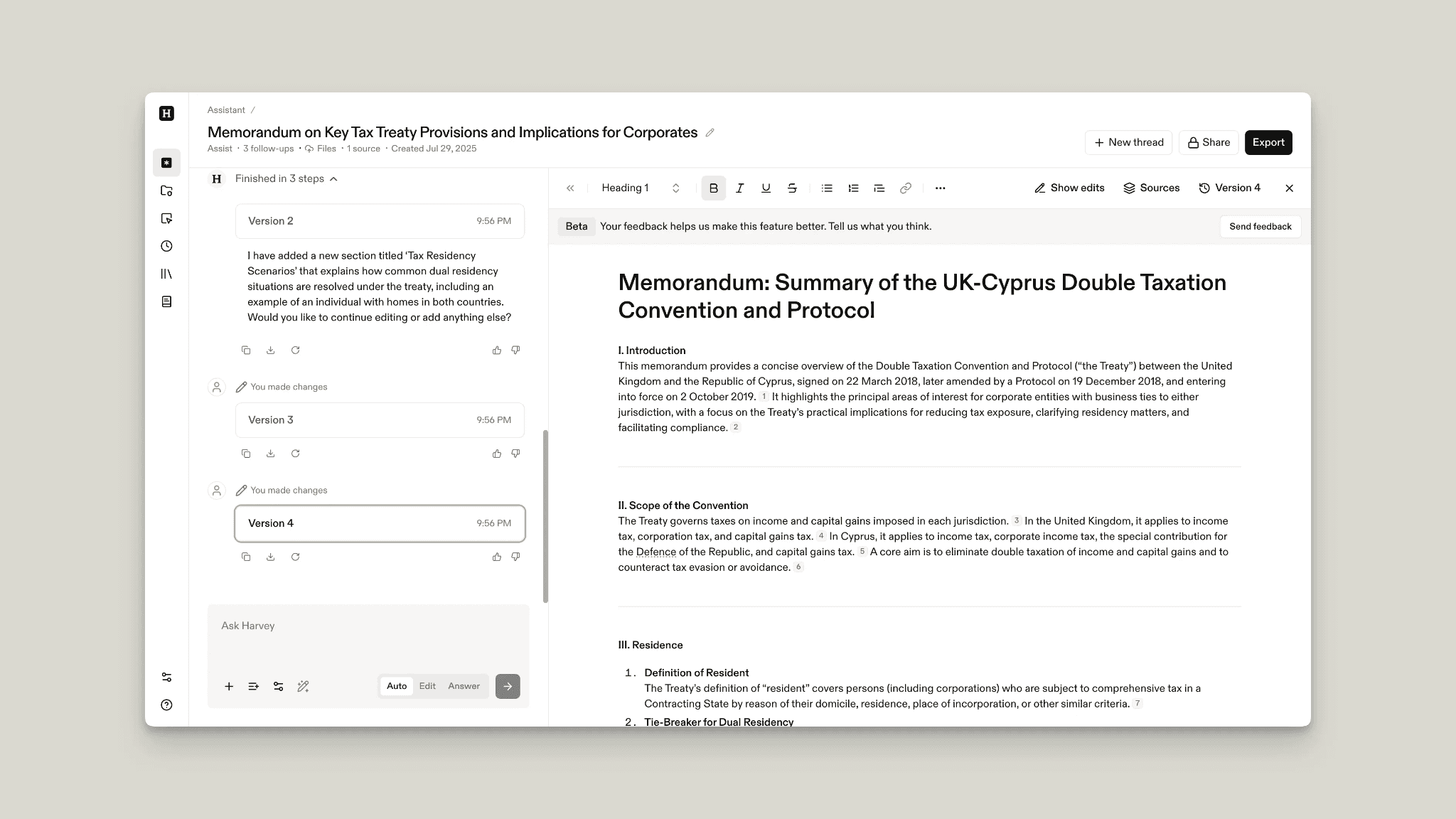
There is a structural point underneath all three. Law firms run on billable hours, so a product built for that model optimises for the quality of a lawyer's output rather than the throughput of a legal function. In-house teams are measured on the opposite: how much work clears without a lawyer touching it, and how little of the business is waiting on legal.
That is the gap the alternatives below are competing to fill, and it explains why the strongest ones look less like a research assistant and more like a legal workflow automation layer with review, drafting and monitoring built into it.
Best Harvey AI Alternative Overall
LEGALFLY is the best overall alternative to Harvey AI for in-house legal teams. It covers the research and drafting Harvey is known for, then adds the two things in-house teams most often find missing: workflows that run end to end without manual coordination, and anonymisation applied before any AI processing begins.
It is also the strongest fit on deployment. LEGALFLY runs inside Microsoft Word, Outlook, Teams, SharePoint and Slack, so adoption does not depend on persuading lawyers to open a new application, and onboarding is measured in days rather than quarters.
Best Harvey AI Alternatives in 2026: In-Depth Review & Comparison
While LEGALFLY is purpose-built for in-house teams, other platforms serve different use cases and organisational structures. Here is how the leading alternatives compare, what they excel at, and which teams benefit most from each.
Each entry follows the same structure: what the product does, who it fits, its strongest capabilities, where it is a credible Harvey replacement, and where it stops.
1. LEGALFLY
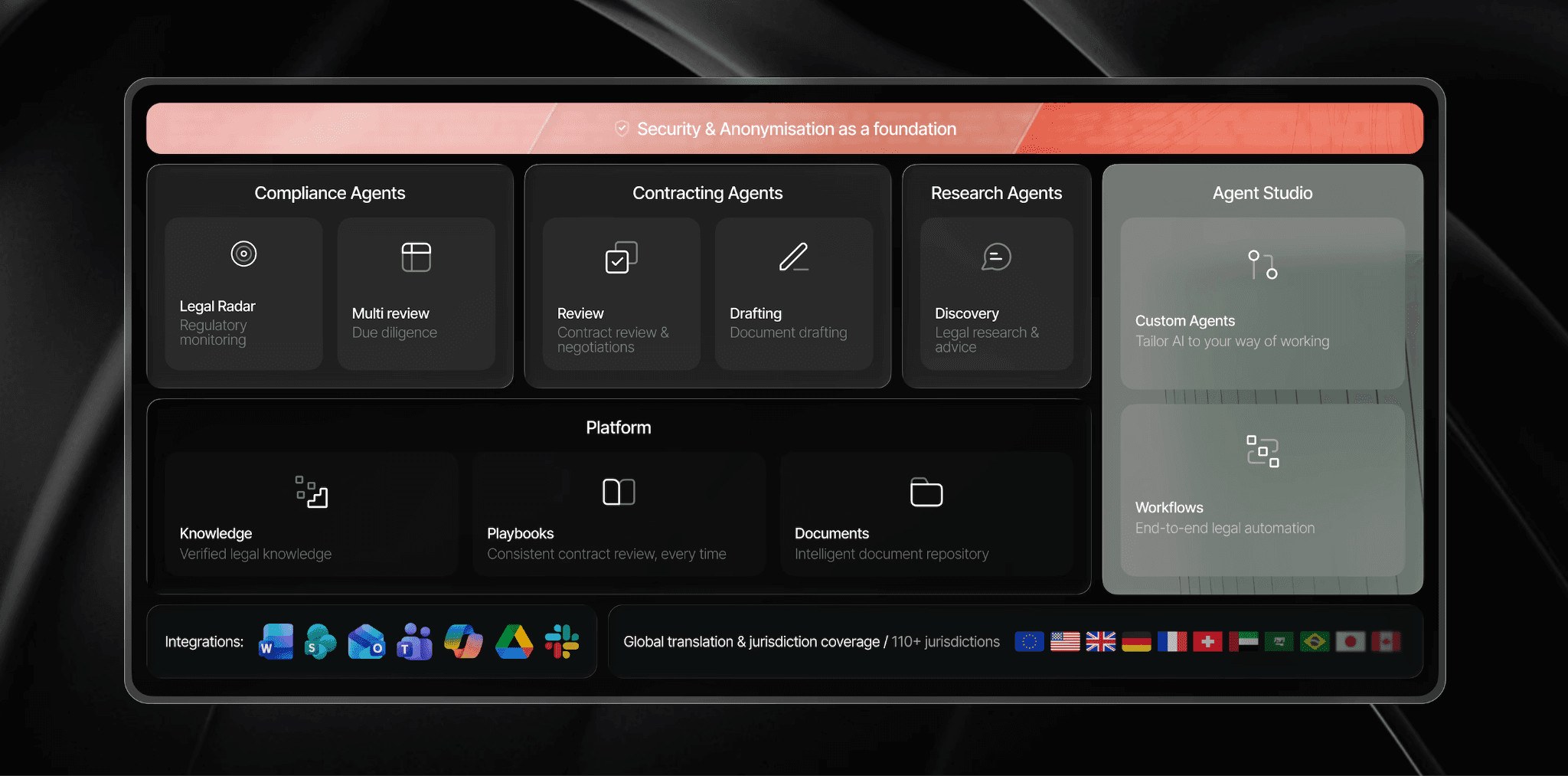
Overview
We know LEGALFLY best because we built it. Here's why in-house legal teams are choosing this software over other AI alternatives in the legal industry.
LEGALFLY is a market-leading legal AI platform for in-house teams that prioritises speed, privacy, and explainability in contracting and compliance workflows. It offers legal agents for contract analysis or review, contract drafting, regulatory tracking, legal research and due diligence, as well as custom agents aligned to your clauses and risk tolerances.
LEGALFLY anonymises all sensitive data before processing, adding an additional layer of security compared to most legal AI tools. It is fully integrated with Microsoft 365, so legal teams can work in familiar tools without heavy setup.
For in-house teams evaluating where LEGALFLY fits within a broader technology stack, it consistently ranks among the leading legal workflow automation tools purpose-built for enterprise legal functions.
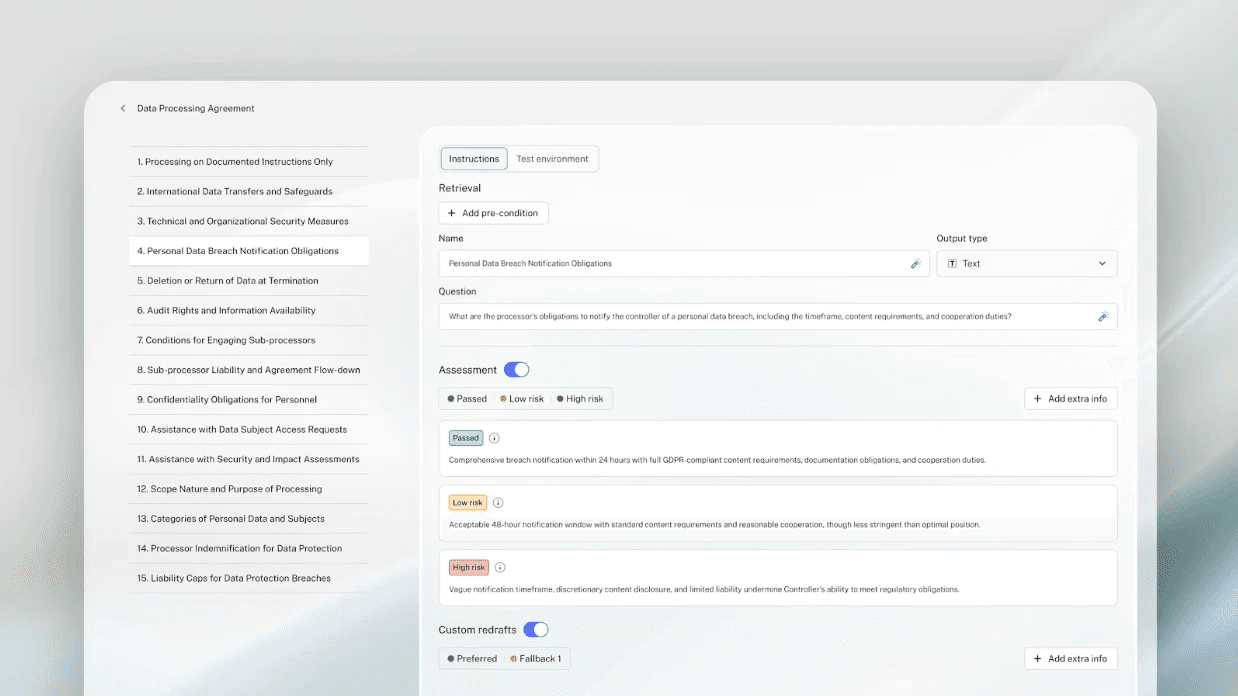
We position ourselves as the legal operating system for corporates: agents do the work, a platform layer holds the knowledge, playbooks and documents behind them, and security sits underneath all of it. Customers include SAP, Lufthansa, Bosch and KPMG, alongside the European Commission, across banking, insurance, technology and manufacturing.
Read this direct comparison of Harvey AI vs LEGALFLY.
Ideal For
In-house legal teams of 3 to 200 supporting a 200 to 100,000 person enterprise
Microsoft 365 centric teams that need privacy-first, explainable AI without a new interface to learn
Regulated industries where the security review decides the shortlist: banking, insurance, technology, manufacturing
Procurement, compliance, HR and sales teams that need to self-serve inside rules legal sets once
Organisations spread across contracting and compliance work rather than research alone
Top Features
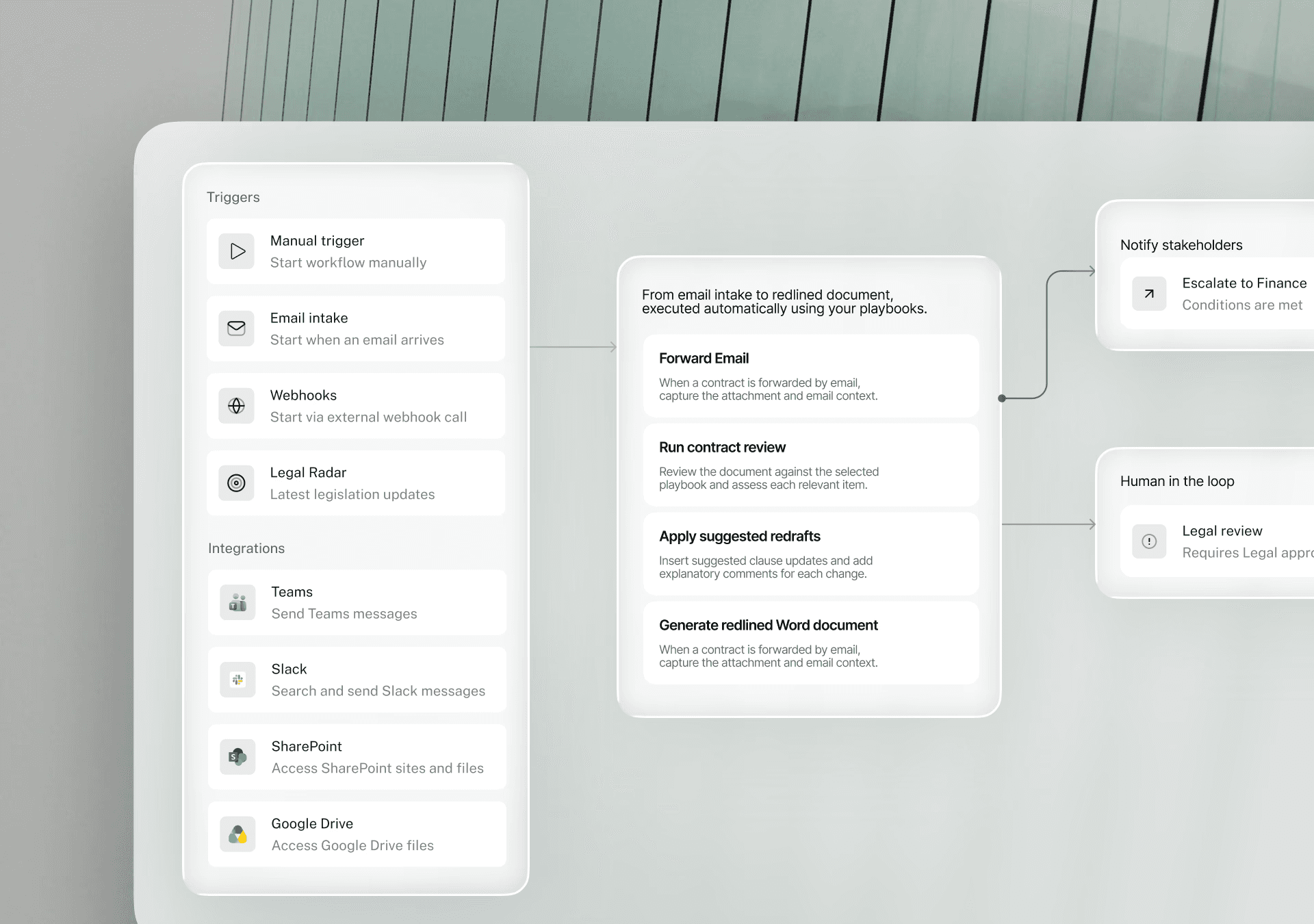
Agent Studio for end-to-end legal workflow automation, with triggers from email, Teams, Outlook, Slack or webhooks, conditional routing, escalation thresholds and legal approval built into each stage
Playbook-driven ai contract review software that scans every clause against your approved positions, grades risk and redrafts non-compliant language in tracked changes inside Word
AI legal document review across hundreds of contracts at once, applying one playbook to a whole portfolio and exporting an audit-ready summary with every finding linked to its source clause
AI for legal research grounded in 700+ official sources across 130+ jurisdictions, with citations on every answer
Regulatory tracking software monitoring official regulators and publishers across 70+ jurisdictions, testing impact against your own contracts and policies rather than reporting change in the abstract
120+ lawyer-built playbooks across 100+ document types, plus a builder that generates a custom playbook from your own golden contracts
Anonymisation applied at import, ISO 27001 and SOC 2 Type II certified, with SaaS, single-tenant and on-premise anonymisation deployment options

LEGALFLY helps your team move faster: less time buried in contracts, more time on the work that actually matters. Book a call to see it in action.
How LEGALFLY Contract Review Works: Step-by-Step
Document review in LEGALFLY follows a structured workflow. Your documents pull directly into the platform, context is extracted automatically, your playbooks guide the analysis, and the output is audit-ready and explainable.
Here's what happens:
Step 1: Pull your document and anonymise instantly. Pull the document directly from SharePoint or Google Drive, open it in Microsoft Word, or trigger a review directly from Teams, Outlook or Slack. Sensitive data and confidential information is anonymised automatically before any AI processing begins, no manual redaction required.
Step 2: Extract contract context automatically. The platform detects the contract type, jurisdiction, language, and party roles so every legal AI review starts with the right context and the right standards. This means LEGALFLY adapts to your specific legal requirements from the outset.
Step 3: Select and apply your playbook. Choose the playbook that aligns with your approved clauses, fallbacks and negotiation standards. LEGALFLY applies your playbook automatically to every contract, ensuring outcomes stay consistent across teams, regions and reviewers. Your standards are the engine.
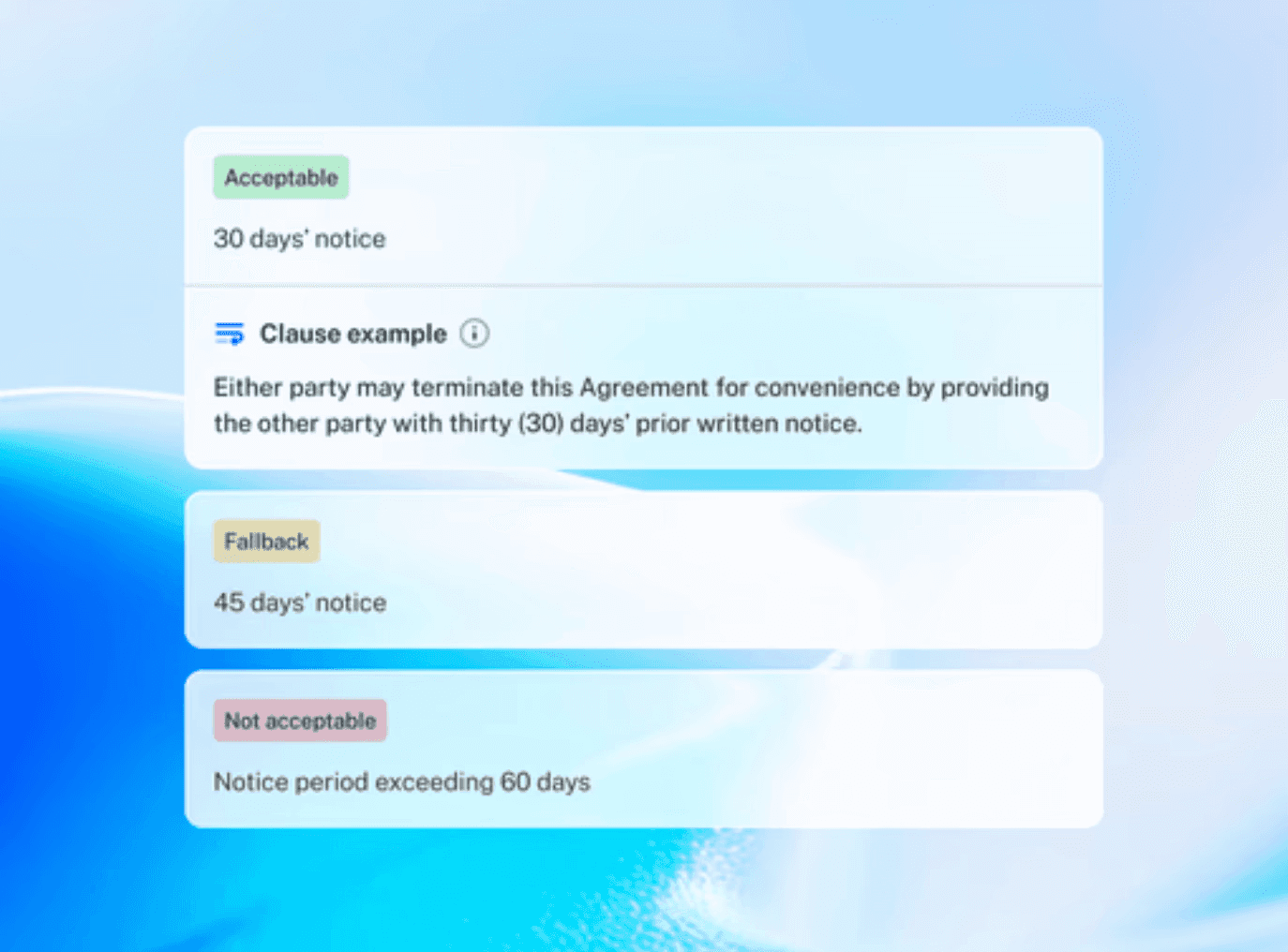
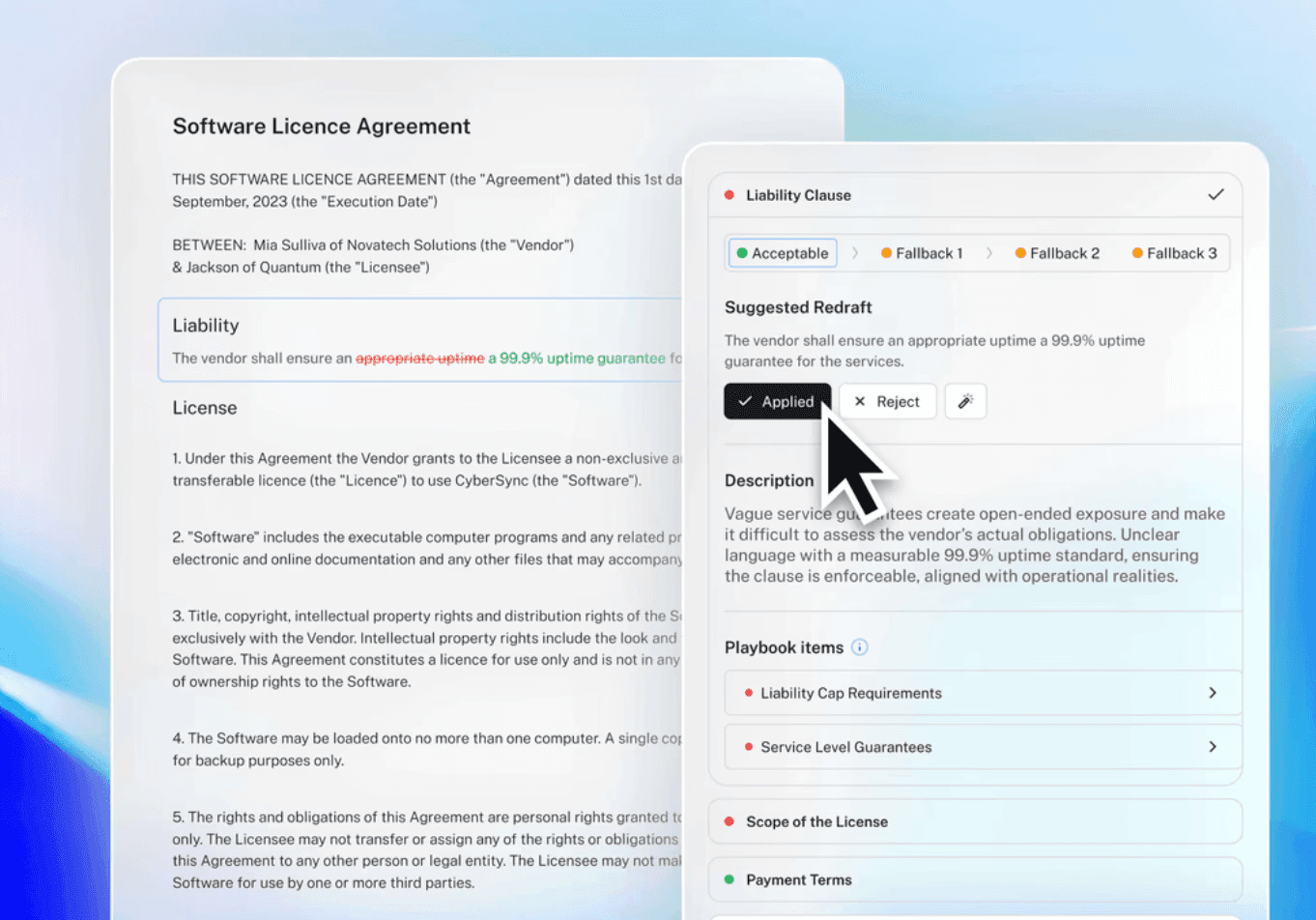
Step 4: Run the AI review and flag deviations. LEGALFLY scans every clause against your playbook and flags deviations instantly. Every flagged clause comes with the "why": clear reasoning, supporting sources and a transparent trail, so decisions are defensible and easy to audit.
Step 5: Compare clauses and generate redlines. Generate clean, playbook-aligned redlines instantly. Accept, reject, edit or bulk-apply changes with tracked changes formatted and negotiation-ready. LEGALFLY outputs a fully redlined document with explanations included, reducing manual work and ensuring every change is consistent with your standards.
Step 6: Maintain full audit trails through to execution. Export clean redlines for negotiation or final versions for execution, backed by a complete audit trail. Every review session is logged: documents analysed, deviations flagged, reasoning captured, approvals recorded. For in-house teams in regulated industries, this level of traceability isn't optional, it's a requirement.
To find out how LEGALFLY could work for you, schedule a call with one of our experts.
Why We're the Best Harvey AI Alternative
LEGALFLY isn't the only legal AI platform. But it's the only one built for the whole enterprise, not just the legal team. By combining contract intelligence with workflow automation and knowledge management, LEGALFLY makes every team that touches legal work faster, while legal keeps full control of the standards.
Most legal AI tools serve a single team: lawyers. LEGALFLY serves every team that touches legal work. Sales, Procurement, HR, Compliance and Claims all generate contracts, ask compliance questions and trigger legal review every day, and LEGALFLY brings them into the same governed workflow as legal itself. Lower cost Collaborator seats make it practical to roll out across thousands of business users rather than only power users in the legal department.
Agent Studio is an end-to-end workflow automation solution that lets your legal team define how processes run, when actions are triggered, who gets notified, and what happens at each escalation point. You set the logic. Legal retains final approval at every step. Workflows trigger from the tools your organisation already uses: email, Teams, Outlook, Slack, or any external system via webhooks. Custom knowledge collections mean policies and legal guidance can be uploaded once and accessed instantly by any team through a chat interface, without those teams needing to contact legal directly.
The speed is measurable. MSIG Europe cut legal queries from a full day to around 20 minutes, and ECS doubled its legal capacity while halving the time spent on document analysis. When your team is processing dozens of contracts monthly, that compounds into weeks of recovered time.
Privacy is architectural rather than an afterthought. LEGALFLY anonymises all sensitive data before any AI processing begins. No manual redaction. No exceptions. The platform holds ISO 27001 and SOC 2 Type II certifications, and offers deployment options including SaaS, single-tenant and single-tenant with on-premises anonymisation.
The playbooks scale your standards rather than someone else's. LEGALFLY comes with 120+ pre-built playbooks across 100+ document types, but the real power is customisation: build your own agents aligned to your clauses, risk tolerances, and jurisdiction requirements. One platform, one source of truth, one set of standards applied consistently across your entire team.
Integration removes the adoption barrier. Legal teams don't want new tools. They want their existing tools to be smarter. LEGALFLY integrates natively with Microsoft Word, SharePoint, Teams, Outlook, Copilot, DocuSign, Google Drive and Slack. Your lawyers work where they already work. No training overhead.
Coverage spans global operations. LEGALFLY supports 130+ jurisdictions for verified legal sources, so multi-regional legal teams can rely on consistent, jurisdiction-aware review standards without building custom logic.
And every output includes the reasoning. Every flagged clause points to the source contract text. Legal teams keep control because they can see exactly why LEGALFLY made a recommendation. This transparency is non-negotiable when stakes are high and audit trails matter, and it is the single most common complaint raised about black box tools.
Finally, the product was purpose-built for in-house legal departments rather than adapted from a firm product. The workflows are built around how legal teams actually work: high volume, tight compliance requirements, integration with corporate systems, and the need for consistent, auditable decisions across the team. Law firms have different pressures. LEGALFLY doesn't try to be everything to everyone.
Pros
Anonymisation before analysis, built into the architecture rather than offered as a setting
Whole-enterprise workflows: procurement, compliance, HR and sales work inside legal's playbooks
Native Microsoft 365 integration, so adoption does not depend on a new interface
Explainable outputs with clause-level reasoning and a full audit trail on every session
Onboarding measured in days, with 120+ playbooks usable from the first review
Cons
Not built for law-firm matter management, billing or time recording
Sales-led, so evaluation starts with a demo and a scoping conversation
Value depends on configured playbooks, which takes time upfront with your approved positions
Final Verdict
If you are leaving Harvey because the research is strong but nothing else moves, LEGALFLY is the closest thing to a direct answer. It handles the review, drafting and research, then automates the workflow around all three and lets the rest of the business self-serve inside rules legal wrote once.
If your organisation is a law firm and the job is precedent depth and lawyer productivity, this is not the switch to make. LEGALFLY is optimised for enterprise in-house functions and does not pretend otherwise.
LEGALFLY helps your team move faster: less time buried in contracts, more time on the work that actually matters.
To find out how LEGALFLY could work for you, schedule a call with one of our experts.
2. Luminance
Overview
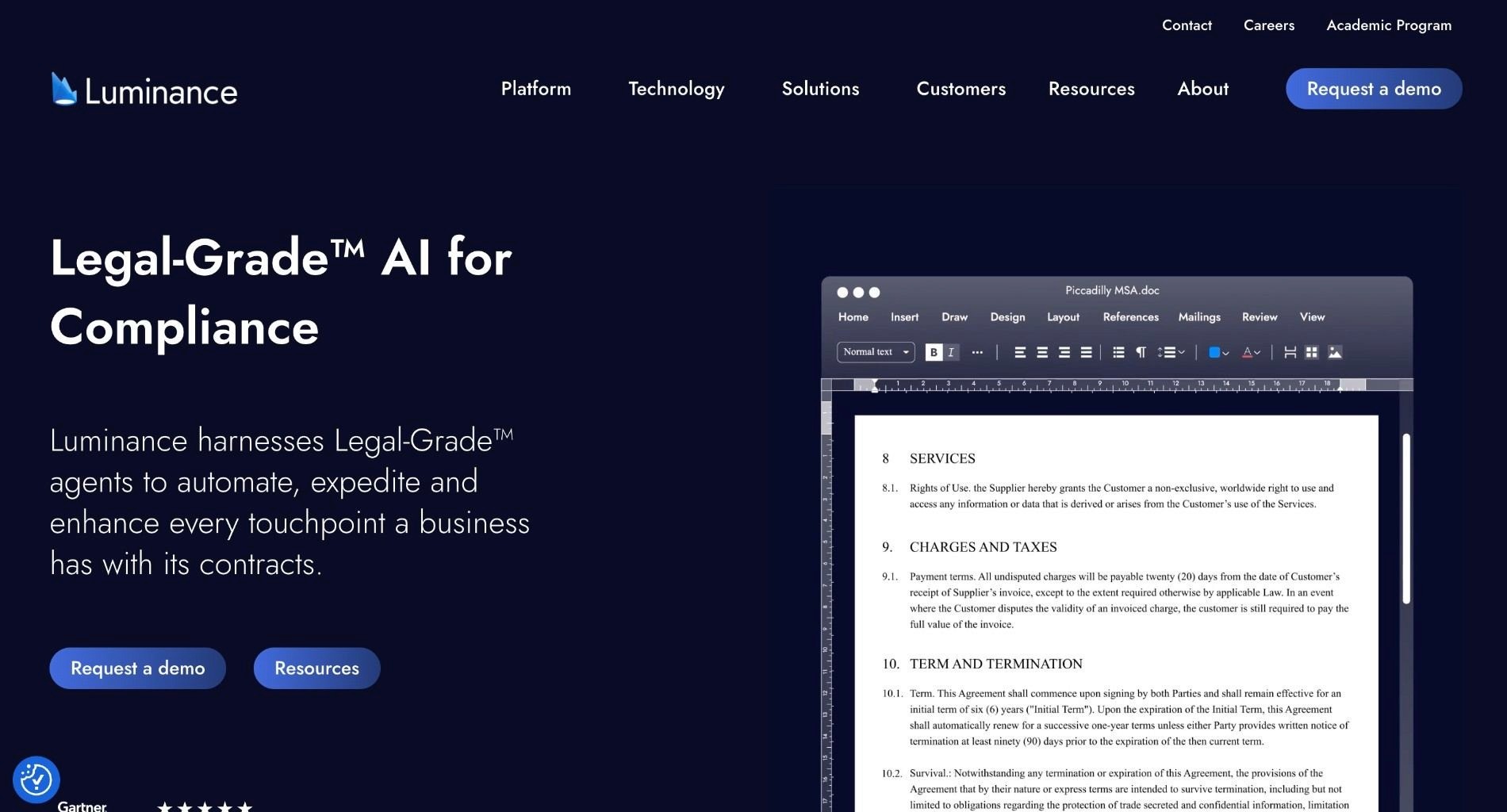
Luminance provides contract review with visual risk mapping, AI-driven document insights, and workflow automation. Its global language coverage and integrations with iManage, NetDocuments, and Word make it well suited to large matters where rapid issue spotting and reviewer coordination are required.
Founded in 2015, it predates the current generation of legal AI, and that shows in what it is best at: reading a large body of documents nobody has seen before and surfacing what is unusual in them. That is a diligence problem rather than a negotiation problem, and it remains the product's centre of gravity.
If Luminance isn't the right fit for your team, there are strong Luminance alternatives worth considering that may better match your workflow, jurisdiction requirements, or security standards.
Ideal For
Large review projects where rapid issue spotting and reviewer coordination across a deal team are the priority
Cross-border matters spanning several languages and legal systems
Corporates mapping an existing contract portfolio against a new obligation
Firms already running iManage or NetDocuments as the document system of record
Top Features
Anomaly detection across unfamiliar document sets without prior configuration
Visual risk mapping that shows where issues cluster across a portfolio
Multilingual analysis for global contract sets
Integrations with iManage, NetDocuments and Microsoft Word
Why It's a Strong Harvey AI Alternative
Luminance is one of the strongest options for the moment a deal team is handed several thousand agreements and asked what is in them. Where Harvey is built to help a lawyer think, Luminance is built to help a team triage, and for diligence-heavy organisations that is the more valuable capability.
The visual layer matters more than it sounds. Seeing risk distribution across a portfolio changes which contracts get human attention first, which is a different and often better outcome than making each individual review faster.
Pros
Strong anomaly detection across large, unfamiliar document sets
Global language coverage for cross-border review
Established presence in enterprise and law firm environments
Deep integration with the document systems firms already run
Cons
Onboarding takes longer than tools that live inside Word
Not embedded in Microsoft 365, so it sits outside daily workflow
Less focused on playbook-driven redlining of individual contracts
Serves both firms and corporates, so workflows are not in-house specific
Final Verdict
Luminance is a smart choice if you are leaving Harvey because your real workload is portfolio review rather than research, particularly across languages and jurisdictions where an unfamiliar clause is easy to miss.
It is a weaker answer if the daily problem is the NDA that arrived this morning. Teams whose bottleneck is throughput on routine paper will find a Word-native review tool fits the workflow better.
Read our comparison of LEGALFLY vs Luminance.
3. Kira Systems

Overview
Now part of Litera, Kira focuses on clause extraction, comparison, and custom machine learning models that firms can tune for their playbooks. It integrates with major document management and e-discovery systems to support high-scale diligence and legacy repository mining.
Kira predates almost everything else on this list, and its extraction models were trained on a scale of annotated legal documents that is difficult to replicate. That history is the product's main asset, and it is why the tool still appears on shortlists dominated by newer names.
Ideal For
M&A advisory teams and law firms running large-scale due diligence
Teams mining legacy contract repositories for obligations and provisions
Firms already invested in the Litera transaction stack
Any team whose problem is finding provisions rather than negotiating them
Top Features
Deep clause and provision extraction across very large document sets
Custom machine learning models tuned to a firm's own playbooks
Comparison tooling for reviewing variations across a contract population
Integration with major document management and e-discovery systems
Why It's a Strong Harvey AI Alternative
Extraction accuracy at scale is a narrow capability, and Kira is one of the strongest options at it. When the deliverable is a diligence chart covering four thousand agreements, precision on provision identification is the entire job, and general-purpose legal AI rarely matches a purpose-built extraction engine.
The custom model training is the other differentiator. Teams that repeat the same unusual extraction across matters can teach the system once and reuse it, which compounds in value across a transaction practice in a way that prompt-based tools do not.
Pros
Provision extraction accuracy across very large document sets
Custom ML tuning for matter-specific extraction
Long track record in due diligence and M&A workflows
Fits neatly into an existing Litera deployment
Cons
Not built for redlining or negotiation
Usually scoped per matter, which suits projects more than daily review
Firm-side workflows rather than in-house self-service
No anonymisation before processing
Final Verdict
Kira is the right tool for a data room, not for the contract that landed in your inbox this morning. On extraction at scale it remains one of the smartest choices available.
As a Harvey replacement it only works if diligence was the reason you bought Harvey in the first place. Most in-house teams run something like this alongside a review platform rather than instead of one.
4. LawGeex

Overview
LawGeex streamlines frontline review and approvals using pre-trained playbooks and automated routing, with native use inside Word and common CLM and CRM systems. It is designed to shorten turnaround on standard agreements while maintaining consistent, policy-aligned outcomes.
The product makes a deliberate trade. Rather than helping a lawyer review faster, it aims to remove the lawyer from routine agreements altogether, approving what falls inside policy and escalating only what does not.
Ideal For
Procurement and legal operations teams needing fast, policy-driven review of standard agreements
Vendor onboarding workflows with high volume and low variation
Organisations wanting first-pass review handled with minimal reviewer involvement
Teams that want value without a long configuration project
Top Features
Pre-trained playbooks that ship ready for common agreement types
Automated routing and approval for contracts falling inside policy
Native operation inside Microsoft Word
Integrations with common CLM and CRM systems
Why It's a Strong Harvey AI Alternative
For a procurement function drowning in supplier paper, LawGeex answers a question Harvey does not attempt: how do we stop routing routine agreements to lawyers at all. The pre-trained playbooks mean the first useful output arrives quickly, without a configuration phase.
It is also one of the easier tools on this list to justify internally, because the metric is simple. Either the volume of agreements reaching legal falls, or it does not, and that shows up within a quarter.
Pros
Fast onboarding with playbooks that work out of the box
Removes routine agreements from the legal queue entirely
Works inside Word and connects to CLM and CRM systems
Clear, measurable outcome on standard paper
Cons
Narrow to first-pass review and approval
Limited depth on heavily negotiated or unusual agreements
Not a research, drafting or regulatory monitoring platform
Playbooks need adapting before they reflect your actual risk appetite
Final Verdict
LawGeex is a sensible move if the reason you are leaving Harvey is that it never reduced the volume of work arriving at legal. On standard agreements it does exactly that.
It is not a replacement for a broad legal AI platform. Teams needing research, drafting, regulatory monitoring or workflow automation will need to keep buying those elsewhere.
5. ThoughtRiver

Overview
ThoughtRiver accelerates pre-screening by applying precedent-based risk scoring and playbook automation at intake, highlighting issues before full review. Integrations with Word, CLM, and CRM help teams triage efficiently and enforce consistent positions.
The design insight is that most review time is wasted on the wrong contracts. By scoring risk at intake, ThoughtRiver aims to make sure senior attention lands on the agreements that need it, rather than being distributed evenly across the queue.
Ideal For
Commercial legal teams needing early-stage risk triage before contracts reach full review
Organisations enforcing consistent playbook positions at the point of intake
Teams with a large volume of inbound third-party paper
Legal ops functions trying to route work by risk rather than by who is free
Top Features
Precedent-based risk scoring applied at intake
Playbook automation that enforces consistent positions across reviewers
Pre-screening that surfaces issues before a full review begins
Integrations with Word, CLM and CRM systems
Why It's a Strong Harvey AI Alternative
Triage is a genuinely different capability from research, and it is one in-house teams often need first. Knowing which twenty of two hundred contracts deserve real attention changes the shape of the week more than making each review marginally faster.
It is one of the stronger options for teams whose problem is prioritisation rather than analysis, and it slots in ahead of whatever review process already exists rather than replacing it.
Pros
Catches issues before full review begins
Consistent playbook positions applied at intake
Fits ahead of an existing review workflow rather than replacing it
Useful reporting on where risk concentrates in the inbound queue
Cons
A triage layer, so a review tool is still needed behind it
Limited drafting and no regulatory monitoring
Value depends on a documented playbook existing first
Adds a step to the stack rather than consolidating one
Final Verdict
ThoughtRiver is a smart addition for commercial teams whose bottleneck is deciding what to look at, and it delivers on that narrow job well.
As a straight Harvey replacement it is incomplete. Most teams that adopt it still need a platform behind it for the review, drafting and research work.
Most teams using LEGALFLY cut their contract review time in half within a few weeks of onboarding. Book a short demo to see how it works for your business.
6. Leah, formally ContractPodAi
Overview
Leah, formerly ContractPodAi, is a full contract lifecycle management platform with embedded AI review and workflow automation. It suits teams seeking one system for authoring, approvals, repository, and analytics, with integrations across Salesforce, DocuSign, and Microsoft 365.
This is a platform decision rather than a tooling decision. Choosing it usually means consolidating several systems into one, which changes the evaluation from feature comparison to implementation planning.
Ideal For
Organisations consolidating contract authoring, approvals, repository and analytics into one platform
Enterprises replacing an ageing CLM rather than adding an AI layer
Teams that need clause libraries and compliance scoring in the same environment as the workflow
Businesses where end-to-end process control matters more than best-of-breed review
Top Features
Full contract lifecycle management with repository and workflow automation
Embedded AI review with clause libraries and compliance scoring
Integrations across Salesforce, DocuSign and Microsoft 365
Analytics across the executed contract portfolio
Why It's a Strong Harvey AI Alternative
If the frustration with Harvey is that it improves individual output without changing how contracts move through the business, a CLM answers the other half of that problem. Intake, approvals, signature, storage and renewals all become governed steps rather than email threads.
It is one of the stronger choices for organisations that want a single vendor across the lifecycle, and the embedded AI means the review layer is not a separate purchase.
Pros
One system for the whole contract lifecycle
AI review included rather than bought separately
Strong integrations with the commercial stack
Portfolio analytics across executed agreements
Cons
Suite implementation effort, measured in months rather than weeks
Review depth sits behind AI-native review platforms
Heavier than most teams need if the goal is faster review
No anonymisation before processing
Final Verdict
Leah makes sense when the real problem is the contract lifecycle rather than the quality of the review, and when consolidating vendors is a goal in its own right.
If you are leaving Harvey because you want better legal work rather than better contract logistics, this is the wrong direction. A review-first platform will get you there faster and with far less implementation.
Why LEGALFLY Works Across Multiple Use Cases
Harvey is a research assistant. The teams leaving it are usually not looking for a better research assistant; they are looking for something that moves work. Here is where that difference shows up in practice.
LEGALFLY for In-House Legal Teams
A team of three to fifteen supporting a multi-jurisdiction enterprise does not have a research problem, it has a queue problem. Contracts arrive faster than they clear, and the same clause gets a different answer depending on who picked it up and how close the deal is to quarter end.
Playbook-driven review fixes both at once. The standard is applied uniformly, the volume gets absorbed, and every decision carries the rule it was based on. That is what makes the output defensible six months later when someone asks why a position was accepted.
LEGALFLY for Procurement Teams
Procurement owns the contracts that wait longest in the legal queue, and the wait is rarely about risk. Standard vendor paper sits behind negotiated commercial agreements because there is one queue and one set of reviewers.
With approved positions encoded once, procurement clears standard paper without a lawyer touching it and routes only genuine deviations for review. Supplier lead times drop without anyone loosening the standard, which is the outcome a research tool cannot produce.
LEGALFLY for Compliance and Risk Teams
Teams working against the EU AI Act, DORA, NIS2, CSRD and CSDDD need to know what changed, which of their own documents it touches, and be able to prove they acted. Manual monitoring caps out at one or two jurisdictions per person.
Regulatory monitoring across 70+ jurisdictions removes that ceiling, and because impact is tested against your own contracts rather than reported in the abstract, the output is a list of documents to fix rather than a newsletter to read.
LEGALFLY for Legal Operations
Legal ops usually runs the evaluation and has to defend the shortlist to both the General Counsel and the CISO. The failure mode is a tool that passes the demo and fails the security review three months later.
Anonymisation before analysis, single-tenant and on-premise deployment options, and a full audit log on every session are what make that review survivable. Adoption in week six is the other metric worth tracking, and it favours tools that live inside Word.
LEGALFLY for Sales and Commercial Teams
Sales does not want a legal tool. Sales wants an NDA back the same day, and will use whatever gets them there fastest, including a general chatbot and a copy-pasted clause.
Self-service review inside rules legal already set turns a two-day wait into a same-day answer and keeps the terms inside approved language. It also removes the main reason sales goes around legal in the first place, which no amount of research capability addresses.
LEGALFLY helps your team move faster: less time buried in contracts, more time on the work that actually matters. Book a call to see it in action.
What Makes a Good Harvey AI Alternative?
Harvey does research well, so an alternative that only does research better is not solving the problem most teams are leaving for. These are the criteria that actually decide it.
1. It Automates Workflows, Not Just Tasks
Making a single task faster leaves the coordination around it untouched, and the coordination is usually where the time goes. A genuine alternative captures the request, routes it, escalates by risk threshold and notifies the right person without anyone chasing it.
Ask to see a workflow triggered from an email or a Teams message and run end to end during the demo. If the answer is a roadmap item, it is not an alternative yet.
2. It Handles Your Data the Way Your Security Team Requires
Get the answer in writing before the shortlist closes. Is data anonymised before analysis or after, where is it processed, under which deployment model, and can the anonymisation component run inside your own environment?
This is the question that most often kills a shortlisted tool late in the cycle. Asking it in week one turns the security team into a participant rather than a veto.
3. It Applies Your Standard, Not a Generic One
Prebuilt playbooks get you started. Your own approved positions are what make the output usable, and the difference shows up immediately in how many suggestions your lawyers accept without editing.
Check whether the vendor can generate a playbook from your existing golden contracts, and ask who updates a position when it changes. That maintenance question is rarely asked in a demo and always matters afterwards.
4. It Works Where the Work Already Happens
Review happens in Word and starts in Outlook or a document management system. A tool that requires a separate window adds a step to every review, and that step is where adoption quietly dies.
Confirm the Word add-in, your document system and your storage layer before the pilot rather than after. A tool that only reads uploads is creating work rather than removing it.
5. It Explains Itself
A flag without a reason creates work instead of removing it. Every flagged clause should carry the rule it breached, the source behind it, and a record of what the reviewer decided next.
In regulated industries that trail is the difference between a tool you can deploy and one your compliance function will not sign off. Ask to see the log, not the dashboard.
How to Choose the Right Harvey AI Alternative for Your Needs
Choosing well requires a structured approach. The steps below keep you focused on what matters: fit, accuracy, and return. Work through them systematically, involve your team early, and don't skip the pilot.
1. Assess Firm-Specific Needs
Map your contract types, review volumes, service-level expectations, and risk tolerances. Confirm integration requirements with Microsoft 365, SharePoint, CLM, DMS, and security controls. Know your starting position before evaluating vendors.
Be specific about the split between routine and negotiated work. A team where 70% of volume is NDAs and vendor terms needs throughput; a team drafting bespoke agreements needs reasoning quality, and buying for the wrong half is the most common mistake in this category.
2. Form an Evaluation Squad
Include legal, IT, security, and operations to test accuracy, explainability, and workflow fit. Have each member score independently, then compare. Different perspectives surface different risks.
Bringing security in at this stage rather than at contract is the single highest-value change most teams can make to their process, because it front-loads the question that otherwise ends evaluations in month four.
3. Run Trials or Live Demos
Request demos from shortlisted legal AI tools and insist on trying the tool using your real contracts and workflows. Measure accuracy, explainability, reviewer effort, and cycle-time impact. Generic demos don't show you real-world performance.
Bring three real contracts and your current approved positions. Measure time to first usable redline, the share of suggestions your lawyers accept unedited, and how many people are still using it a month later.
4. Evaluate Vendor Support and Roadmap
Review onboarding materials, training paths, and response service levels. Ask about AI governance, data handling, model update cadence, and roadmap alignment with your priorities. Vendor maturity matters as much as product maturity.
Ask for two references at your size and ask them what happened the last time something broke. Support quality separates these platforms more than features do, and it never shows up in a demo.
5. Model the Full Scope, Not Just the Licence
Include implementation, data migration, training, and ongoing support in your plan, not just the software. Weigh these against expected savings from faster reviews, reduced escalations, and fewer disputes.
Ask vendors what a deployment aligned to your volumes, integrations and security requirements actually involves, including implementation and training. The headline capability rarely reflects the real effort.
6. Gather Team Feedback and Decide
Involve end users early and capture feedback on usability, output quality, and adoption barriers. Use a simple scorecard to compare legal AI tools on fit, risk, and value before committing. Ensure every tool is evaluated on the same criteria so comparison is fair and defensible.
Expert tip: Start with a focused use case such as NDAs or vendor agreements, prove value, then expand to more complex contracts.
7. Plan Change Management
Schedule enablement, office-hours support, and a phased rollout so adoption sticks and value shows up quickly. The best legal AI tool fails if your team doesn't use it.
Extend to a second team only once the first workflow is stable. Rolling out to procurement and sales at the same time as legal is the most reliable way to stall both.
To find out how LEGALFLY could work for you, schedule a call with one of our experts.
Everything You Need to Know About Harvey AI Alternatives
Category | Key considerations |
|---|---|
Top 3 alternatives | LEGALFLY for in-house workflow automation and privacy, Luminance for large-scale portfolio review, Leah for full contract lifecycle consolidation |
Best overall option | LEGALFLY. It covers review, drafting, research and regulatory monitoring, automates the workflow around them, and anonymises every document before analysis begins |
Why look for Harvey AI alternatives | Rigid workflows that are hard to customise, limited additional value over general AI tools on everyday work, explainability concerns, and difficulty proving return against a firm-first product |
How to choose | Decide whether your bottleneck is research or execution, get the data handling answer in writing, test playbook quality on your own contracts, and check the tool lives where your team already works |
Ease of switching | Days rather than months for tools that run inside Microsoft 365, since there is no repository to migrate. Full CLM platforms are a multi-month implementation |
Must-have features | Playbook enforcement, anonymisation before analysis, native Word and document system integration, clause-level explainability, and an audit trail on every session |
Mistakes you should not make | Buying for the wrong half of your document mix, leaving the security question until month four, evaluating on the vendor sample set, and rolling out to every team at once |
Ready to Move On from Harvey AI? Try LEGALFLY
Three things separate LEGALFLY from everything else on this list.
Documents are anonymised before analysis begins, on an architecture designed pre-LLM rather than added later. Whole workflows run end to end, from intake through triage and review to approval, without manual coordination. And the same playbooks legal writes once govern procurement, compliance, HR and sales, so the whole business moves faster while legal keeps control of the standard.
It is built for one buyer in particular: the in-house legal, compliance or procurement team inside a regulated enterprise, working across more than one jurisdiction, where the security review decides the shortlist and the backlog is already visible to the business.
Adeera reduced review time by 93%. Duvel Moortgat went from over an hour to five minutes on routine queries. Wealins recovered around a fifth of its team's working time. Bring three of your own contracts and your current approved positions to the demo, and see what the same workflow does with your paper.
To find out how LEGALFLY could work for you, schedule a call with one of our experts.
FAQs About Harvey Alternatives
What is Harvey used for?
Harvey AI is used primarily for legal research, document analysis and drafting support inside large law firms and professional services organisations. It is designed around the lawyer as the user, optimising for precedent work, memo drafting and analysis across long documents. In-house teams also use it, but the workflows reflect firm-side practice rather than corporate legal operations.
What are the best Harvey alternatives in 2026?
The best Harvey AI alternatives in 2026 are LEGALFLY for in-house teams that need workflow automation and anonymisation before analysis, Luminance for large-scale portfolio and cross-border review, Kira for extraction-heavy due diligence, LawGeex for policy-driven first-pass approval, ThoughtRiver for risk triage at intake, and ContractPodAi for full contract lifecycle consolidation. Which one fits depends on whether your bottleneck is research, review throughput, diligence or contract logistics.
What features should I look for in a Harvey AI alternative?
Look for playbook enforcement against your own approved positions, anonymisation before any AI processing, native integration with Microsoft Word and your document system, clause-level explainability, and workflow automation that runs from intake through to approval. Those five cover the gaps in-house teams most often cite when leaving a research-first platform. Feature lists beyond that rarely change the outcome of an evaluation.
How to choose the best Harvey AI alternative for your needs?
Start by deciding whether your bottleneck is research quality or execution speed, because that single question eliminates most of the list. Then check data handling with your security team in week one rather than month four, test playbook quality on three of your own contracts, and confirm the tool works inside the applications your team already opens. Measure adoption at week six, which predicts value better than accuracy in week one.
Is it easy to switch from Harvey AI to an alternative?
Switching is straightforward for platforms that run inside Microsoft 365, because there is no repository to migrate and no new interface to learn. LEGALFLY deployments are typically measured in days, with teams starting on one contract type and one playbook before extending. Switching to a full contract lifecycle management platform is a different exercise and usually takes several months, since it touches sales, procurement and finance as well as legal.
Is LEGALFLY better than Harvey AI?
LEGALFLY is the stronger fit for in-house legal teams, and Harvey is the stronger fit for large law firms. LEGALFLY automates whole workflows across legal, procurement, compliance, HR and sales, anonymises documents before analysis and runs inside Microsoft 365. Harvey is built around firm-side research and lawyer productivity. The honest answer is that they are optimised for different buyers rather than one being better outright.
What is the main difference between LEGALFLY and Harvey?
The main difference is who the product is built for and what it automates. Harvey is designed for the lawyer in a law firm and optimises individual output. LEGALFLY is designed for the in-house legal function and automates the workflow around the work, extending legal's own playbooks to the business teams that generate the requests. The second structural difference is anonymisation before analysis, which LEGALFLY applies by default.
Do Harvey alternatives work with Microsoft 365?
Several do, but the depth varies considerably. LEGALFLY runs natively inside Word, Outlook, Teams and SharePoint with a Microsoft Copilot connector, and LawGeex and ThoughtRiver operate inside Word. Luminance and Kira integrate with document management systems such as iManage and NetDocuments rather than living inside Microsoft 365. Confirm which applications your team actually opens before shortlisting.
Are Harvey alternatives secure enough for regulated industries?
The leading platforms hold ISO 27001 and SOC 2 Type II certification, but certification is the baseline rather than the differentiator. What separates them in a security review is what happens to the document before the model reads it, and whether single-tenant or on-premise deployment is available. LEGALFLY anonymises every document before analysis begins and offers SaaS, single-tenant and on-premise anonymisation options, which is why it clears reviews that stop other tools.