





Ironclad and LEGALFLY solve different problems.
Ironclad is a contract lifecycle management platform with an AI assistant added to support contract work. That assistant, Jurist, can help with drafting, redlining, summarising and document Q&A inside Ironclad’s CLM environment.
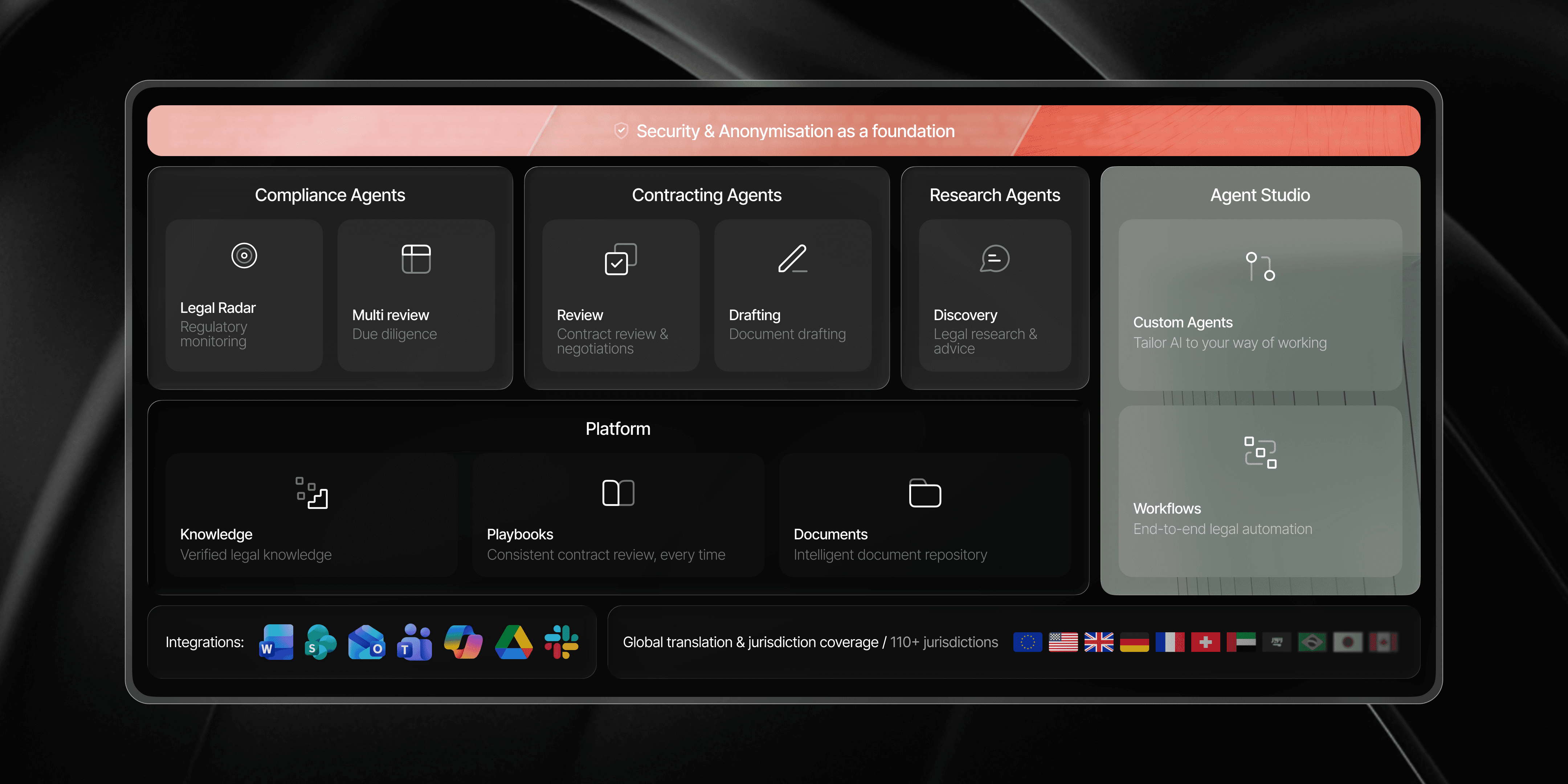
LEGALFLY is a legal AI platform for enterprise legal teams that need AI to do more than assist with contracts. It supports contract review, drafting, legal research, regulatory monitoring, due diligence, business self-serve and workflow automation across Microsoft 365.
The key difference is that Ironclad uses AI to support contract management, while LEGALFLY uses AI to execute legal work.
This article sets out what each platform does, what each does not do, and where they differ.
For enterprise in-house teams that need more than contract management, LEGALFLY covers the full range: multiple jurisdictions, workflow automation, and regulatory monitoring, with data anonymisation built in. Book a demo.
What Is Ironclad?
Founded in 2014 and headquartered in San Francisco, Ironclad is one of the largest CLM platforms on the market. It manages contracts across their full lifecycle: intake, workflow, negotiation, approval, signature, storage, and obligation tracking.
Ironclad's AI assistant, Jurist, handles contract drafting, review, summarisation, and document Q&A. It works in a native .docx environment and integrates into Ironclad's CLM workflows.
Beyond Jurist, Ironclad's strength is its contract management infrastructure, with configurable approval workflows, obligation tracking, dashboards, entity profiles, and integrations with Salesforce, DocuSign, Google Drive, and others.
It does not have the same breadth as a legal AI platform built for in-house legal work across contracts, research, compliance, regulatory change and due diligence.
What Is LEGALFLY?
Based in London, Ghent, and Dubai, LEGALFLY is a legal AI platform designed for enterprise in-house legal, compliance, and procurement teams.
The platform covers the full range of in-house legal work: playbook-driven contract review with fallback language and escalation logic, contract drafting from approved templates, legal research across 110+ jurisdictions and 500+ official legal sources, multi-document due diligence with risk flagging, and proactive regulatory monitoring. Agent Studio lets legal teams configure automated workflows from intake to approval. LEGALFLY runs across the full Microsoft 365 stack, including Word, Teams, SharePoint, Outlook, Copilot, and Slack.
Most teams using LEGALFLY cut their contract review time in half within a few weeks of onboarding. Book a short demo to see how it works for your business.
LEGALFLY is LLM-agnostic, selecting the best available model for each task. All data is anonymised before any model processes it.
In-house teams including SAP, Lufthansa, AXA, KPMG, and Bosch currently use LEGALFLY.
Ironclad vs LEGALFLY: a direct comparison
Feature | Ironclad | LEGALFLY |
Contract review | Reviews and redlines contracts inside CLM workflows | Playbook-driven. Fallback language, redraft wording, and escalation logic. 120+ playbooks across 100+ document types. |
Contract drafting | Generates and edits contract language | Web and Word. From approved templates in your house style or from prompts. |
Legal research | AI-assisted Q&A with citations | 110+ jurisdictions, 500+ official legal sources, 80 languages. Primary sources only. |
Regulatory monitoring | Not offered. | Legal Radar monitors official legislative and regulatory sources and alerts your team when changes affect your contracts or compliance obligations. |
High-volume review and due diligence | Limited bulk extraction | Multi-Review Agent applies your playbook across batches and ranks outputs by deviation severity. |
Business team self-serve | Intake forms for business teams via existing channels. | Business teams generate standard contracts and submit requests through Slack, Teams, or email within guardrails legal has set. |
End-to-end automation | Intake, routing, and approval workflows. No AI task execution. | Agent Studio automates workflows across the full range of in-house legal tasks, from intake to approval, including AI execution of the legal work. |
Microsoft 365 | Word add-in and web platform. | Full stack: Word, Teams, SharePoint, Outlook, Copilot, and Slack. |
Data protection | Enterprise security certifications. No auto-anonymisation before AI processing. | Anonymisation before AI processing. ISO 27001, SOC 2 Type II, GDPR-compliant. On-premises deployment available. |
AI model | Multiple LLMs via Jurist. | LLM-agnostic. Benchmarks and selects the best available model per task. |
What does Ironclad do, and where does it stop?
Ironclad is a contract lifecycle management platform. Its strength is contract infrastructure: intake, workflows, approval routing, negotiation, signature, storage, reporting and obligation tracking.
Jurist adds AI assistance to that CLM system. It can help draft, review, summarise and answer questions about contracts. However, Jurist is centred on contract tasks. It is not a broader legal AI platform for the full in-house legal function.
Ironclad does not offer regulatory monitoring, structured legal research from verified jurisdictional sources, due diligence with risk flagging, or configurable AI agents that execute legal workflows based on your team’s policies.
LEGALFLY is built for broader legal work. It helps with contract review, drafting, legal research, regulatory monitoring, due diligence and workflow automation in one platform.
Verdict: Ironclad's AI is useful for contract work. For legal teams looking beyond contracts into research, regulatory monitoring, and due diligence, LEGALFLY can do more.
Which platform is better for contract review?
Both platforms review contracts in Word against a playbook and return suggested edits. The difference is what those playbooks contain and what happens after the review runs.
Jurist helps with contract review inside Ironclad’s CLM workflow. It can identify issues, suggest edits and support redlining.
LEGALFLY's playbooks encode how your team negotiates, not just what to check.
Each playbook includes the clauses to assess, the preferred position, fallback wording if the preferred position is rejected, and escalation triggers for deviations that require sign-off. The Playbook Builder generates a review playbook from a reference contract you already use.
LEGALFLY also automates the workflow around review, so contracts move from submission through review to approval without manual coordination at each step. A two-hour manual review can be done in 15 minutes.
How to build a playbook in LEGALFLY
The Playbook Builder a few clarifying questions and produces a structured review framework in seconds, with the clauses to check, the assessments to run, fallback positions, and suggested redraft wording.
From there, refine it to match how your team negotiates. Add conditional rules, adjust preferred language, and define escalation triggers.
Once approved, publish it for use across teams. Every contract reviewed against it follows the same logic, so standards stay consistent as volume grows.
Verdict: Ironclad accelerates clause-level review within a governed workflow. LEGALFLY encodes your negotiating positions and fallback logic into the review itself, and automates the process around it.

Can business teams self-serve, or will everything still come to legal?
A major share of Legal's time goes to requests that do not require a senior lawyer: standard NDAs, routine procurement contracts, template employment agreements. If the AI platform does not let business teams handle these themselves, legal remains the bottleneck.
Ironclad has self-service intake forms that business teams use to submit contract requests. It routes those requests into the appropriate workflow. The legal work - review, drafting, research - still needs a lawyer to pick it up.
LEGALFLY lets business teams in sales, procurement, and HR generate their own standard contracts within guardrails legal has already set. They submit requests through Slack, Teams, or email. LEGALFLY runs the review against the relevant playbook, routes the output to legal for sign-off where thresholds are met, and returns it to the business.
Verdict: Ironclad gives business teams a structured way to submit requests. LEGALFLY lets them self-serve on standard contracts within guardrails you have set, reducing the volume reaching legal.
What can the platform do beyond contract review?
Ironclad is made for contracts. It answers document-level Q&A and has internet-connected research, but there is no structured legal research from verified sources, no regulatory monitoring, and no due diligence capability with risk flagging.
LEGALFLY covers three areas Ironclad does not: legal research, regulatory monitoring, and transaction due diligence.
Legal research
LEGALFLY's Discovery Agent draws from 500+ official legal sources across 110+ jurisdictions, covering legislation, case law, and regulatory guidance sourced directly from government bodies and legal publishers, in 80 languages. Every answer traces back to a specific source, not internet search results. When you need to know how a specific obligation applies across five European markets, you get a sourced, citable answer.
Regulatory monitoring
Keeping on top of regulatory change across multiple jurisdictions using manual searches risks missing something. Legal Radar changes that. You configure notifications by topic and jurisdiction. When a relevant change is published, you receive an alert in the app or by email that summarises the update and assesses its impact on your organisation.
Legal Radar also searches your document repository for contracts affected by the change, so you know exactly where to act without starting from scratch.
LEGALFLY helps your team move faster: less time buried in contracts, more time on the work that actually matters. Book a call to see it in action.
Due diligence at scale
LEGALFLY's Multi-Review Agent runs your playbook across entire document sets for M&A, joint ventures, or portfolio reviews: flagging deviations, extracting key risks, and ranking outputs by severity. Ironclad's Smart Import extracts key terms from bulk uploads but does not do risk assessment.
Verdict: Ironclad covers contracts. LEGALFLY covers contracts, research across 110+ jurisdictions, regulatory monitoring, and transaction due diligence in the same platform.
Where can you use each platform?
Ironclad works in its web interface and in Microsoft Word via an add-in. Contract review and drafting run inside Word with tracked changes and playbook logic integrated directly. Beyond Word, Ironclad connects to Salesforce, DocuSign, Google Drive, Box, and Dropbox for contract storage and routing. Submitting a request from Slack or Teams, or moving a reviewed contract into an approval flow from Outlook, happens outside the platform.
LEGALFLY runs across the full Microsoft 365 stack. A contract request that arrives in Outlook moves to a Word review and into Teams for approval without anyone leaving the tools they already use. SharePoint connects your document repository directly, so review runs on files where they already live. Business teams submit requests through Slack, Teams, or email and receive outputs through the same channels. The Outlook add-in lets lawyers summarise emails and attachments, draft replies, run legal research, or review a contract without leaving their inbox.
Verdict: Ironclad works in Word and on the web, with integrations for storage and CRM. LEGALFLY connects legal to the rest of the business across the full Microsoft 365 environment.
Which platform protects your data better?
Ironclad holds ISO 27001, 27017, 27018, and 27701, SOC 1 and SOC 2 Type II, GDPR compliance via Standard Contractual Clauses, and HIPAA certification. Per Ironclad's privacy policy, data is transferred to, processed, and stored in the United States by default, with EU hosting available for certain customers. It does not automatically anonymise sensitive data before AI processing.
LEGALFLY anonymises every document before it reaches any AI model. Names, commercial terms, and counterparty details are stripped at import as part of the platform's standard processing, regardless of which underlying model handles the task. LEGALFLY holds ISO 27001 and SOC 2 Type II certification, is GDPR-compliant, and offers on-premises and single-tenant deployment for regulated industries where data cannot leave a specific environment.
Verdict: Ironclad processes data in the US by default and does not anonymise before AI processing. LEGALFLY anonymises documents before any model processes them, so no identifiable data reaches the AI regardless of provider.
What does implementation look like?
Ironclad is a substantial implementation. One-time implementation fees in the range of $5,000-$50,000 are reported, with AI add-ons priced separately. Workflow configuration requires administrators to define extensive rules and variables manually. G2 and Capterra reviews consistently flag the complexity - one Capterra reviewer described "a long learning curve that makes it difficult to understand the entire system."
LEGALFLY is designed for fast deployment at team level. The Playbook Builder generates a first-pass review playbook from a reference contract you already use, so your standards are encoded before manual configuration is complete. With 120+ pre-built playbooks across 100+ document types, most teams are reviewing live contracts within the first week. Legal engineering support is included. Check out LEGALFLY's free legal AI training for professionals. See how it can streamline your legal workflows and save your team hours every week.
Verdict: Ironclad carries significant configuration overhead and a reported steep learning curve. LEGALFLY can be used across your organisation within the first week.
Which should you choose?
Ironclad is worth evaluating if your main need is contract lifecycle management infrastructure: structured approval workflows, obligation tracking, a searchable contract repository, and integrations with Salesforce, DocuSign, and the rest of your enterprise stack.
LEGALFLY is more useful if you run an enterprise in-house legal function whose work spans contracts, research, compliance, and coordination - and you want data anonymisation, proactive regulatory monitoring, and end-to-end workflow automation that executes the legal work, not just routes it. Rather than accelerating individual tasks, it governs how work gets done across the organisation, applying your legal standards consistently across every contract.
See how LEGALFLY works for enterprise in-house teams. Book a demo.
FAQs
What is the alternative to Ironclad?
For enterprise in-house legal teams, LEGALFLY covers contract review, drafting, legal research, regulatory monitoring, due diligence, and end-to-end workflow automation in one platform. For teams whose primary need is CLM depth, Juro and Icertis are also worth evaluating. For contract review specifically, Luminance and Spellbook are options in that narrower space.
Does Ironclad do legal research?
Ironclad's Jurist has internet access and can answer legal questions with citations from online sources. It does not offer structured research from verified legal databases across specific jurisdictions. LEGALFLY's Discovery agent draws on 500+ official legal sources across 110+ jurisdictions, with every answer traceable to a specific piece of legislation, regulation, or official guidance.
Does Ironclad monitor regulatory changes?
No. Ironclad does not offer regulatory monitoring. LEGALFLY's Legal Radar monitors legislative and regulatory sources across the jurisdictions you configure, sends automated notifications when something changes, assesses the impact on your organisation, and identifies which contracts in your repository are affected.
Which is easier to implement, Ironclad or LEGALFLY?
Ironclad carries significant implementation overhead. Reported one-time implementation fees range from $5,000-$50,000, and the workflow configuration requires extensive manual setup. G2 and Capterra reviewers consistently cite a steep learning curve. LEGALFLY's Playbook Builder generates a working review playbook from a reference contract in seconds, and most teams are reviewing live contracts within the first week.
This information was last updated in Q2 2026. For the most current information, check directly with the provider.