







Most in-house legal teams started exploring AI contract tools through drafting, and Spellbook was one of the first tools to make that accessible inside Microsoft Word. For transactional lawyers who spend most of their day drafting and negotiating inside Word, that was a practical entry point.
But drafting is only part of the problem.
The pressure on in-house teams has shifted. Headcount is flat. Contract volumes are rising. Business teams want faster turnaround on vendor agreements, NDAs, and supplier contracts, and they are not interested in hearing about legal bottlenecks.
The question most teams are now asking is not just whether AI can help them draft faster. It is whether AI can help them review, manage, and govern contracts at scale, without adding risk.
That requires a different kind of tool. This guide covers the best Spellbook alternatives in 2026, with a focus on which platforms can genuinely support the full contract review process, not just word-level drafting.
Note: If you're evaluating AI drafting or contract review tools and want to see what a full legal workspace looks like beyond Word-based drafting, book a demo. We'll show you how LEGALFLY handles drafting, review, playbook enforcement, and bulk document analysis, all inside Microsoft 365.
Key Takeaways (TL;DR)
Who Spellbook is for: Transactional lawyers, solo practitioners and small firms doing clause-level drafting and negotiation inside Microsoft Word, where the value is speed on the document in front of them.
Why seek a Spellbook alternative: In-house teams outgrow document-level drafting when volume rises. They need governed review against their own playbooks, bulk analysis across a portfolio, and data protected before a model reads it.
Best overall alternative: LEGALFLY. It gives legal teams a governed workflow rather than a smarter editor: playbooks that encode your own risk thresholds and fallback positions, jurisdiction detection, and batch review for high-volume contracts.
What sets LEGALFLY apart: LEGALFLY anonymises every document before analysis begins, an architectural decision taken pre-LLM rather than added later as a compliance layer, which no other platform on this list fully replicates.
How to choose: Work out where your team's biggest friction actually sits, drafting or review, then check data handling before the security review and test playbook quality on your own contracts.
Most teams using LEGALFLY cut their contract review time in half within a few weeks of onboarding. Book a short demo to see how it works for your business.
Top Spellbook Alternatives in 2026 at a Glance
The AI contract review market has matured quickly. The table below compares the top Spellbook alternatives by who they serve, what they do, and where each one stops.
Tool | Best for | Key features | Pros | Cons |
|---|---|---|---|---|
LEGALFLY | In-house legal, compliance and procurement teams at mid-to-large enterprises | Agent Studio workflows, Contract Intelligence, playbook review across 130+ jurisdictions, Multi Review, drafting, Legal Radar, anonymisation | Governed review at volume; anonymisation before analysis; no system change for Microsoft 365 teams | Setup investment on advanced configuration; not built for law firms or solo practitioners |
Cicerai | Legal teams whose primary need is deep research across case law, statutes and regulations | AI contract review, clause extraction, document summarisation, natural-language querying | Strong analysis capabilities; effective for due diligence; easy natural-language interface | Limited drafting; not a full contract lifecycle solution |
Ironclad | Large enterprise legal and procurement teams needing full contract lifecycle management | End-to-end CLM, AI review and redrafting, approval routing, CRM and ERP integration | Full lifecycle automation; powerful analytics; strong enterprise integrations | Complex implementation; heavier than most teams need for review alone |
LegalOn | In-house teams wanting AI review and redlining in Word with attorney-built playbooks | AI review and risk identification, playbook-based revisions, Word, DMS and CLM integration | Strong compliance and risk focus; easy to adopt; playbooks ready on day one | Less automation outside review and drafting; limited workflow customisation |
Lexion | Legal teams needing fast-to-implement CLM with strong repository intelligence | AI contract repository and search, generative drafting, no-code workflow automation | Fast, intuitive drafting; strong repository intelligence; comprehensive integrations | Limited advanced automation; not as feature-rich for large enterprises |
Why Consider Spellbook Alternatives?
Spellbook earned its position honestly, and an alternatives page that skips past that is not credible. The question is what happens when the work outgrows the tool.
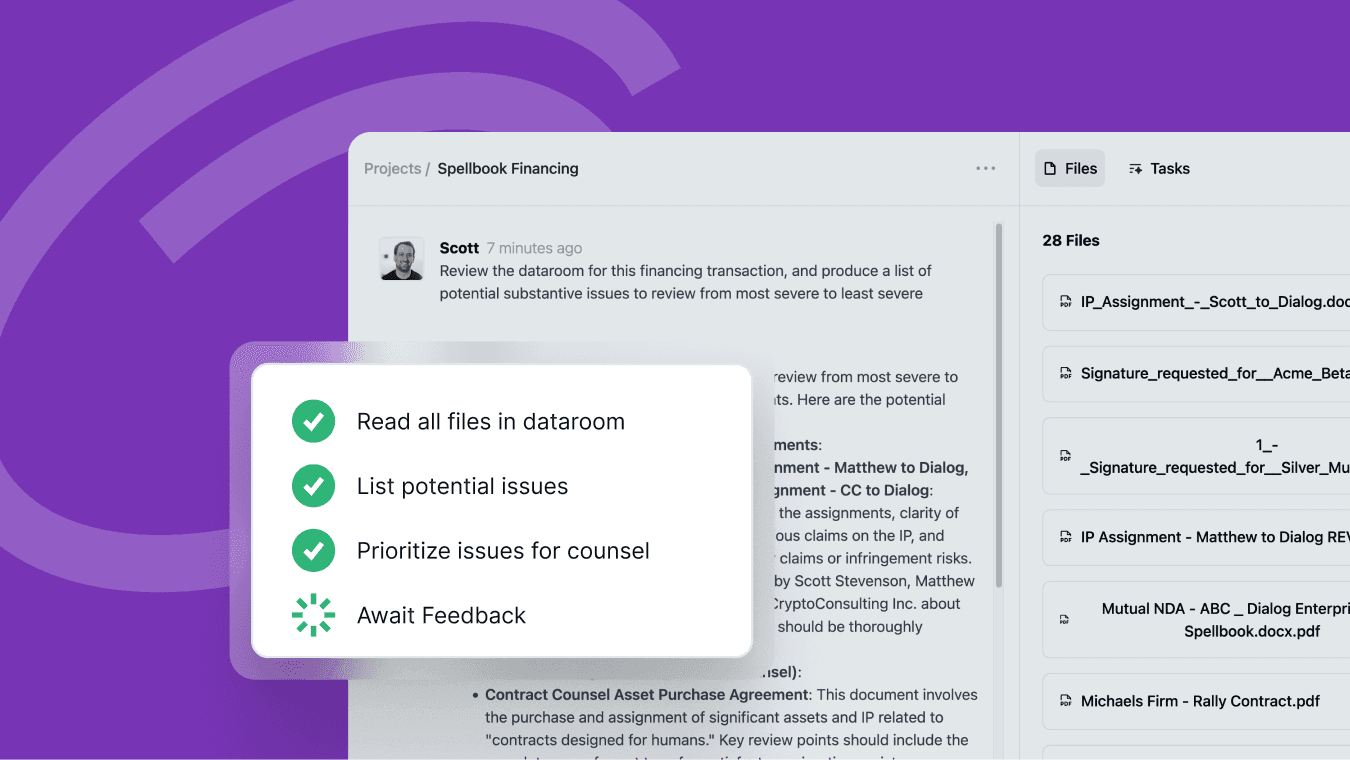
What Spellbook Does Well
Spellbook is, at its core, a drafting and redlining tool built for Word. It is well suited to transactional lawyers and solo practitioners doing clause-level drafting and negotiation, and it was one of the first tools to make AI drafting genuinely accessible inside the application lawyers already had open.
That matters more than it sounds. Adoption is close to instant because there is no new interface, no migration and no repository to populate, and the clause benchmarking layer answers a question playbooks do not: whether a position is market standard, rather than whether it matches your own.
For a small team that needs value in week one rather than quarter two, it remains one of the strongest options available, and nothing below changes that.
Where Spellbook Falls Short
What Spellbook does not offer is a structured, governed contract review workflow, and that is the gap most in-house legal teams are trying to close. Drafting help improves the document in front of one lawyer; it does not change how a queue of two hundred agreements clears.
The second limitation is volume. Reviewing contracts one by one at high volume is not a workflow problem that Word-based tools are built to solve, and compliance sweeps, portfolio audits and due diligence all ask what is true across hundreds of agreements at once.
The third is data handling. In-house teams in regulated sectors are increasingly asked what a model sees before it processes a document, and document-level tools that pass text to a model in its original form find that question harder to clear each year.
None of these is a criticism of the product. They are the boundaries of what a Word add-in was designed to do, and they are the reason the platforms below exist.
Best Spellbook Alternative Overall
Among the Spellbook alternatives in 2026, LEGALFLY stands out as the most capable platform for in-house legal teams that need more than AI-assisted drafting.
LEGALFLY approaches AI-powered contract review differently. Instead of augmenting the Word editing experience, it gives legal teams a governed workflow: playbooks that encode your own risk thresholds and fallback positions, jurisdiction detection, automatic data anonymisation before any AI processing begins, and batch review for high-volume contracts. For in-house teams, that distinction matters.
Read our head-to-head comparison of LEGALFLY vs Spellbook.
To find out how LEGALFLY could work for you, schedule a call with one of our experts.
Best Spellbook Alternatives: In-Depth Review & Comparison
Below are the top Spellbook alternatives for in-house legal teams, evaluated on drafting capability, contract review depth, workflow automation, and enterprise readiness.
1. LEGALFLY
Overview
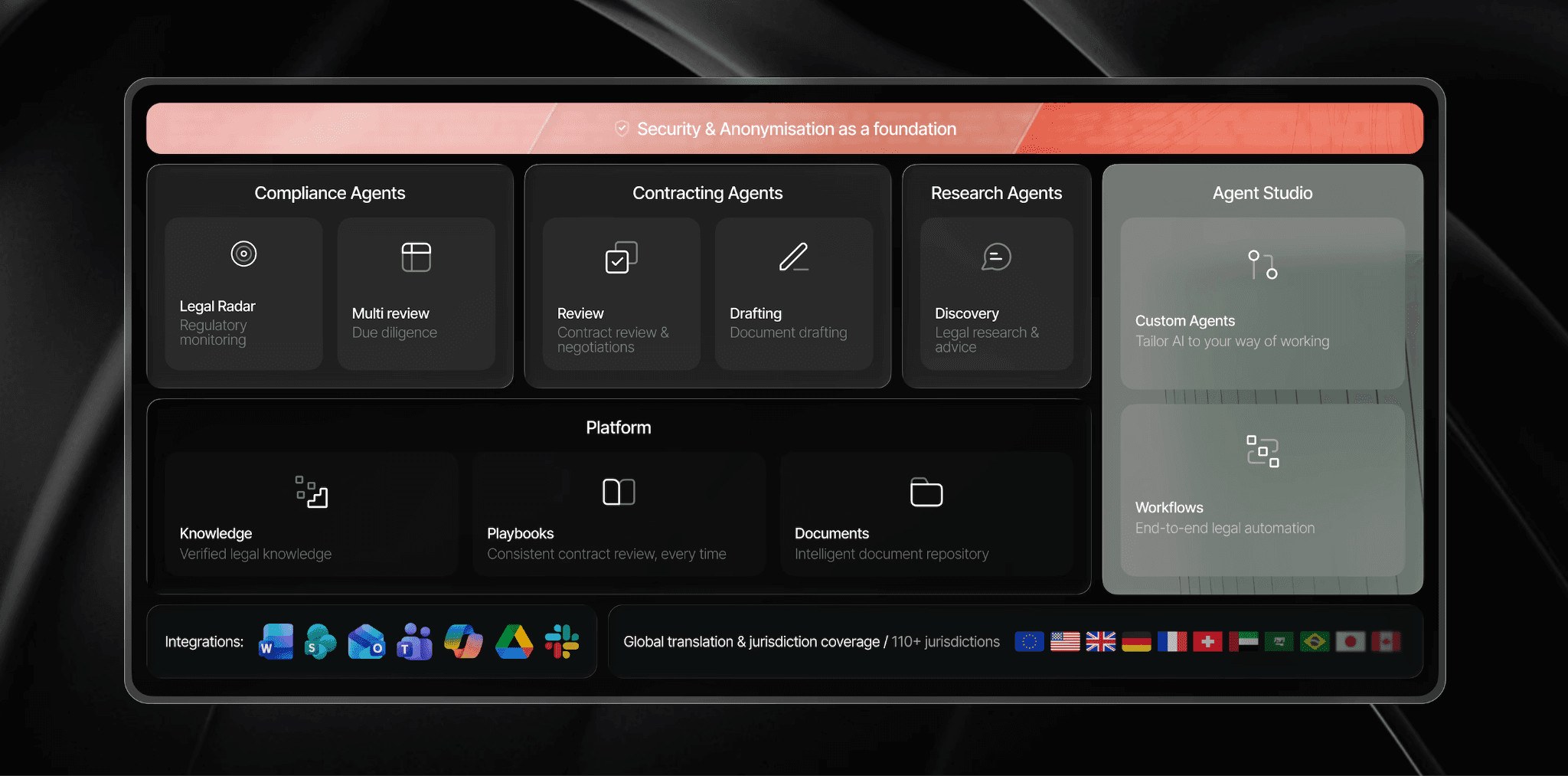
LEGALFLY is an AI-powered legal operating system built exclusively for in-house legal, procurement, and compliance teams. It covers the full range of in-house legal work: contract review, contract drafting, legal research, due diligence, regulatory monitoring, and bulk document analysis, all deeply integrated within Microsoft 365.
Enterprises including SAP, Lufthansa, Bosch and KPMG use LEGALFLY to manage high-volume contract work without increasing headcount, alongside the European Commission, which signed in 2026 following a competitive evaluation.
At Adeera, a 5,000-person hospitality group in the PIF portfolio, contract review time fell by 93%, from between two and four hours down to ten or fifteen minutes, without adding headcount to the legal team.
Ideal For
In-house legal, compliance and procurement teams at mid-to-large enterprises
Regulated sectors such as financial services, insurance and technology
Teams reviewing contracts at volume across multiple jurisdictions
Organisations that need playbook-governed workflows inside Microsoft 365
Legal functions where the security review decides the shortlist
Top Features
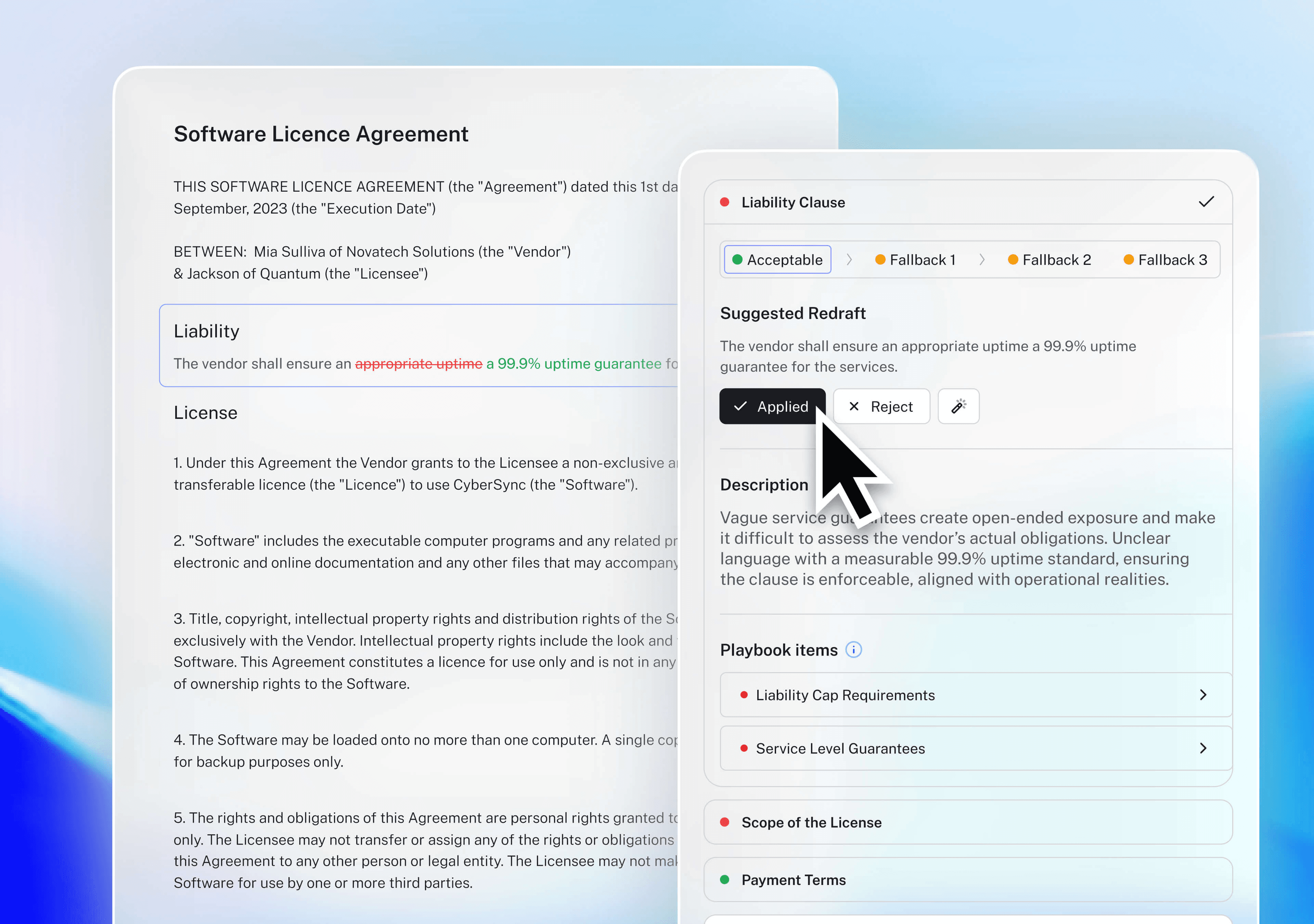
Playbook-driven ai contract review software with enforcement across 130+ jurisdictions, detecting contract type, jurisdiction, language and party roles so every review starts with the right context, then flagging risks and non-compliant clauses with suggested redrafts in your house style
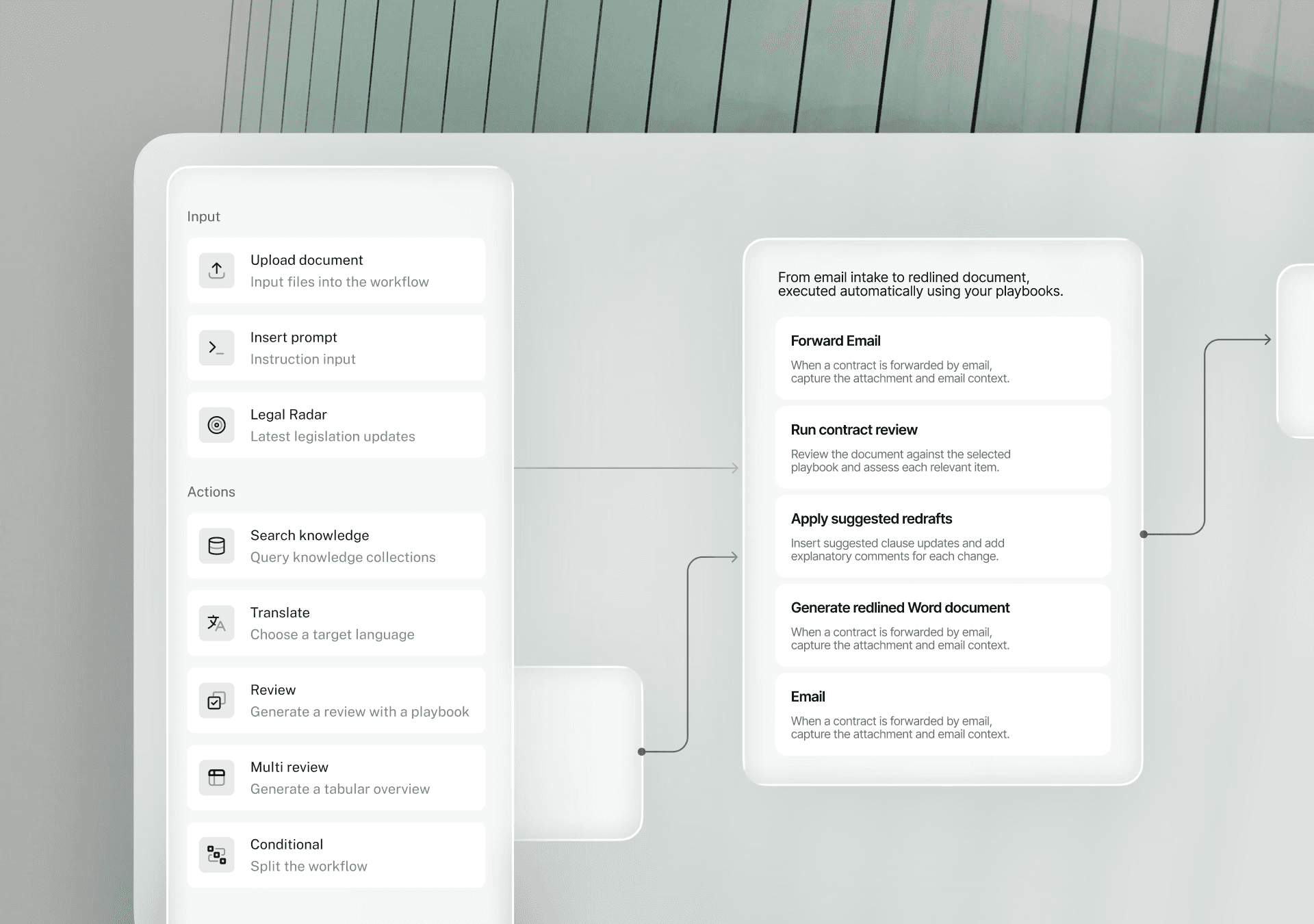
Agent Studio for comprehensive legal workflow automation: build multi-step legal processes once, trigger them from email, Teams, Outlook, Slack or a webhook, and set conditional routing, escalation thresholds and legal sign-off at each stage so work moves without anyone directing it
Contract Intelligence across the full contract lifecycle, pre and post signature. Rather than storing agreements once they are signed, it keeps track of what is in them, what has changed, where risk sits, which obligations are coming up and what needs attention next
AI legal document review through the Multi Review agent, scanning hundreds of contracts simultaneously against the same playbook criteria and presenting results in a structured, comparable format for due diligence, portfolio audits and regulatory compliance sweeps
120+ pre-built playbooks covering 100+ document types, usable out of the box or customised to your risk tolerance, preferred language and escalation rules, with a Playbook Builder that generates a custom playbook from your own golden contracts in around two minutes
Playbooks that separate business checks such as payment terms and liability caps from legal checks such as regulatory compliance and jurisdiction requirements, and encode fallback positions and exception handling for negotiation
Contract drafting with a reported 50% reduction in drafting time, and a structured review report exportable with findings, risk levels and recommended actions for sign-off or escalation
Regulatory tracking software for monitoring and horizon scanning across 70+ jurisdictions, alerting your team before changes affect your contracts
AI for legal research grounded in 700+ official sources, with a citation on every answer and plain-English querying rather than Boolean syntax
Anonymisation built into the core architecture before AI processing, with an LLM-agnostic design, ISO 27001 and SOC 2 Type II certification, and SaaS, single-tenant and on-premises anonymisation deployment options
Connections to Microsoft Word, SharePoint, Teams, Outlook, Copilot, Slack and Google Drive, so a review can be triggered from an email, a message or a stored file without switching tools or copying documents manually
To find out how LEGALFLY could work for you, schedule a call with one of our experts.
How Contract Review Works in LEGALFLY
Here is how a typical contract review runs inside LEGALFLY, from document intake to final report.
You pull the document from SharePoint or Google Drive, open it in Microsoft Word, or trigger a review directly from Teams, Outlook or Slack. There are no manual uploads or copying, and sensitive data is anonymised automatically before any AI processing begins.
You then choose from 120+ pre-built playbooks covering 100+ document types, or use a custom playbook built from your own golden contracts, so your fallback positions, escalation rules and preferred language apply from the start rather than a generic template.
LEGALFLY detects the contract type, jurisdiction, language and party roles so every review starts with the right context, then flags risks and non-compliant clauses. Suggested redrafts match your house style and risk posture, with acceptable, fallback and not-acceptable positions displayed inline. Final judgment remains with your team, and every output is explainable and traceable.
You then export a structured review report with findings, risk levels and recommended actions for sign-off or escalation, with audit trails and consistent outputs across all reviewers supporting governance and compliance requirements. Every step keeps your team in control: LEGALFLY surfaces the risks, recommends the redlines, and flags what needs escalation.
Why We're the Best Spellbook Alternative
The difference is not that LEGALFLY drafts better. It is that drafting is one agent on a platform rather than the product. A team that adopts a drafting tool still owns the review queue, the compliance sweep and the portfolio audit; a team that adopts a platform hands all three to the same set of playbooks.
That shows up most clearly at volume. Reviewing contracts one at a time is fine at ten a month and untenable at two hundred, which is the point most in-house teams reach within a year of contract volume rising against flat headcount.
The second difference is architectural. Anonymisation happens at import rather than as a configurable setting, so confidential information, party names and commercially sensitive terms never reach an underlying model in their original form. For enterprise legal teams in regulated sectors, that distinction is what makes deployment possible at all.
The third is reach. Agent Studio extends legal's own playbooks to procurement, compliance, HR and sales, so the teams that generate the requests can move their own work inside rules legal wrote once, with anything outside standard parameters routing back automatically. No Word add-in can do that, because the work never reaches Word until someone has already decided who owns it.
LEGALFLY helps your team move faster: less time buried in contracts, more time on the work that actually matters. Book a call to see it in action.
Pros
Cuts review time by 93%, the result Adeera measured across its own contracts
Handles high-volume contract review through batch processing across a portfolio
Consistent playbook enforcement across all reviewers and departments
Privacy-first design with automatic anonymisation before AI processing
No system change required for teams already in Microsoft 365
Trusted by enterprises including SAP, Lufthansa, Bosch and KPMG
Cons
Advanced feature configuration requires initial setup investment
Not designed for law firms or solo practitioners
Best value for teams with consistent contract volume rather than occasional review
Final Verdict
If your team is reviewing contracts one by one and still spending hours on each one, LEGALFLY is built for this problem. It is the strongest fit for in-house teams whose contract volume has outgrown a drafting tool and whose security team has started asking harder questions.
It is the wrong choice for a solo practitioner or a small firm doing clause-level drafting, where Spellbook remains the more proportionate tool. That is a genuine boundary rather than a hedge.
To find out how LEGALFLY could work for you, schedule a call with one of our experts.
2. Cicerai
Overview
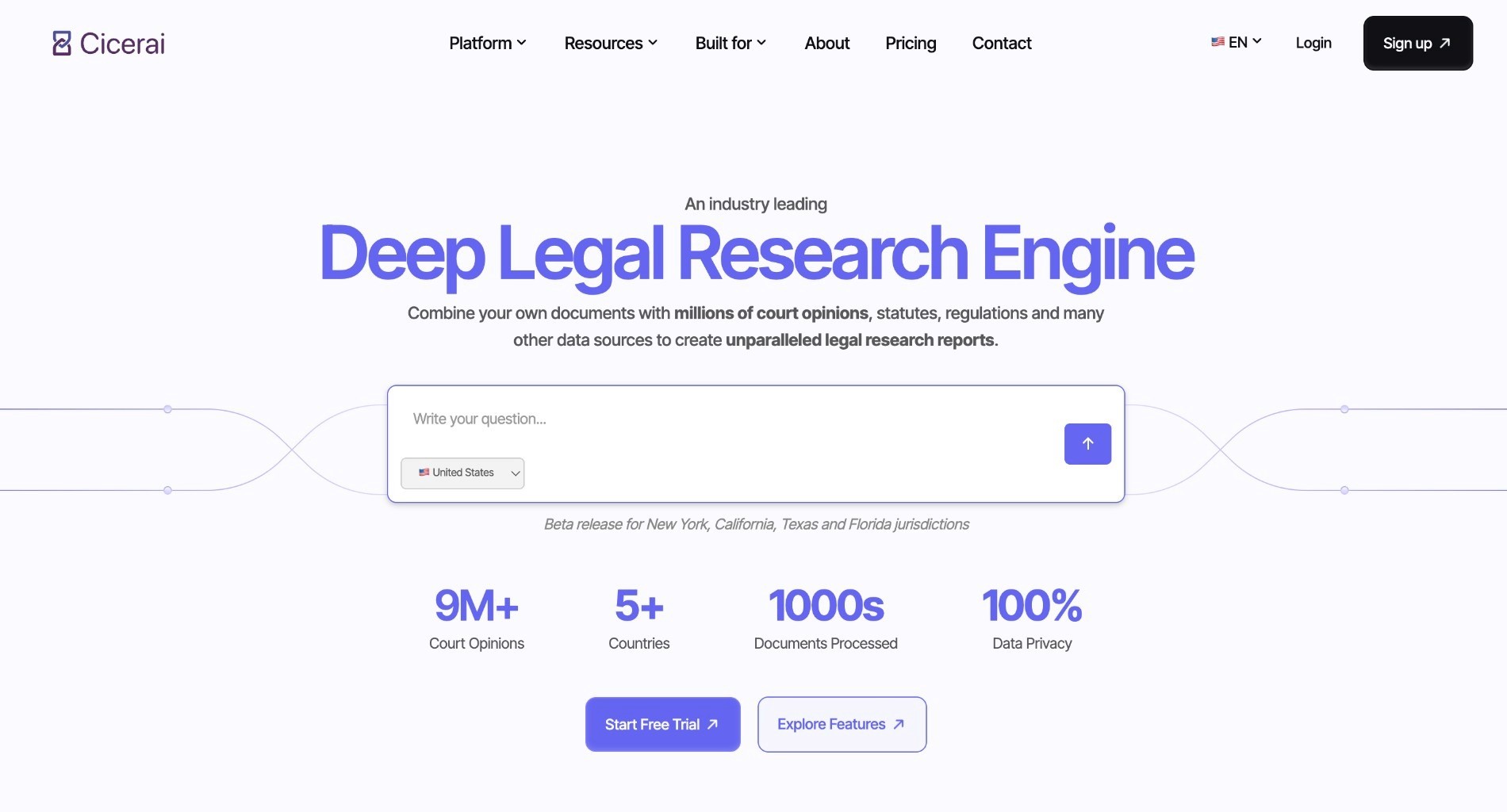
Cicerai is an AI-powered legal research and contract analysis platform focused on accelerating contract review, risk identification, and document understanding. It excels at quickly analysing complex contracts and surfacing key issues through natural-language querying.
It is a strong option for legal teams focused on due diligence and document-heavy workflows, sitting closer to research than to negotiation. Its strength is reading a document you did not write and telling you quickly what is in it, which is a different job from enforcing a position across a contract population.
Ideal For
Legal teams whose primary need is deep legal research across case law, statutes, and regulations
Contract review and risk analysis on third-party paper
Due diligence and document-heavy workflows
Mid-size to large legal teams without a governed review process in place
Top Features
AI-driven contract review and risk identification
Clause extraction and document summarisation
Legal research across statutes, case law, and documents
Natural-language querying of contracts
Integration with document-based legal workflows
Why It's a Strong Spellbook Alternative
Cicerai excels at quickly analysing complex contracts and surfacing key risks and insights, significantly reducing manual review time.
For teams whose use of Spellbook was mostly about understanding an incoming agreement rather than drafting one, it is a more direct answer, and the natural-language interface means there is no query syntax to learn before it becomes useful.
Pros
Strong contract review and analysis capabilities
Effective for due diligence and document-heavy work
Easy-to-use natural-language interface
Accessible without heavy IT infrastructure behind it
Cons
Limited drafting functionality
Not a full contract lifecycle management solution
Not built for governed review workflows or playbook-driven risk analysis
No anonymisation before processing
Final Verdict
Cicerai is a smart choice for legal teams whose main need is deep research and fast document understanding, particularly during due diligence.
It is not a governed review platform, and teams leaving Spellbook because they need playbook enforcement or bulk review will find the same gap here.
3. Ironclad
Overview
Ironclad is a comprehensive CLM platform with integrated AI review and workflow automation, supporting the full contract lifecycle from intake to post-signature management. Its strength is automating complex approval workflows and providing a single repository for contracts across the enterprise.
Implementation is involved, and the platform is most suited to large enterprise legal departments with established contract management infrastructure. It is a platform decision rather than a tooling decision.
Ideal For
Large enterprise legal and procurement teams needing full contract lifecycle management from intake to post-signature tracking
Organisations wanting deep Salesforce integration and centralised contract data across the business
Teams whose bottleneck is workflow automation and analytics rather than review quality
Enterprises replacing an ageing CLM rather than adding an AI layer
Top Features
End-to-end contract lifecycle management
AI-driven review and redrafting
Robust workflow automation and approval routing
Integration with CRM, ERP, and business systems
Why It's a Strong Spellbook Alternative
Ironclad's strength is its ability to automate complex workflows and provide a single source of truth for contracts across the enterprise.
If the reason you are leaving Spellbook is that better drafting never changed how contracts move through the business, a CLM answers the other half of that problem: intake, approvals, signature, storage and renewals become governed steps rather than email threads.
Pros
Full lifecycle automation from intake to renewal
Powerful analytics and reporting
Strong enterprise integrations
Self-service contracting from pre-approved templates
Cons
Implementation can be complex and is measured in months
Heavier than most teams need if the goal is faster review
AI review depth sits behind AI-native review platforms
No anonymisation before processing
Final Verdict
Ironclad is the right answer when the problem is the contract lifecycle itself across several departments, and when consolidating systems is a goal in its own right.
For a team that simply wants review to stop taking two hours, this is a disproportionate response. A review-first platform gets there faster and with far less implementation.
4. LegalOn
Overview
LegalOn specialises in AI-powered contract review with a focus on compliance and risk mitigation through playbook enforcement. It is well regarded for teams that prioritise consistent compliance checking during both drafting and initial review.
Outside of review and drafting, workflow customisation is more limited, which may constrain teams looking for broader legal workflow automation beyond the contract work itself. Its defining choice is the attorney-built playbook library, which ships ready to use rather than waiting on your configuration.
Ideal For
In-house legal teams wanting AI-powered contract review and redlining inside Microsoft Word, with attorney-built playbooks and a knowledge repository
Compliance-driven contract reviews in regulated sectors
Midsize to large legal teams without a documented playbook of their own yet
Teams that need to start reviewing on day one rather than after a configuration project
Top Features
AI-powered review and risk identification
Playbook-based revisions with attorney-curated content
Intuitive user interface with fast adoption
Integration with Word, DMS, and CLM systems
Why It's a Strong Spellbook Alternative
LegalOn is ideal for teams that prioritise compliance and need robust playbook enforcement during both drafting and review.
It is the closest direct upgrade path from Spellbook: the same Word-native working pattern, with a governed review layer on top and positions written by lawyers rather than assembled by the buyer.
Pros
Strong compliance and risk focus
Easy to use and adopt
Effective playbook enforcement out of the box
Attorney-written content maintained by an in-house legal team
Cons
Less automation outside review and drafting
Limited workflow customisation
Integration surface narrower than platform competitors
No anonymisation before processing
Final Verdict
LegalOn is one of the smartest choices for compliance-driven in-house teams that want consistent, auditable review without a long implementation, and it is the most natural step up from a Word add-in.
Teams needing workflow automation beyond the review itself, or bulk analysis across a portfolio, will hit the same ceiling within a year and should compare the platform entries instead.
LEGALFLY helps your team move faster: less time buried in contracts, more time on the work that actually matters. Book a call to see it in action.
5. Lexion
Overview
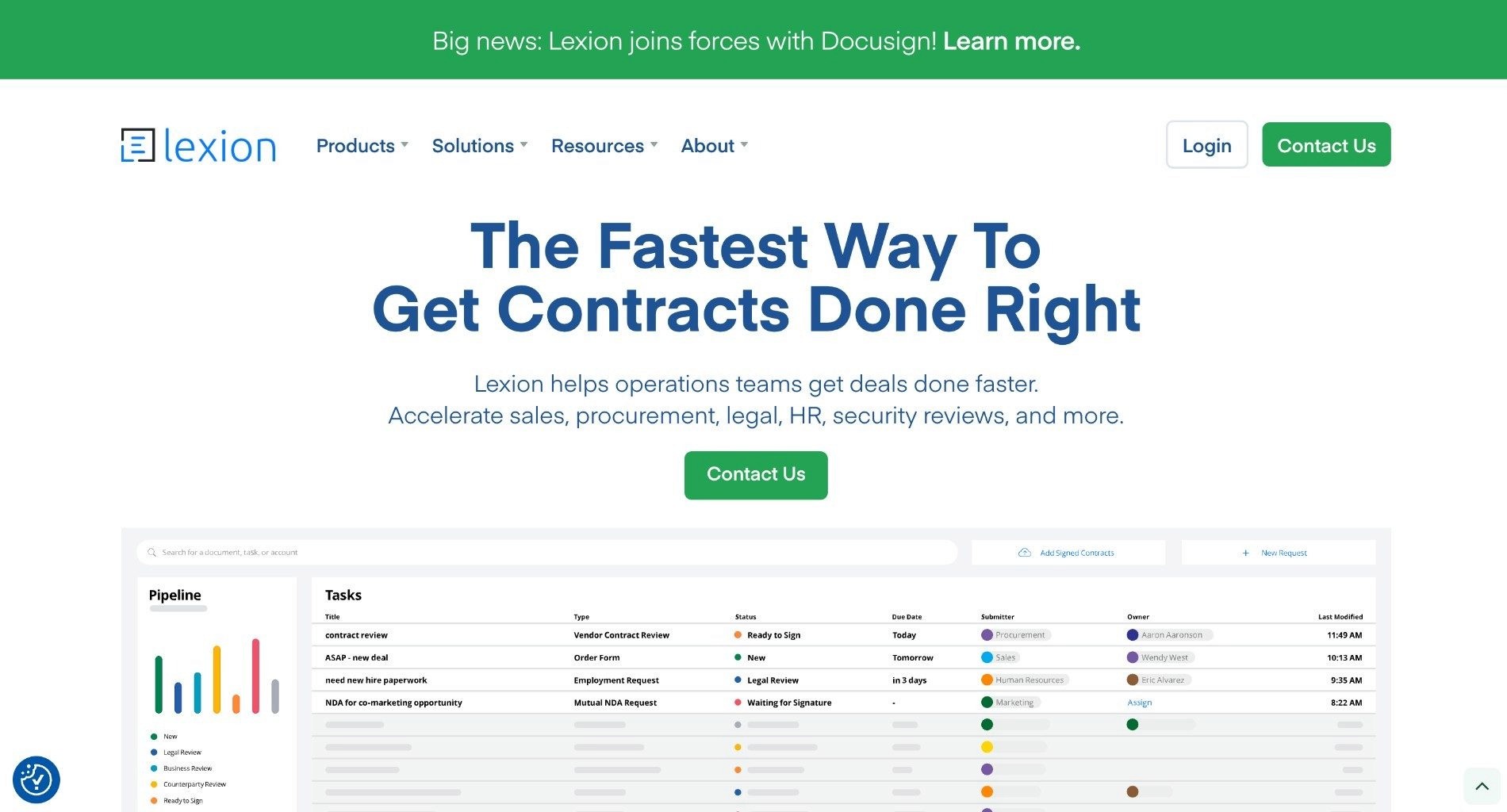
Lexion combines AI-powered contract repository intelligence with lightweight drafting and workflow automation. It is a practical choice for small firms and smaller in-house teams that need fast contract creation and repository search without the overhead of a full CLM or a heavy enterprise implementation.
For large legal teams handling high-volume contracts or needing advanced automation, its capabilities are more limited. It sits deliberately between a drafting tool and a CLM rather than trying to be either.
Ideal For
Legal teams needing a fast-to-implement CLM with strong repository intelligence and automated contract extraction
Small to midsize legal teams wanting fast drafting and repository management
Teams needing no-code workflow automation for approvals and business stakeholder self-service
Organisations that want contract intelligence without an enterprise implementation
Top Features
AI-powered contract repository and search
Generative drafting based on contract intelligence
Workflow automation for requests and approvals
Integration with DMS, CLM, and Word
Why It's a Strong Spellbook Alternative
Lexion's unique value is its ability to leverage contract data for smarter drafting and repository management, all in a lightweight package.
For a team that outgrew Spellbook but is not ready for an enterprise platform, it is the most proportionate step: drafting stays fast, and the repository layer answers the questions a Word add-in cannot.
Pros
Fast, intuitive drafting
Strong repository intelligence
Comprehensive integrations available
Quick to implement compared with full CLM platforms
Cons
Limited advanced automation
Not as feature-rich for large enterprises
Lighter enterprise security and deployment options than platform competitors
No anonymisation before processing
Final Verdict
Lexion suits small and midsize teams that want drafting speed plus a searchable, intelligent repository without committing to a full CLM rollout.
Large enterprises with high volume, multi-jurisdiction exposure or strict data residency requirements will outgrow it, and should look at the platform entries above.
Why LEGALFLY Works Across Multiple Use Cases
Spellbook answers one question well: how do I get this document right, faster. In-house teams usually have four or five other questions running at the same time. Here is where that shows up.
LEGALFLY for In-House Legal Teams
A team of 3 to 200 supporting a multi-jurisdiction enterprise has a queue problem rather than a drafting problem. Contracts arrive faster than they clear, and the same clause gets a different answer depending on who picked it up and when.
Playbook-driven review fixes both at once: the standard is applied uniformly and the volume gets absorbed, with every decision carrying the rule it was based on. That is what makes an accepted position defensible six months later.
LEGALFLY for Procurement Teams
Procurement owns the contracts that wait longest in the legal queue, and the wait is rarely about risk. Standard vendor paper sits behind negotiated agreements because there is one queue and one set of reviewers.
With approved positions encoded once, procurement clears standard paper without a lawyer touching it and routes only genuine deviations. Supplier lead times drop without anyone loosening the standard, which no drafting tool can deliver.
LEGALFLY for Compliance and Risk Teams
Teams working against the EU AI Act, DORA, NIS2, CSRD and CSDDD need to know what changed, which of their own documents it touches, and be able to prove they acted. Manual monitoring caps out at one or two jurisdictions per person.
Monitoring across 70+ jurisdictions removes that ceiling, and because impact is tested against your own contracts, the output is a list of documents to fix rather than a newsletter to read.
LEGALFLY for Due Diligence and Portfolio Audits
Diligence and audit work are volume problems with deadlines attached. The deliverable is a defensible view across several thousand agreements, not a better read of one.
Multi Review applies one playbook across a whole data room, ranks findings by deviation severity and links each one to its source clause, so the review is reproducible rather than a snapshot of what someone noticed.
LEGALFLY for Sales and Commercial Teams
Sales does not want a legal tool. Sales wants an NDA back the same day, and will use whatever gets them there fastest, including a general chatbot and a copy-pasted clause.
Self-service review inside rules legal already set turns a two-day wait into a same-day answer and keeps the terms inside approved language. It also removes the main reason sales goes around legal in the first place.
What Makes a Good Spellbook Alternative?
Spellbook does drafting well, so an alternative that only drafts better is not solving the problem most teams are moving for. These are the criteria that decide it.
1. It Reviews at Volume, Not One Document at a Time
The moment contract volume outgrows the team, the constraint moves from document quality to throughput. A genuine alternative applies the same playbook across a batch and returns a structured, comparable result rather than a set of files to open individually.
Ask to see a portfolio review during the demo, not a single contract. That is where the difference between a drafting tool and a platform becomes obvious.
2. It Applies Your Standard, Not a Market Average
Benchmarking tells you whether a clause is market standard. A playbook tells you whether it is acceptable to you, which is the question your General Counsel is actually asking.
Check whether the platform can generate a playbook from your existing golden contracts, whether rules can differ by jurisdiction, and who updates a position when it changes.
3. It Protects Data Before the Model Sees It
Get the answer in writing before the shortlist closes. Is data anonymised before analysis or after, where is it processed, and can the anonymisation component run inside your own environment?
Certifications are the baseline: every serious vendor holds ISO 27001 and SOC 2 Type II. The sequence is what separates them in a security review.
4. It Works Where Your Team Already Works
Word-native adoption is the thing Spellbook got right, and any alternative that ignores it will lose on usage regardless of capability. Review happens in Word and starts in Outlook or a document system.
Confirm the Word add-in, your document system and your storage layer before the pilot. A platform that only reads uploads is adding a step to every review.
5. It Moves the Work, Not Just the Document
Most of the elapsed time in a contract process is spent waiting: for assignment, for approval, for a status update. Improving the document does nothing to that, which is why teams report faster drafting and the same cycle time.
Ask to see a workflow triggered from an email or a Teams message and run end to end. If the answer is a roadmap item, the platform is a better editor rather than a different category.
Most teams using LEGALFLY cut their contract review time in half within a few weeks of onboarding. Book a short demo to see how it works for your business.
How to Choose the Right Spellbook Alternative for Your Needs
The right Spellbook alternative depends on where your team's biggest friction actually sits. Here is what to evaluate, in the order that decides most evaluations.
1. Quality and Accuracy of AI Outputs
The quality of outputs matters most when evaluating legal AI, but it can be the hardest aspect to judge. Try to understand how underlying models have been refined for the legal domain, for example through legal publisher or law firm partnerships. During the evaluation, make sure you can test the platform on the specific use cases and documents you want to review or create.
Measure the share of suggestions your lawyers accept without editing. That single number tells you more than any accuracy claim, and it is easy to capture during a pilot.
2. Governance, Security, and Compliance
Look for robust governance features such as granular permissions, audit trails, approvals, and policy controls. Enterprise adoption also depends on strong security and compliance foundations, including data hosting options, encryption, certifications, and privacy-first handling of sensitive information.
Ask specifically what happens to a document before a model reads it, and bring your security team in during shortlisting rather than at contract. A tool that fails this in month four has cost you the whole evaluation.
3. Playbooks and Clause Intelligence
If contract review is your main use case, look into playbook functionality. How easy is it to build your own review playbooks, and how comprehensive are the options to add preferred wording, fallback clauses, and define acceptable levels of risk? When it comes to redlining, the most advanced tools insert language based on your precedents and surgically edit text rather than replacing entire clauses.
Then ask the maintenance question, which almost nobody asks in a demo: when a position changes, who updates it, and does the change apply everywhere at once or contract by contract?
4. Workflow and Integrations
The less change to daily workflows required, the easier software is to implement. The most effective tools connect directly to systems like Microsoft Word and document repositories like SharePoint. Integrating an AI solution with your contract lifecycle management platform can enable automated routing, redlining, review, and approvals, but may mean a longer implementation timeframe.
How well a tool fits your existing workflows is often the deciding factor in adoption. For a closer look at how leading platforms compare on this, see our breakdown of the best legal workflow automation tools for in-house teams.
5. Scalability and Performance
Evaluate how well the platform handles growing volumes, multiple teams, and parallel matters. Enterprise-ready tools support batch review, high usage across regions, and structured workflows that avoid bottlenecks as your organisation and contract load expand.
The test worth running is not whether it works on one contract, but whether it still works on the two hundredth in a month, applied by six different reviewers.
6. Return and Scope of Deployment
Weigh the measurable gains in cycle times, risk reduction, and reduced outside counsel work against the scope of what you are deploying. A platform that covers review, drafting, research and monitoring replaces more than one line in the stack, which changes the comparison.
Model the full deployment rather than the software alone: implementation, playbook configuration, training and the rollout sequence across teams. Start with one workflow, prove it, then extend.
Everything You Need to Know About Spellbook Alternatives
Category | Key considerations |
|---|---|
Top 3 alternatives | LEGALFLY for governed review at volume with anonymisation, LegalOn for Word-native review with attorney-built playbooks, Lexion for lightweight drafting plus repository intelligence |
Best overall option | LEGALFLY. Playbook-driven review inside Microsoft Word, bulk analysis across a portfolio, drafting, research and regulatory monitoring on one platform, with anonymisation before analysis |
Why look for Spellbook alternatives | Document-level drafting does not clear a review queue, does not scale to portfolio work, and passes text to a model in its original form, which regulated teams increasingly cannot accept |
How to choose | Work out whether your friction is drafting or review, check data handling in week one, test playbook quality on your own contracts, and confirm the tool works where your team already does |
Ease of switching | Straightforward for platforms that run inside Microsoft 365, since there is no repository to migrate. LEGALFLY deployments are measured in days; full CLM platforms take several months |
Must-have features | Playbook enforcement against your own positions, bulk review across a portfolio, anonymisation before analysis, native Word integration, and clause-level explainability |
Mistakes you should not make | Buying a better editor when the problem is the queue, leaving the security question until month four, evaluating on the vendor sample set, and ignoring who maintains playbooks after go-live |
Ready to Move On from Spellbook? Try LEGALFLY
Three things separate LEGALFLY from everything else on this list. Documents are anonymised before analysis begins, on an architecture designed pre-LLM rather than added later. Review runs against your own playbooks at portfolio scale, not one document at a time. And Agent Studio extends those same playbooks to procurement, compliance, HR and sales, so the whole business moves faster while legal keeps control of the standard.
It is built for one buyer in particular: the in-house legal, compliance or procurement team inside a mid-to-large regulated enterprise, standardised on Microsoft 365, reviewing contracts at volume across more than one jurisdiction.
Spellbook remains a useful tool for AI-assisted drafting inside Microsoft Word, particularly for transactional lawyers and small firms doing clause-level contract work. For in-house legal teams dealing with contract review at scale, playbook enforcement, and multi-jurisdiction compliance, it was not built for that problem.
The best Spellbook alternatives for 2026 offer broader workflows, deeper playbook intelligence, more robust automation, and stronger governance. LEGALFLY stands out as the most comprehensive option for in-house legal teams, delivering playbook-driven contract review, bulk document analysis, privacy-first architecture, and the Microsoft 365 integrations that enterprise teams already rely on.
If your team is managing a growing contract load with flat headcount and still spending hours reviewing contracts individually, the gap between Spellbook and a full legal AI platform is where the value sits.
Book a demo to see how LEGALFLY handles your specific contract types and volumes.
To find out how LEGALFLY could work for you, schedule a call with one of our experts.
FAQs About Spellbook Alternatives
What is Spellbook used for?
Spellbook is used for AI-assisted contract drafting and redlining inside Microsoft Word. It suggests clauses, flags risks and generates redlines in the document a lawyer already has open, which makes it a practical entry point for transactional lawyers and small firms. It also benchmarks language against a large contract corpus, answering whether a position is market standard.
What is the best Spellbook alternative in 2026?
LEGALFLY is the top Spellbook alternative for 2026. It offers advanced AI contract drafting, multi-document review at scale, comprehensive review playbooks, and enterprise-grade governance. It is deeply integrated with Microsoft 365, making adoption smooth for in-house legal teams that do not want to change how they work.
What are the best Spellbook alternatives for in-house teams?
The best Spellbook alternatives for in-house teams are LEGALFLY for governed review at volume with anonymisation before analysis, LegalOn for Word-native review with attorney-built playbooks, Cicerai for research-led document analysis, Lexion for lightweight drafting plus repository intelligence, and Ironclad for full contract lifecycle management. Which one fits depends on whether your friction is review throughput, contract logistics or research.
What features should I look for in a Spellbook alternative?
Look for bulk review across a contract portfolio, playbook enforcement against your own approved positions rather than market averages, anonymisation before any AI processing, native Microsoft Word integration, and workflow automation that runs from intake to approval. Those five cover the gaps in-house teams most often cite when outgrowing a drafting tool.
How to choose the best Spellbook alternative for your needs?
Start by identifying whether your biggest friction is drafting or review, because that single question eliminates most of the list. Then check data handling with your security team in week one rather than month four, test playbook quality on three of your own contracts, and confirm the platform works inside the applications your team already opens. Measure adoption at week six.
Is it easy to switch from Spellbook to an alternative?
Switching is straightforward for platforms that run inside Microsoft 365, because there is no repository to migrate and no new interface to learn. LEGALFLY deployments are typically measured in days, with teams starting on one contract type and one playbook before extending. Moving to a full contract lifecycle management platform such as Ironclad takes several months, since it touches sales, procurement and finance as well as legal.
Which Spellbook alternatives work inside Microsoft Word?
Most leading AI contract tools, including LEGALFLY, Spellbook, and LegalOn, provide native Microsoft Word integrations for drafting and review. Platforms like Ironclad focus more on browser-based or CLM-native drafting environments, and Lexion works across Word alongside its repository. Confirm which applications your team actually opens before shortlisting.
Are AI contract drafting tools reliable for legal teams?
Yes. Modern AI legal drafting tools are highly reliable when paired with human review. Solutions such as LEGALFLY offer explainable outputs, audit trails, playbook alignment, and automated risk detection to ensure accuracy and compliance at scale. Final judgment stays with the lawyer, and every suggestion carries the rule it was based on.
What is the best AI contract drafting solution for enterprise workflows?
LEGALFLY is purpose-built for enterprise legal operations. Its breadth of functionality, privacy-first architecture, and Microsoft 365-native experience make it the strongest choice for complex organisations that need consistency, governance, and speed. Drafting sits alongside review, research and regulatory monitoring on the same platform rather than as a standalone tool.

