








This article breaks down user reported Harvey pricing figures, explains why quotes vary so widely, and shows what you should ask before committing. It also compares Harvey to LEGALFLY, an alternative built specifically for in-house legal teams, so you can see which platform fits your operating model and budget.
Note: If your legal team handles high-volume contracts, regulatory monitoring, and business intake across your organisation, not just law firm matters, then LEGALFLY's approach to implementation, Agent Studio workflows, and privacy-first architecture is built to handle that. Your playbooks and processes matter more than generic AI features. See how LEGALFLY compares to Harvey on the features your in-house team actually uses. Book a demo today.
The cost of Harvey AI
Harvey does not publish its rates. If you want an exact price for your legal team, you need to contact sales. Publicly available figures vary widely.
Harvey's own 2026 ROI calculator for in-house teams suggests a cost of roughly $288 to $500 per legal employee per month, depending on team size.
But reported buyer quotes are much higher. In one 2026 Reddit discussion, a buyer at a 100-lawyer firm said Harvey initially quoted $1,200 per user per month, rising to $2,400 with Lexis integration, before later offering a lower tier at around $399 per user per month.
Here is what Harvey's own in-house calculator shows. Reports suggest these prices are for a basic set up without tools like iManage:
Users | Annual Harvey cost ($) | Effective monthly cost per employee ($) |
5 | 30000 | 500 |
10 | 54000 | 450 |
20 | 93000 | 388 |
50 | 210000 | 350 |
100 | 390000 | 325 |
200 | 690000 | 288 |
If these costs are too high, explore more Harvey AI alternatives.
Reported Harvey prices vary for several reasons
Products, integrations, legal content, deployment size, support, and negotiated terms can all affect the final cost.
Minimum commitments are also unclear. Harvey does not publish a standard seat minimum. Public buyer reports include everything from 15 users to 30-person pilots and larger commitments, while other buyers say no minimum applied to their deal.
Fast Company previously reported a 100-employee, one-year commitment for Harvey's bespoke services.
Most teams using LEGALFLY cut their contract review time in half within a few weeks of onboarding. Book a short demo to see how it works for your business.
The seat price does not tell you the full cost
For an in-house team, the number of lawyers with licences is only one part of the economics.
You may have ten lawyers supporting 1,000 employees. Sales sends contracts for review, procurement needs clauses checked, HR asks employment questions, and compliance monitors regulatory change.
If those teams also need access to legal AI, you need to know who requires a paid licence, how occasional users are charged, what automated workflows cost, and how much internal work it takes to set everything up.
This is where LEGALFLY might work better.
LEGALFLY is built specifically for in-house legal teams and the business functions they support. Core legal users have full licences. Business users can access controlled legal workflows through lower-cost Collaborator Access, while automated workflows are charged according to use.
Read our 1 to 1 comparison of LEGALFLY vs Harvey AI.
Commercial model | Harvey | LEGALFLY |
Core pricing | Custom, per seat | Custom, per seat |
Small-team minimum | Not publicly documented | Single seat available |
Business-user pricing | No separate tier documented | Collaborator Access at 50% of standard seat price |
Workflow pricing | Not publicly documented | Usage-based |
That structure lets you match the cost to how people use legal AI. Lawyers can have full access, regular business users can work inside controls set by legal, and a much larger group can trigger workflows when they need legal support.
For an in-house team, that can make cost per completed legal process as important as cost per lawyer.
See how LEGALFLY fits your legal operating model
Explore how full seats, Collaborator Access, and automated workflows can work across legal and the wider business.
Implementation can matter as much as software
Buying legal AI also creates implementation work. Someone needs to connect your knowledge, configure permissions, build playbooks and workflows, and make sure people use the platform.
Both Harvey and LEGALFLY provide support.
Harvey describes enterprise onboarding as part of its offering and has legal engineering teams that help customers configure and optimise agents.
LEGALFLY takes a more hands-on approach, focused on in-house processes. You can build your own playbooks or have the LEGALFLY team create them from your internal guidelines and golden contracts.
At Duvel Moortgat, LEGALFLY worked with the legal team to examine existing workflows, identify where automation could help, and configure applications around the company's own contracts and processes.
If you run a lean legal department, this can affect the value you get from the platform. Ask who will configure it with you, what your lawyers need to build themselves, and how much support you receive after launch.
LEGALFLY helps your team move faster: less time buried in contracts, more time on the work that actually matters. Book a call to see it in action.
Harvey vs LEGALFLY: What do you get?
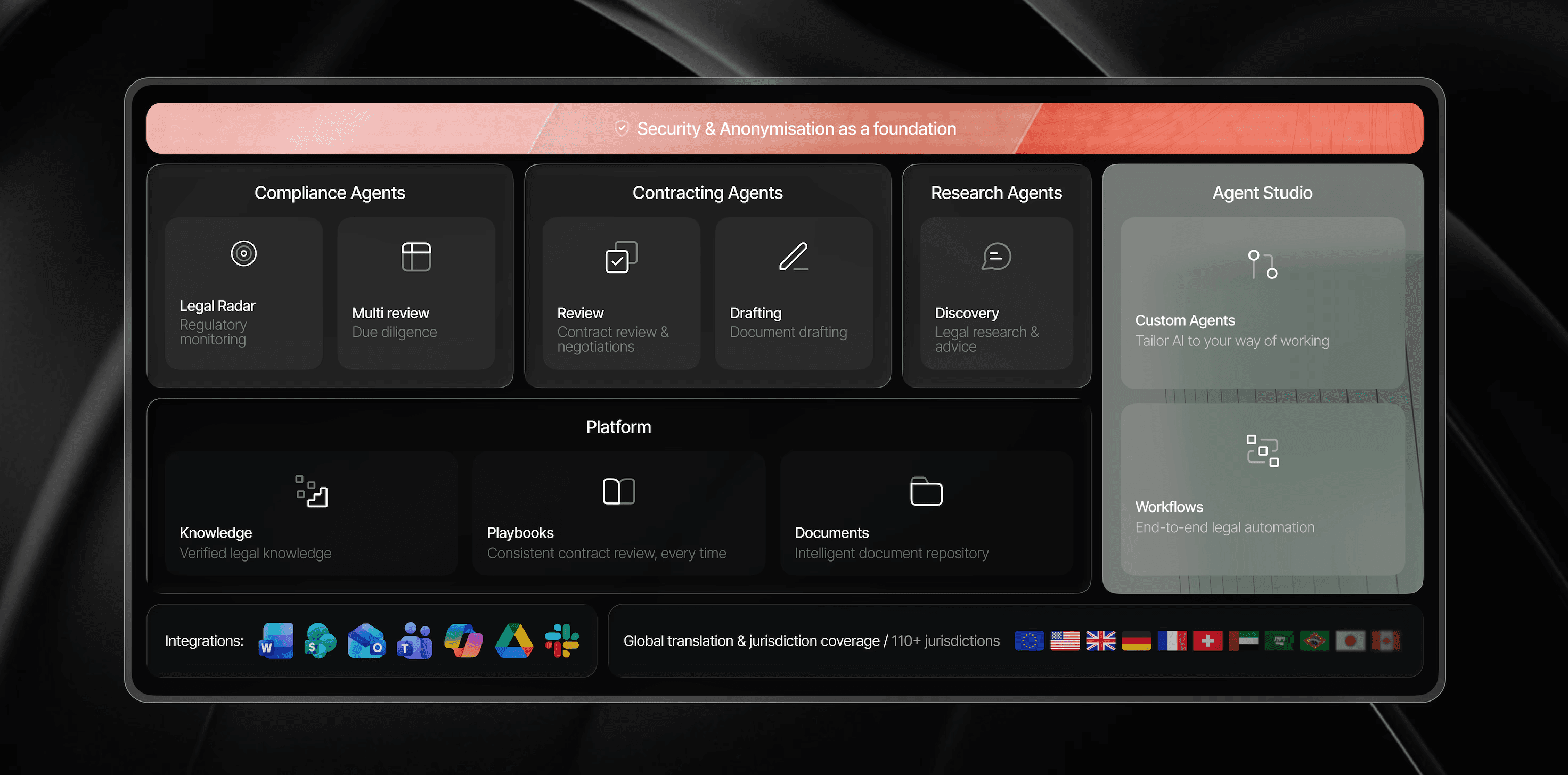
Harvey and LEGALFLY overlap across many core legal tasks. Both support research, contract work, drafting, document analysis, regulatory work, agents, and workflows.
The differences are clearer when you look at how each platform is designed and deployed.
Area | Harvey | LEGALFLY |
Built for | Law firms and in-house legal teams | In-house legal and business teams |
Implementation | Enterprise onboarding and legal engineering | Legal engineers on hand to support with set up, playbooks, workflow configuration, and whenever needed |
Legal research | 1,000+ legal knowledge sources | 130+ jurisdictions, 500+ official sources, verified legal content and internal knowledge |
Contract work | Contract Intelligence, review, drafting and playbooks | Contract Intelligence, Review, Draft and configurable playbooks |
Regulatory work | Check regulatory compliance across 100+ jurisdictions | Legal Radar for ongoing regulatory monitoring |
Bulk document analysis | Vault | Multi Review |
Agents and workflows | Agents and multi-step workflows | Agent Studio with conditional logic, approvals and escalation |
Privacy and deployment | Enterprise security and regional processing | Pre-processing anonymisation plus SaaS, private cloud, hybrid and on-premises deployment |
Legal research and knowledge
Harvey says its in-house platform can synthesise information from more than 1,000 legal knowledge sources, including LexisNexis and EDGAR. Its regulatory capabilities cover more than 100 jurisdictions and 12,000 source authorities.
LEGALFLY's Discovery covers legal research across 130+ jurisdictions. It combines verified legal publisher content and more than 500 official sources with your own documents, policies, and internal knowledge.
Discovery can also work directly with uploaded material and create Microsoft Word documents, Excel files, and PowerPoint presentations from the research.
See why LEGALFLY is a top-ranked legal research tool.
Regulatory monitoring
Harvey supports regulatory compliance across more than 100 jurisdictions and 12k source authorities. It does not update your contracts automatically.
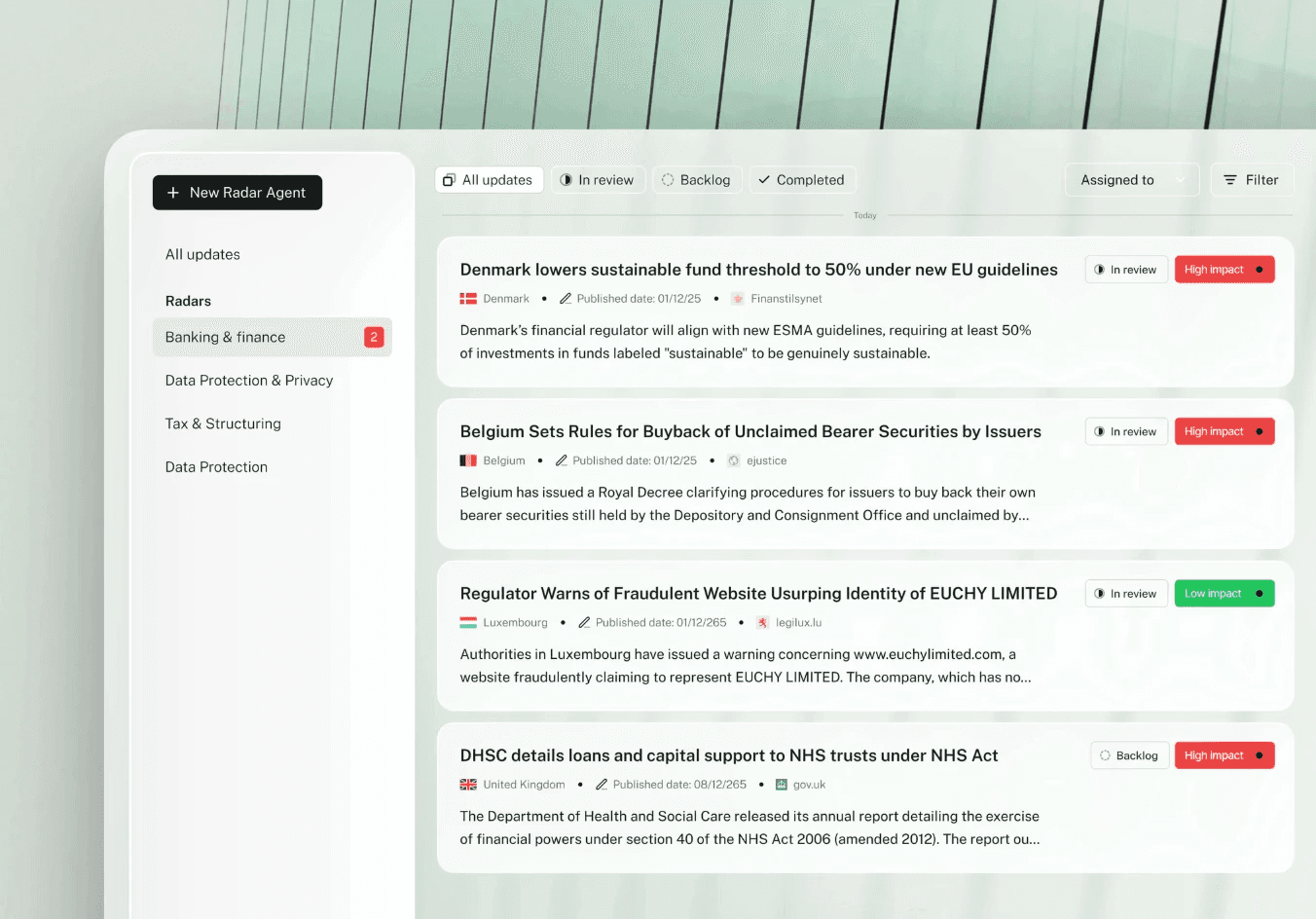
LEGALFLY’s Legal Radar is for ongoing monitoring. It tracks official regulators and publishers, filters changes against your jurisdictions, industry, and risk profile, and assesses what they mean for your business. You can then use Discovery to investigate an update further and connect it to affected contracts, policies, and actions.
LEGALFLY's Legal Radar feature puts it at the top of legal AI softwares.
Contract review and drafting
Harvey supports contract review against playbooks, forms, and templates, with drafting and tracked-change suggestions. Contract Intelligence extends this across contract intake, review, negotiation, and executed agreements.
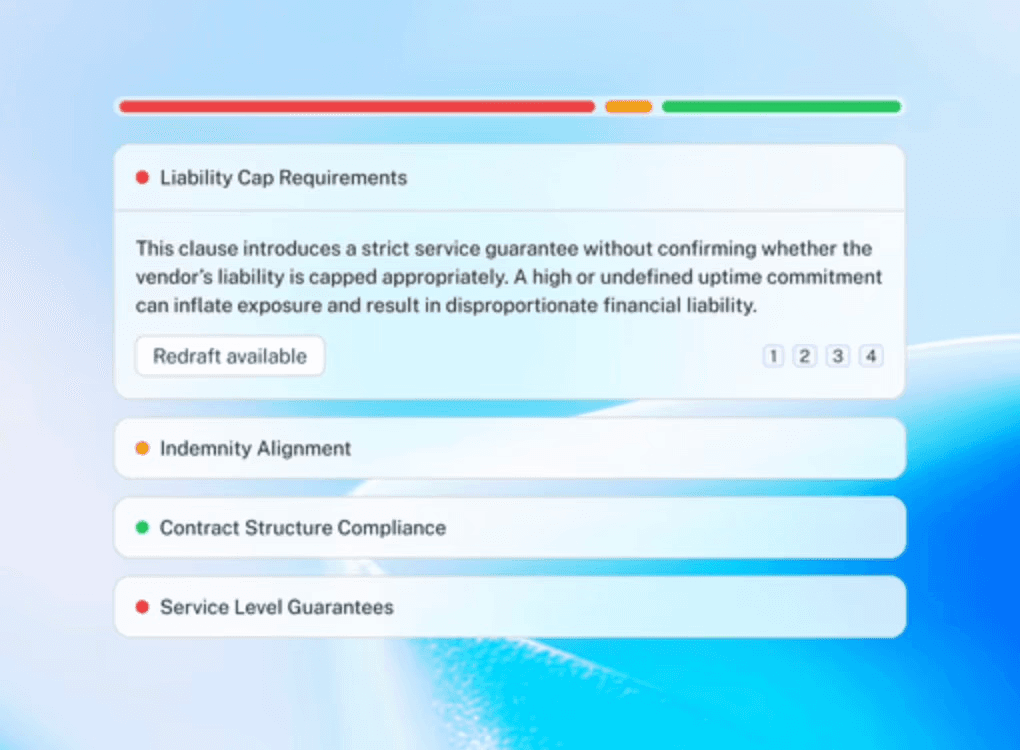
LEGALFLY Review applies your own playbooks to contracts, identifies departures from your approved position, and suggests redlines directly in Microsoft Word.
LEGALFLY includes more than 120 lawyer-built playbooks across more than 100 document types. You can also encode your preferred clauses, fallbacks, risk levels, and jurisdiction-specific rules, with support from the LEGALFLY team to turn existing guidance into working playbooks.
Draft can then turn existing contracts into reusable smart templates, with clause logic adapting to the jurisdiction and deal context.
Agents and workflows
Both platforms support agents and multi-step workflows.
Harvey says its in-house platform can move legal work from intake through to resolution.
LEGALFLY Agent Studio lets you configure the legal and operational steps around a task. Requests can come from email, Microsoft Teams, Slack, or manual intake. You can define approvals, conditional logic, follow-ups, and escalation thresholds.
For example, a contract request can automatically trigger Review against your playbook. Low-risk work can continue through the workflow, while exceptions are sent to legal for judgment.
You can also see how to use AI in your legal drafting workflows.
This is relevant if you want legal AI to extend beyond individual lawyers and into the way the wider business requests and receives legal support.

Privacy, security, and deployment
Harvey is SOC 2 Type II and ISO 27001 certified, alongside ISO 27701 and ISO 42001. It offers enterprise controls including SAML SSO, audit logs, access controls, and data lifecycle management, and says customer data is not used to train its models.
LEGALFLY is ISO 27001 and SOC 2 Type II certified and undergoes annual independent penetration testing.
Its architecture also anonymises sensitive information before AI processing. For organisations with stricter requirements, the anonymisation component can run inside your own environment so identifiable sensitive data is removed before information reaches your dedicated LEGALFLY tenant.
Deployment options include SaaS, single tenant, private cloud, hybrid, and full on-premises configurations.
Which delivers more ROI?
Both Harvey and LEGALFLY report substantial time and cost savings for in-house teams.
Harvey customers report savings of around four to eight hours per lawyer per week. Harvey's own ROI calculator uses a more conservative assumption of roughly 15 hours saved per legal employee per month.
LEGALFLY customer results are similarly concrete. Adeera cut contract review from 2-4 hours to 10-15 minutes. ECS reports 50% less time spent on document analysis. Wealins estimates savings of up to 20% of its legal team's working time alongside lower external legal spend.
Test LEGALFLY on your use cases
Bring the workflows you want to improve, from contract review and legal research to regulatory monitoring and business intake.
Is Harvey AI the best option for your team?
Harvey is an established legal AI platform covering research, contract work, drafting, document analysis, regulatory compliance, agents, knowledge, and workflows.
Its exact pricing remains private. Its in-house calculator suggests an average cost of about $500 per legal employee per month for teams of up to five, falling to $350 at 50 employees, $325 at 100, and $288 at 200.
But reported quotes show that the actual price can be much higher depending on the customer and configuration.
LEGALFLY offers a different proposition. It is built specifically for in-house legal teams, with lower-cost access for business users, usage-based workflows, hands-on implementation, and security architecture designed for enterprise legal work.
That can be particularly useful for lean legal teams that want to move beyond individual AI licences and build repeatable legal workflows people can use across the business.
Looking for a Harvey AI alternative built for in-house legal?
See how LEGALFLY combines legal AI, workflow automation, hands-on implementation, and governed access across the business.
FAQs
How much does Harvey AI cost?
Harvey does not publish a rate card. Its 2026 in-house ROI calculator suggests an effective cost of roughly $288 to $500 per legal employee per month, depending on team size. Reported buyer quotes can be much higher, at around $2,400 per seat per month.
Does Harvey AI charge per seat?
Yes. Harvey has said it plans to continue using per-seat pricing. Exact pricing depends on the customer, products, integrations, support, and negotiated terms.
What is the minimum number of Harvey AI seats?
Harvey does not publish a standard minimum. Public buyer reports vary, with some describing minimum commitments and others saying no minimum applied.
Why do reported Harvey AI prices vary so much?
Harvey pricing can vary according to team size, product scope, legal research content, integrations, implementation, support, and contract terms.
What is a Harvey AI alternative for in-house teams?
LEGALFLY is a Harvey AI alternative built specifically for in-house legal and business teams. It combines full legal licences, lower-cost business-user access, usage-based workflows, and hands-on implementation support.
Harvey vs LEGALFLY: which is better?
It depends on your operating model. Harvey serves both law firms and in-house teams. LEGALFLY focuses specifically on in-house legal operations, with flexible business-user access, configurable workflows, and hands-on playbook and workflow set-up.


