








For in-house legal teams, choosing the right AI platform is not just a technology decision, it is a question of how much control, visibility, and trust you can place in a system handling your most sensitive work. The market has moved fast. There are now dozens of platforms promising faster review, smarter drafting, and better compliance. Most were not built with in-house teams in mind.
Legora and LEGALFLY are two of the more credible options in this space. Both speed up legal work. Both integrate with Microsoft tools. But they differ in who they were built for, how they handle sensitive data, and how much transparency they give you over every output. This comparison breaks down what each platform actually does, where the key differences matter, and what GCs should know before making a decision.
Note: If you want fewer review bottlenecks, faster turnaround with document analysis, and full visibility into every clause decision, book a demo. We'll walk through how LEGALFLY fits into your existing Microsoft 365 environment and what it looks like on your contract types.
What is LEGALFLY?
Founded in Belgium in 2023, LEGALFLY is a top legal AI tool built specifically for in-house, compliance, and procurement teams. It covers contract review, drafting, legal research, compliance monitoring, and workflow automation in a single platform, all inside the tools your team already uses. In-house teams at SAP, Lufthansa, and AXA use it to review contracts 7x faster, without removing lawyers from decisions that matter.

The platform includes agents for contract review, multi-document review, drafting, legal research and regulatory horizon scanning. It supports 35 jurisdictions and integrates directly with Microsoft Word, Teams and SharePoint.
Best for: In-house legal, compliance, and procurement teams at regulated enterprises that need playbook-driven review, default anonymisation for data security, and full Microsoft 365 integration.
Here are some key considerations for why you should try LEGALFLY.
Your standards applied on every contract, automatically
When a contract comes in, LEGALFLY reviews it clause by clause against your playbooks, flagging deviations from your approved positions, identifying missing provisions, and proposing redrafts in your approved language. All of this happens directly in Microsoft Word, with suggested data-driven insights appearing as a tracked change and every suggestion tied to a specific playbook rule. Final judgment stays with the lawyer.
For high-volume work, regulatory compliance audits, M&A due diligence, supplier portfolio reviews, the Multi-Review Agent processes hundreds of contracts simultaneously, applying the same playbook checks at scale without proportional increases in legal resource.
To find out how LEGALFLY could work for you, schedule a call with one of our experts.
Sensitive data anonymised before any AI sees it
Every document processed through LEGALFLY is anonymised before AI contract analysis begins. Names, financials, counterparty details, and sensitive identifiers are stripped at the architecture level, not as a configuration option, but as the default. This means legal teams can run reviews on live transactions and confidential contracts without the data exposure risks that come with general-purpose tools.
LEGALFLY is ISO 27001 and SOC 2 Type II certified. For organisations with stricter requirements, single-tenant deployment and on-premise anonymisation are available, giving teams full control over where their data is processed and ensuring sensitive data never leaves their environment in identifiable form.
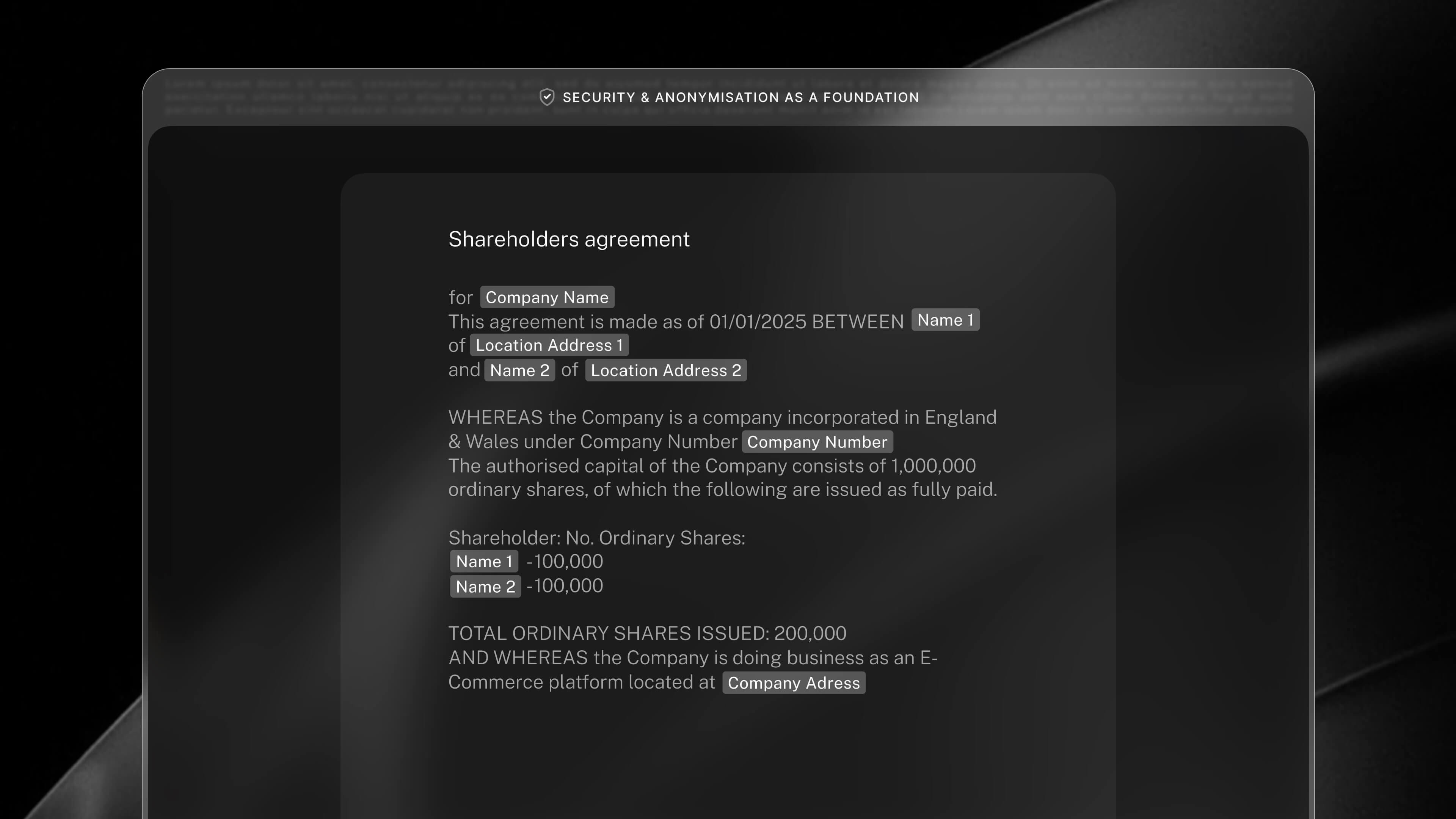
Drafting that starts from your approved language, not a blank page
LEGALFLY's smart templates generate complete, compliant contracts in seconds from pre-approved structures. Upload existing agreements and the platform converts them into reusable templates, automatically detecting variables like party names, governing law, and payment terms. Every new contract starts from an approved baseline, with a reported 50% reduction in drafting time.
For procurement and sales teams handling contracts without legal training, pre-approved templates with built-in guardrails mean they can self-serve routine agreements safely, within the boundaries legal sets once.
Research and regulatory monitoring built in
LEGALFLY's Discovery agent gives legal teams instant answers to legal questions drawn from 500+ official legal sources. Legal Radar monitors regulatory and legislative developments across your chosen jurisdictions, delivers tailored alerts, and includes a business impact assessment, so your team knows what changed, which contracts are affected, and what action is required, without manual tracking.
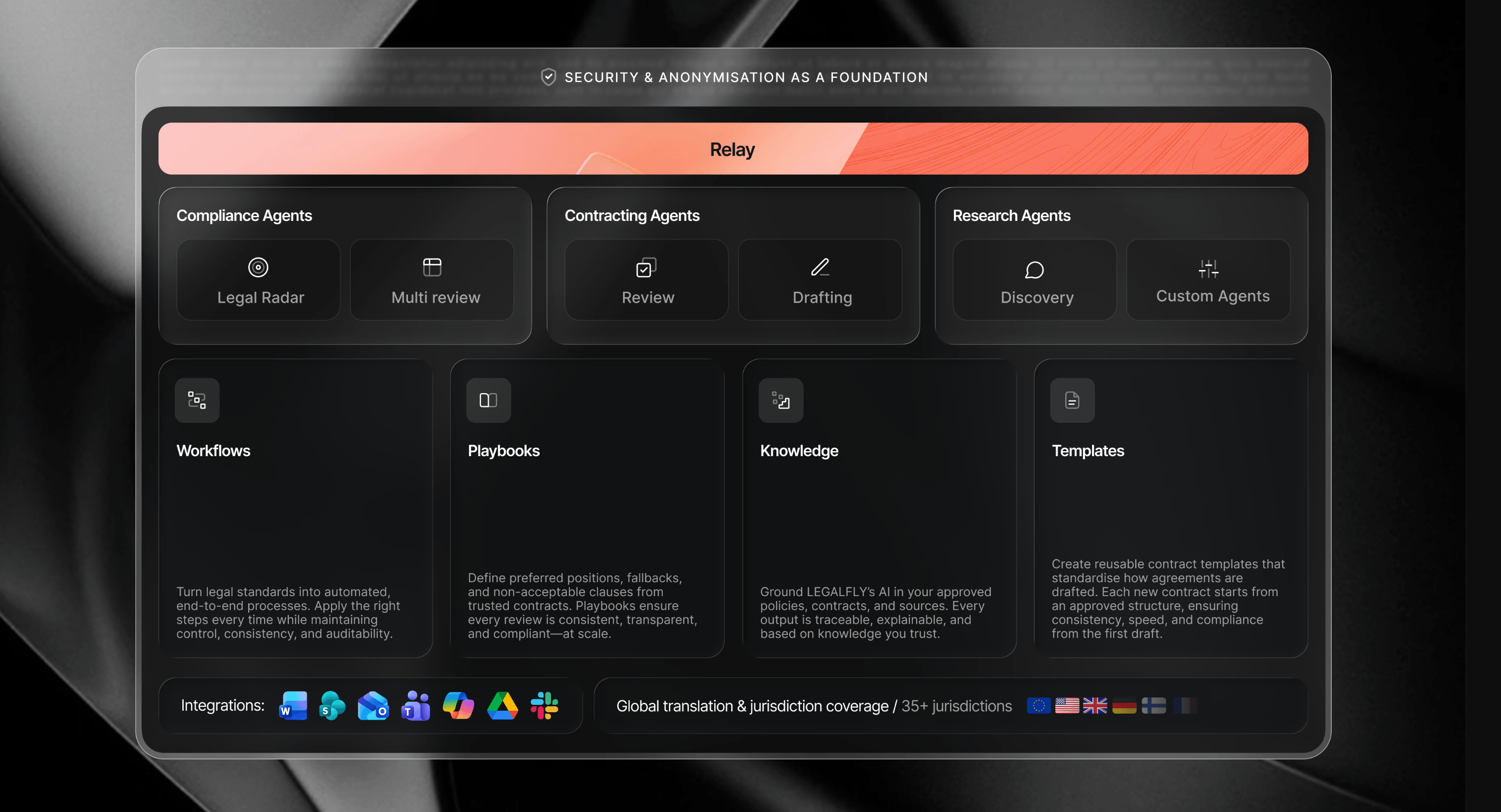
Automate the workflow, not just the task
Most legal AI tools stop at the output. The contract gets reviewed, the answer gets delivered, and then the follow-up, the routing, the escalation, that's all still manual.
Agent Studio is LEGALFLY's end-to-end workflow automation solution. You define the steps, the escalation logic, and who is involved at each stage. Once configured, LEGALFLY executes the workflow automatically, while legal retains final approval at all times. The process reflects how your team actually works, not a generic sequence of prompts passed to a general model.
The process reflects how your team actually works, not a generic sequence of prompts passed to a general model, and unlike Legora, which support chained prompts, Agent Studio automates the full workflow end-to-end.

How LEGALFLY contract review works: step by step
When starting with Legal AI, most In-house teams choose contract review as their first use case. See how LEGALFLY provides comprehensive AI contract review aligned with internal standards below.
Step 1: Connect to your document in Word
Open the contract inside Microsoft Word using the LEGALFLY add-in, or pull it directly from SharePoint, Outlook, or Teams. Sensitive data is anonymised automatically before any processing begins.
Step 2: Choose a playbook or build from a template
Select the playbook for that contract type, or apply a custom playbook built from your own approved contracts. Your fallback positions, risk thresholds, and escalation rules are applied from the start.
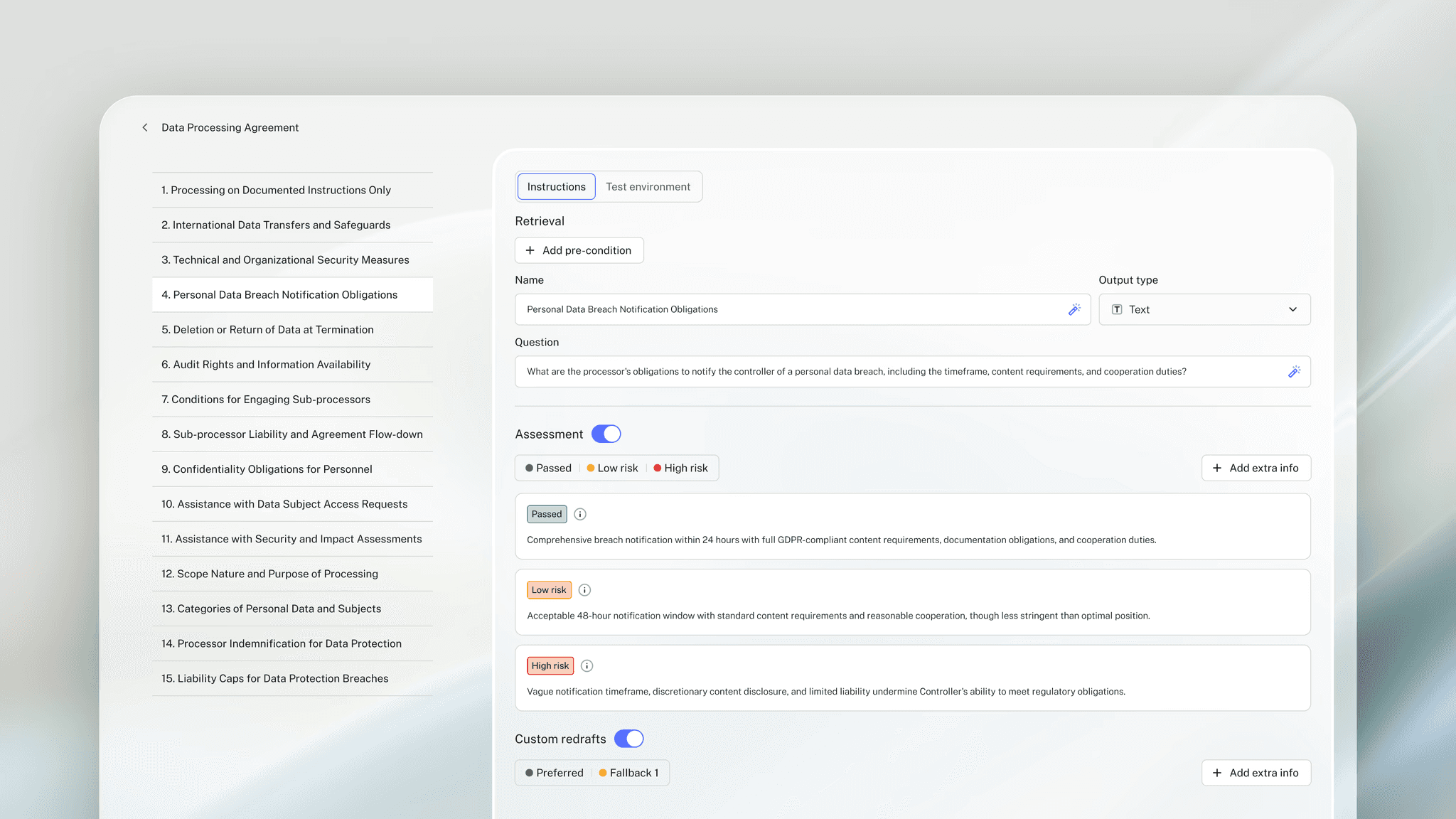
Step 3; Let LEGALFLY analyse the contract
LEGALFLY reviews clause by clause against your playbook, flagging deviations, grading risks, and proposing redrafts in your approved language.
Step 4: Review every suggested edit and why it was made
Every suggested change appears as a tracked change in Word with a plain-language explanation tied to a specific playbook rule. Your team accepts, rejects, or overrides. Final judgment stays with you.
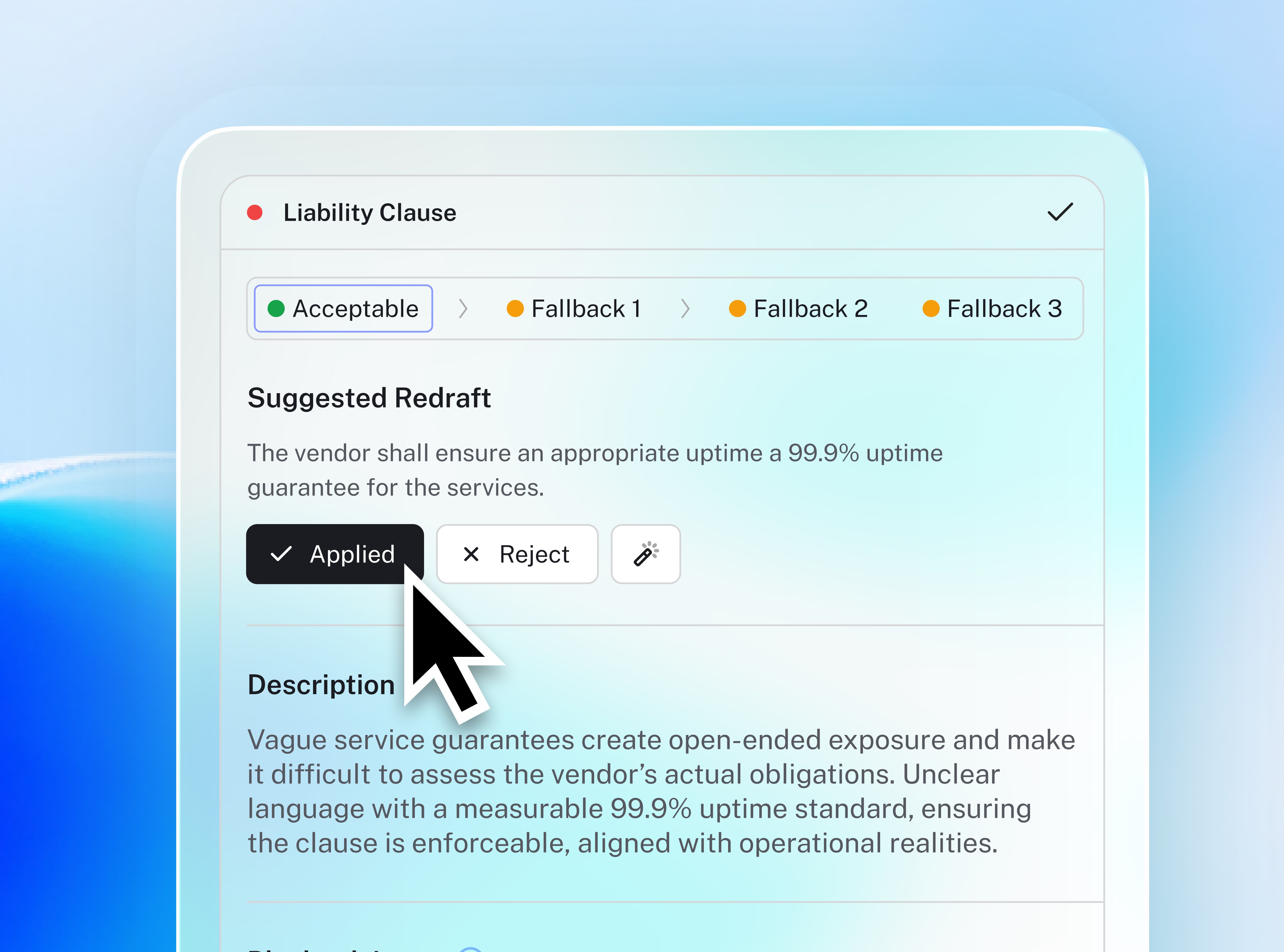
Step 5: Approve, escalate, or let teams self-serve
Contracts meeting your thresholds progress automatically. Those exceeding defined risk levels are escalated through your configured approval chain. Routine agreements can be handled by non-legal teams within guardrails legal sets.
Step 6: Export a clean version with a full audit trail
You have the option to export a clean redline for negotiation, a finalised version for execution or an excel report of the risks and issues raised. Every session is logged, what was reviewed, what was changed, and on what basis.
Want to see how LEGALFLY compares on your own contract types? Book a demo and we'll walk through it in your Microsoft 365 environment.
Case study: Agristo is a fast-growing food manufacturer operating across multiple jurisdictions. As the business expanded, new plants, new partnerships, new legal frameworks, their legal team was fielding constant questions from managers who, without fast answers, were starting to act on gut feeling. Watch how LEGALFLY helped them cut contract review from two hours to 15 minutes and gave non-legal teams the confidence to handle routine agreements safely.
What is Legora?
Founded in Stockholm in 2023, Legora is an AI-powered workspace for legal professionals. It combines document review, drafting, research and legal workflow automation in one platform. Its core tools include a Word add-in for drafting and editing, a Tabular Review interface for large document sets, and a Workflows module for automating multi-step legal processes. Learn more here.
What can you do with each platform?
LEGALFLY | Legora | |
|---|---|---|
Review | Clause-level analysis of contracts using internal or shared playbooks. See risks, deviations and compliance gaps with full reasoning. | Reviews contracts against playbooks. Focuses on batch review and summarisation. |
Multi-review | Multi Review agent analyses large document sets and extracts information according to playbooks of checks. AI analysis can also compare which terms are preferential. | Tabular Review extracts data and compares multiple documents. |
Word integration | Works inside Word with Review, Draft, and Discovery agents. Editing, summarisation and redlining in place. | Word add-in supports AI-assisted edits and redlines but has fewer agents and limited modular functions. |
Drafting | Create reusable templates from existing contracts, upload notes to fill fields, and apply conditional logic for consistency. | Prompt-based clause drafting and editing only. |
Legal research | Connected to trusted publishers such as FromCounsel as well as 250+ official sources of legislation, case law etc. | Connects to databases such as EDGAR, FromCounsel, Cour de Cassation and Bundesrecht. |
Regulatory and legislative monitoring | Legal Radar tracks new laws across 35+ jurisdictions and 250+ integrated sources of government and case law. Then it maps them to your contracts and policies. | No proactive monitoring or alerts. |
Integrations | Deep Microsoft 365 integration with Word, Teams, SharePoint and Copilot plus legal publishers. | Microsoft Azure-based with Word and SharePoint integration and support for some DMS and CLM systems. |
Translation | Built-in DeepL translation that preserves document structure and formatting. Translate entire PDFs, PPTs, Word documents with anonymisation for extra security. | Built-in translation in Word add-in and tabular review. |
Jurisdictional coverage | 60+ jurisdictions with multilingual review and validation across EU, UK and Middle East. | No detailed jurisdiction list. |
Workflows and custom agents | Agent studio enables end-to-end legal automation from intake to approval, including steps for triage, escalations, approval routing, and the creation of custom AI agents. | Workflows module automates multi-step processes by chaining review, drafting and extraction tools. |
How do their capabilities compare?
Both LEGALFLY and Legora help legal teams work faster. For GCs, the question is which platform turns that speed into lasting value through greater capacity, safer delegation and stronger business impact.
Legora focuses on scale. Its automation tools process large document sets, extract data and generate summaries efficiently. That makes it well suited to law-firm-style work such as due diligence or discovery, where throughput and volume matter most. Review more Legora alternative options.
LEGALFLY is designed for in-house teams that need to do more with less. It analyses contracts at clause level, flags risks and compliance gaps with clear reasoning, and produces drafts aligned with approved language, allowing work to be delegated safely across the business. Other teams, such as procurement or finance, can self-serve within defined legal parameters, reducing the load on legal.
Data is anonymised before processing, so no sensitive information leaves your organisation’s environment. With regulatory tracking, AI agents, multilingual review, and a record of every decision, LEGALFLY gives GCs faster output, stronger governance and measurable capacity gains.

LEGORA
Who are these platforms built for?
Legora serves a broad legal audience. It helps lawyers handle complex documents, research, manage case files and process large volumes of contracts, especially for areas like tax law and litigation.
LEGALFLY is built specifically for in-house teams that balance a wide range of responsibilities, from compliance and contract management to strategic business advice.
In-house lawyers operate as generalists, switching between high-level risk assessments and detailed document reviews. LEGALFLY is designed to support that mix of strategic and operational work, so legal teams can focus on high-value work while allowing other departments to self-serve within defined legal boundaries.
How well do they fit into existing workflows?
Both platforms integrate with Microsoft Word, SharePoint, and document management systems, so you can work within familiar environments. Legora’s Word add-in focuses on review and assistant functions, while LEGALFLY extends these capabilities to drafting, review and legal research.
How do they handle security and data control?
Both platforms take compliance seriously, but LEGALFLY’s approach is more powerful and adaptable.
With a founder who was an application security engineer, LEGALFLY applies security principles from the ground up. All documents are anonymised before analysis, meaning sensitive details are stripped out locally so no client or personal data leaves your environment.
Organisations can choose where and how their data is processed through four deployment models:
SaaS, for teams wanting speed and simplicity
Private cloud, hosted within the organisation’s environment
Hybrid, combining local anonymisation with cloud analysis
On-premise, offering full operational and data sovereignty
This flexibility is ideal for legal departments that must comply with internal data-handling rules or sector-specific standards.
Legora is hosted on Microsoft Azure and meets common enterprise standards such as ISO 27001, SOC 2 and GDPR. Both providers have single sign on and never use customer data to train or fine tune AI models.
Which platform offers deeper industry expertise?
Legora takes a broad approach, positioning itself as a platform for lawyers across different practice areas. It does not focus on the particular regulatory or operational challenges faced by specific industries.
LEGALFLY is built for in-house teams in industries where regulation and risk change daily, such as technology, manufacturing, transport, banking and insurance.
Manufacturers and transport operators use it to review multilingual supplier contracts, track renewals and obligations, and align clauses with ESG and CSDDD standards.
Banks and financial institutions rely on it to assess cross-border agreements, test terms, and identify policy or jurisdictional inconsistencies early.
Insurers use it to compare underwriting wordings, analyse coverage and exclusion clauses, and monitor regulatory updates.
Tech companies use LEGALFLY to manage NDAs and data processing agreements, verify alignment with GDPR and DORA, and prepare for new regulations.
How transparent are their AI outputs?
LEGALFLY shows you not just what the AI concludes, but how it got there. Every output includes the reasoning behind each decision and the sources it draws from, whether an internal playbook, legal publisher, or statute. There is a full audit trail for every document, showing how each clause was analysed and every step taken, so review points or discovery questions can be answered with confidence.
Legora also provides comprehensive sourcing, but does not appear to show how the AI reached its conclusions.
Which platform is right for your legal department?
The best legal AI platform isn’t defined by how many features it has, but by how much it improves your working day. For GCs, that comes down to time, control, confidence, and impact.
Time. LEGALFLY cuts routine review and drafting from hours to minutes, freeing legal teams from low-value edits and approvals. Legora’s workflow tools also save time, but focus more on large-scale document handling than day-to-day in-house work.
Control. LEGALFLY gives full visibility into every clause and decision, showing who reviewed what and why. Legora has strong review automation but less traceability for individual reasoning.
Confidence. LEGALFLY anonymises sensitive data before analysis and can be deployed in the cloud, hybrid, or fully on-premise. That flexibility lets you meet internal compliance rules and sector-specific data standards with ease.
Impact. In-house teams using LEGALFLY see tangible results: faster reviews, shorter turnaround times, and measurable capacity gains without additional hires. Legora’s strengths lie in handling large document sets, but its benefits are less tailored to in-house metrics like turnaround and transparency.
If your legal department manages large volumes of external cases or discovery work, Legora may fit your needs. But if your priority is to help a lean in-house team move faster with full oversight and compliance, LEGALFLY might be the better option.
If you're ready to see how enterprise legal teams at SAP, Lufthansa, and AXA have cut contract review time by 75%, we'll show you how it works in practice. Book a demo
Disclaimer: We conducted this research in Q2 2026, and it is correct to the best of our knowledge at this time. Always check with the vendor for the most up-to-date information.