







A consulting agreement can look like one of the more straightforward documents to cross your desk - until a relationship sours, deadlines are missed, or a tax authority asks why a contractor on the books looks like an employee.
Exposure is rarely in any single clause. It is spread across how the engagement is classified, what the consultant has committed to deliver, who walks away owning the work, where liability lands when something goes wrong, and how either side can exit.
This article runs through what to verify in each of those areas before you sign, and pairs it with a downloadable contract review checklist your team can shape to your own positions.
We will start with the fast route: how a review that used to take a couple of hours can be run in about 15 minutes inside LEGALFLY. Then we will go through the full contract review checklist clause by clause.
Run a consulting agreement review in LEGALFLY in 5 steps
In-house teams using LEGALFLY apply a 21-point consulting agreement review playbook against every agreement they receive. A review that would take a senior lawyer two hours runs in about 15 minutes, with the same review logic applied consistently across every contract.
The repetitive part of the work is what automated contract review takes off the desk, freeing in-house legal professionals to spend their time on the judgment calls that actually need them. Here is how it works.
Open the agreement in Microsoft Word
Launch the LEGALFLY add-in. Before any AI processing, sensitive data is anonymised at the point of ingestion: counterparty names, fee figures, and identifiers become tokens, and the original legal documents stay under your control. Enterprise grade data security is built into the platform itself.
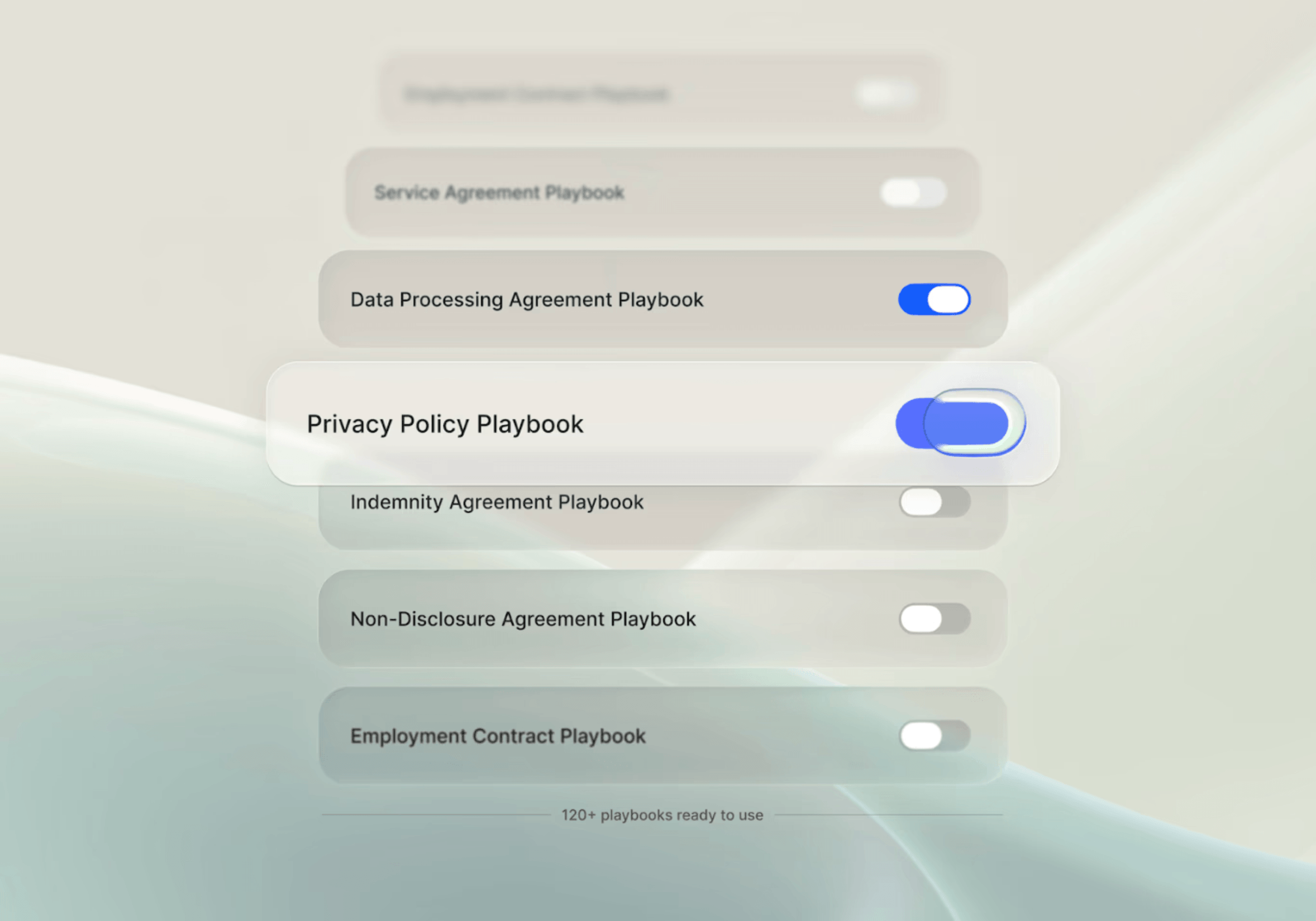
Select the consulting agreement playbook
The playbook contains the 21 review points covered in this article, but can be configured with your organisation's preferred positions if they differ from the default detailed here. LEGALFLY ships with 120 pre-built playbooks covering the most common contract types, and your team can build custom playbooks on top of those using your own standards.
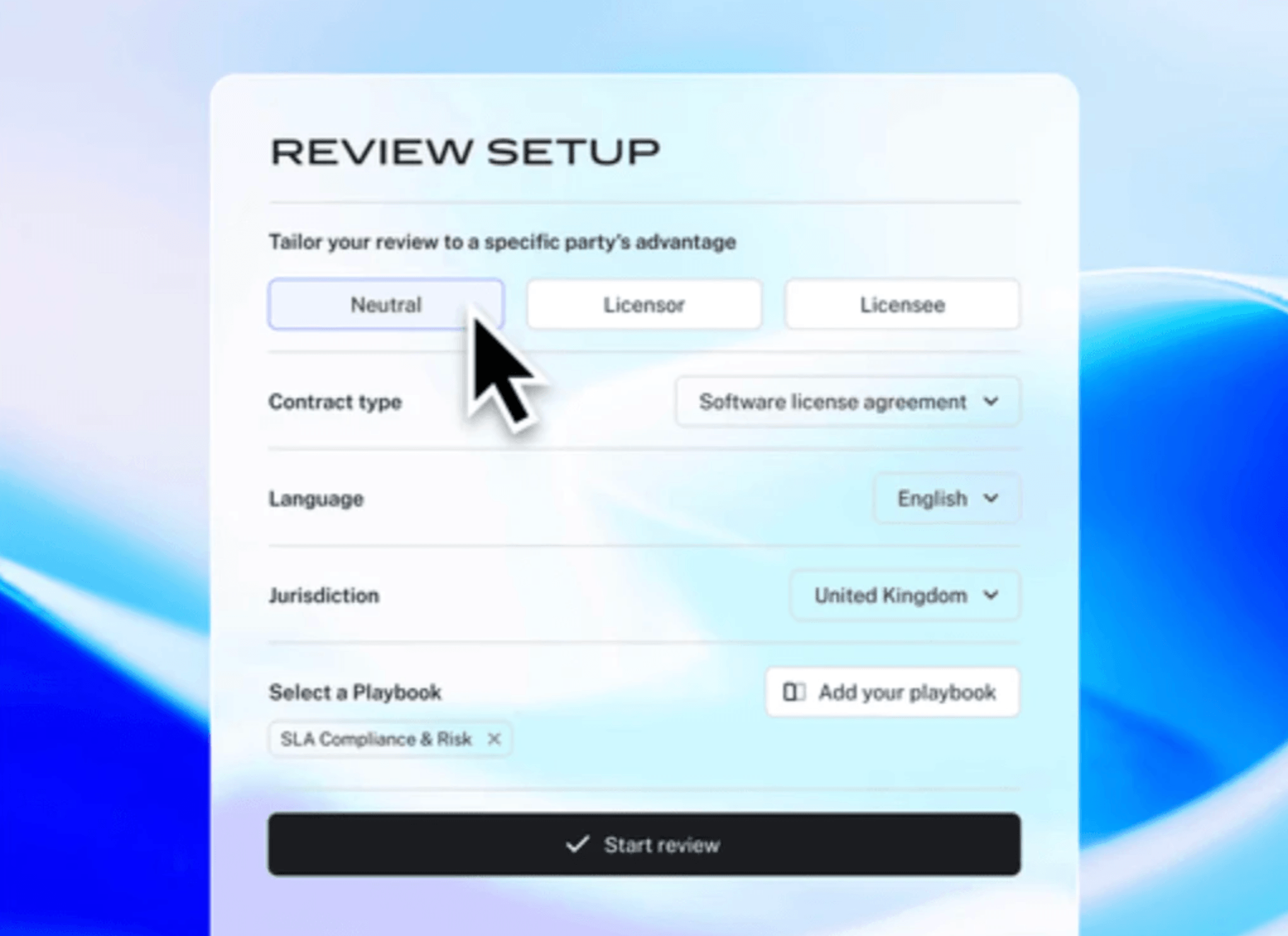
Run the review
LEGALFLY analyses the agreement clause by clause against the playbook, applying your organisation's risk thresholds consistently and flagging deviations from your preferred positions. The same standard is applied to the tenth agreement of the week as to the first.
Review tracked changes with rationale
Each suggested edit appears as a tracked change in Microsoft Word, linked to the specific playbook rule that triggered it. You see what was flagged, why it was flagged, and the redraft language proposed. Accept, modify, or reject each change individually.
Export with a full audit trail
The final document exports with a complete record of changes made, rules applied, and approvals given, ready for internal governance, regulatory compliance, or external audit.
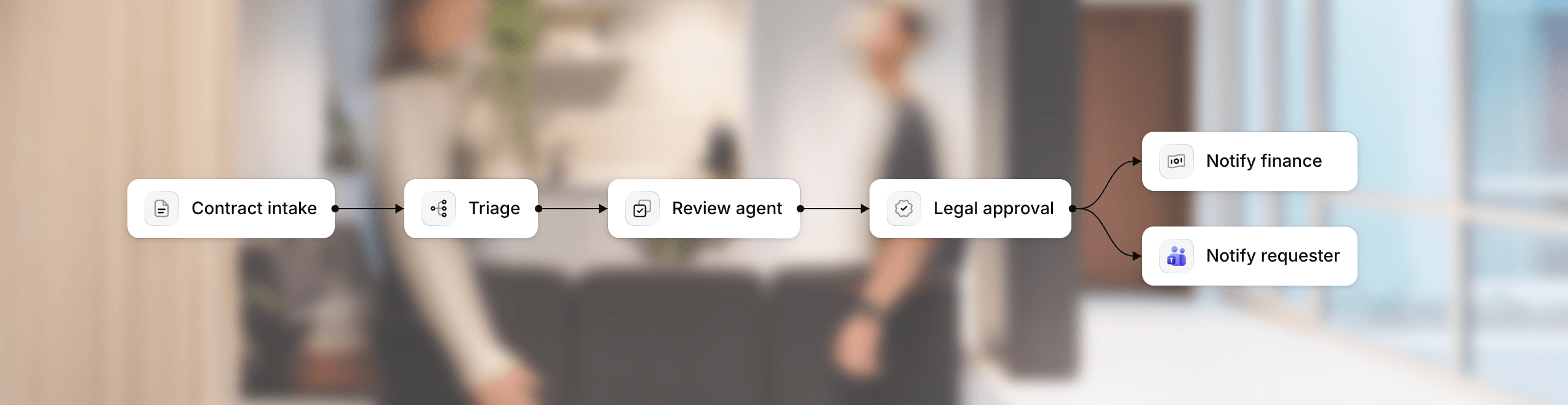
For high-volume agreement types, the review can run as an automated workflow through Agent Studio. Business teams raise requests through Slack, Teams, or email. LEGALFLY captures the request, runs the review against the consulting agreement playbook, and routes the output to the right lawyer based on agreement value or counterparty. Final signoff stays with you throughout.
The in-depth contract review checklist for consulting agreements
Download the 21-point consulting agreement checklist here.
A consulting agreement is, at its core, a document that defines an independent relationship, a body of work, and a price. Most disputes trace back to one of those three being left vague. The checklist below works through the full agreement in the order risk tends to surface, so you can apply consistent standards across every contract your team handles.
Start with the relationship, term, and scope
The first thing to verify is what kind of relationship the agreement actually creates, because everything else depends on it.
Independent contractor status
The defining feature of a consulting agreement is that it should contain a clear, unambiguous clause stating that the consultant is an independent contractor and not an employee, agent, or partner, is not eligible for employee benefits, and is responsible for their own taxes.
Watch for language that contradicts this status: set working hours, mandatory use of company equipment, or supervision arrangements that look like employment.
If the agreement is silent on the relationship, or implies it without stating it, add an explicit clause.
Misclassification exposes the client to back-taxes, penalties, and reclassification claims from tax authorities, which is exactly the kind of regulatory compliance risk that surfaces months after signature.

Term of agreement
The term should be clear and fixed, with a defined start date and either a defined end date or a clean termination mechanism. A one- or two-year term with renewal on mutual written consent is the preferred structure.
Auto-renewal clauses are workable but carry the risk of unwanted extensions, so confirm the non-renewal notice period is reasonable, typically 30 to 60 days. A term that is unspecified, perpetual, or renews indefinitely without a clear exit is a red flag.
Services description
The services should be described in enough detail to be enforceable, ideally in an attached Statement of Work (SOW) that sets out deliverables, timelines, and milestones. A line such as "general consulting services" invites disputes later, because it never pins down what the consultant actually owes.
Where the description is high-level, amend it to include specific, measurable deliverables, and require that any change to the services be agreed in a written amendment to the SOW.
A vague scope is the single most common source of disagreement about what the consultant was actually obliged to perform.
Check the commercial terms
Once the relationship and scope are clear, the commercial terms determine cash flow and leverage.
Payment terms
Payment should be tied to accepted deliverables or approved invoices, and the agreement should preserve the client's right to withhold or set off disputed amounts.
Watch for large advance payments or upfront fees with nothing securing them, and confirm the payment schedule, currency, and invoicing requirements are clearly specified. Payment terms left undefined are the gap to close; the length of the terms themselves is rarely the client's risk.
Late payment interest
If the consultant has included a late-payment interest clause, check that the rate is reasonable, that interest runs only on undisputed sums, and that it is triggered only after an agreed grace period rather than from the invoice date. The absence of an interest provision is not a risk to the client.
Lock down IP ownership and confidentiality
For knowledge work, the value of the engagement often sits in the intellectual property and the information exchanged. These two clauses protect both.
Intellectual property ownership
The balanced, market-standard position is that the client owns the deliverables created under the agreement, while the consultant retains ownership of their pre-existing IP and tools, granting the client a perpetual, royalty-free licence to use any pre-existing IP embedded in the deliverables.
If the agreement says the consultant owns everything created, or is silent on ownership, that is a major risk for the client and must be revised.
Where ownership is not clearly split between deliverables and pre-existing materials, add separate definitions for each to remove the ambiguity.
Confidentiality duration
General confidential information should be protected for a fixed period after termination, typically three to five years, with a perpetual obligation for anything qualifying as a trade secret. A clause with no stated duration is a gap to close.
Be cautious of a perpetual obligation applied to all confidential information, which can be unenforceable in some jurisdictions; the cleaner approach is a fixed term for general information and a perpetual term reserved for trade secrets.
Allocate risk: liability, indemnity, and insurance
This is where consulting agreements are most heavily negotiated.
Limitation of liability
A liability cap is market-standard, so from the client's side the question is whether the cap is high enough for the harm a failed engagement could cause, and whether it is reciprocal rather than protecting only the consultant.
A cap set at the fees paid over the preceding 6 to 12 months can leave the client under-compensated where the consultant's work causes loss well beyond its fee, so push for a figure proportional to the contract value and the risk transferred. Confirm that any cap is mutual, and that the carve-outs below sit outside it.
A cap that is unreasonably low, or one-sided in the consultant's favour, should be renegotiated before the agreement moves forward.
Liability carve-outs
The liability cap should not apply to everything. Standard carve-outs sit outside the cap for breach of confidentiality, indemnification obligations, gross negligence, and wilful misconduct.
Where the carve-outs are missing or overly narrow, the client is exposed to exactly the failures that matter most. Confirm the list is specific and includes, at a minimum, confidentiality and indemnification.
Indemnification
The consultant should provide a reasonable indemnity covering third-party claims arising from their gross negligence or wilful misconduct, and from any claim that the deliverables infringe a third party's IP rights.
A one-sided indemnity running only from the client to the consultant, or a broad uncapped indemnity from the client, is aggressive and should be pushed back on. If there is no indemnification clause at all, add one.
Insurance
The agreement should require the consultant to carry appropriate cover at appropriate limits. An agreement with no insurance requirement leaves the client without recourse if the consultant cannot meet a claim.
Set clear termination rights
The termination clauses decide what it costs to walk away, and who controls that decision.
Termination for convenience (client).
The client should be able to terminate for convenience on reasonable notice, commonly 15 to 30 days, with payment for services performed and expenses incurred up to the termination date.
A notice period that is very short or very long should be adjusted to a sensible middle. If the client has no right to terminate for convenience at all, add one to avoid being locked into an engagement that is not working.
Termination for convenience (consultant)
From the client's perspective, the preferred position is that the consultant cannot terminate for convenience. If they can, it should require a long notice period (60 to 90 days) and transition assistance. A consultant's right to walk away on short notice creates real continuity risk and should be removed, leaving the consultant able to terminate only for cause.
Termination for cause
Either party should be able to terminate for material breach after written notice, with a cure period of commonly 15 to 30 days. A cure period is mutual and market-standard, so it is reasonable to accept, though for serious or non-curable breaches the client will want the right to terminate immediately.
Check restrictive covenants and assignment
Two clauses here determine who you are actually contracting with, and what each side can do around the relationship.
Non-solicitation of employees
Aim for a clause stopping the consultant from soliciting your employees for a reasonable period, typically 12 months after termination. Watch for an over-long duration, or a non-compete dressed up as a non-solicit: a broad non-compete on the consultant's wider business is often unenforceable and should be narrowed to a tight non-solicitation clause.
Assignment
Neither party should be able to assign the agreement without the other's prior written consent, with any assignment in breach void. A carve-out for assignment to an affiliate or in a merger or acquisition is common and acceptable. A clause letting the consultant freely assign or subcontract is the one to fix: you are hiring a specific consultant, so require consent.
Don't forget the boilerplate
The clauses at the back of the agreement get the least scrutiny but cause more disputes than their position suggests.
Force majeure
A standard, mutual force majeure clause should excuse non-performance for causes beyond a party's reasonable control, and give the non-affected party a right to terminate if the event drags on, commonly beyond 30 to 60 days. A one-sided clause, or one with no termination right for prolonged events, should be balanced. No force majeure clause at all should be added.
Notices
The agreement should set out a clear notices process: full addresses for both parties and permitted delivery methods such as personal delivery, certified mail, or recognised overnight courier. Email is reasonable for day-to-day notices but generally should not be the method for termination or breach notices. An incomplete clause, or none at all, invites arguments about whether notice was properly given.
Govern disputes before they happen
The last group of clauses determines where and how any dispute is resolved, and they should be considered together.
Governing law
The governing law should be specified, predictable, and ideally aligned with the country of the competent court. A well-established jurisdiction for contract law is the goal; avoid agreeing to law in an unfamiliar legal system.
Where the governing law is ambiguous it can be an acceptable compromise if the jurisdiction is well established, but where it is unspecified it must be fixed.
Checking how a given cap or carve-out holds up under a chosen jurisdiction is the kind of question where legal research into the relevant case law pays off, particularly on cross-border engagements.
Jurisdiction and forum
The forum should be exclusive and located somewhere convenient and predictable, ideally matching the governing law and your home location. A non-exclusive forum, or an exclusive one in the counterparty's home jurisdiction, is a common compromise, but exclusivity in your own jurisdiction is preferable. An unspecified or remote foreign forum should be corrected.
Dispute resolution
The strongest position is a multi-step process: good-faith negotiation, then mediation, before litigation or arbitration. Mandatory binding arbitration with no preliminary step is workable but worth softening with a negotiation or mediation stage to encourage faster, lower-cost resolution. Silence on dispute resolution, defaulting straight to litigation, is a gap to close.
Where AI fits into consulting agreement review
A consulting agreement is often treated as a simple document, but this checklist is a reminder of how many ways it can go wrong: misclassification, vague scope, IP that defaults to the consultant, a liability cap set too low.
These agreements keep generating obligations long after signature, moving through a contract lifecycle from request to renewal to retirement. Contract management software stores agreements and tracks renewals, but cannot do the review itself, the clause-by-clause judgment where most risk is caught or missed.
LEGALFLY does the actual review. It catches the issues at the review stage and passes clean, consistent agreements back into the rest of the contract lifecycle.
For in-house legal teams, LEGALFLY is a top legal AI workflow platform covering contract review, contract drafting, legal research, due diligence, and regulatory monitoring, with data anonymisation and lawyer sign-off built in.
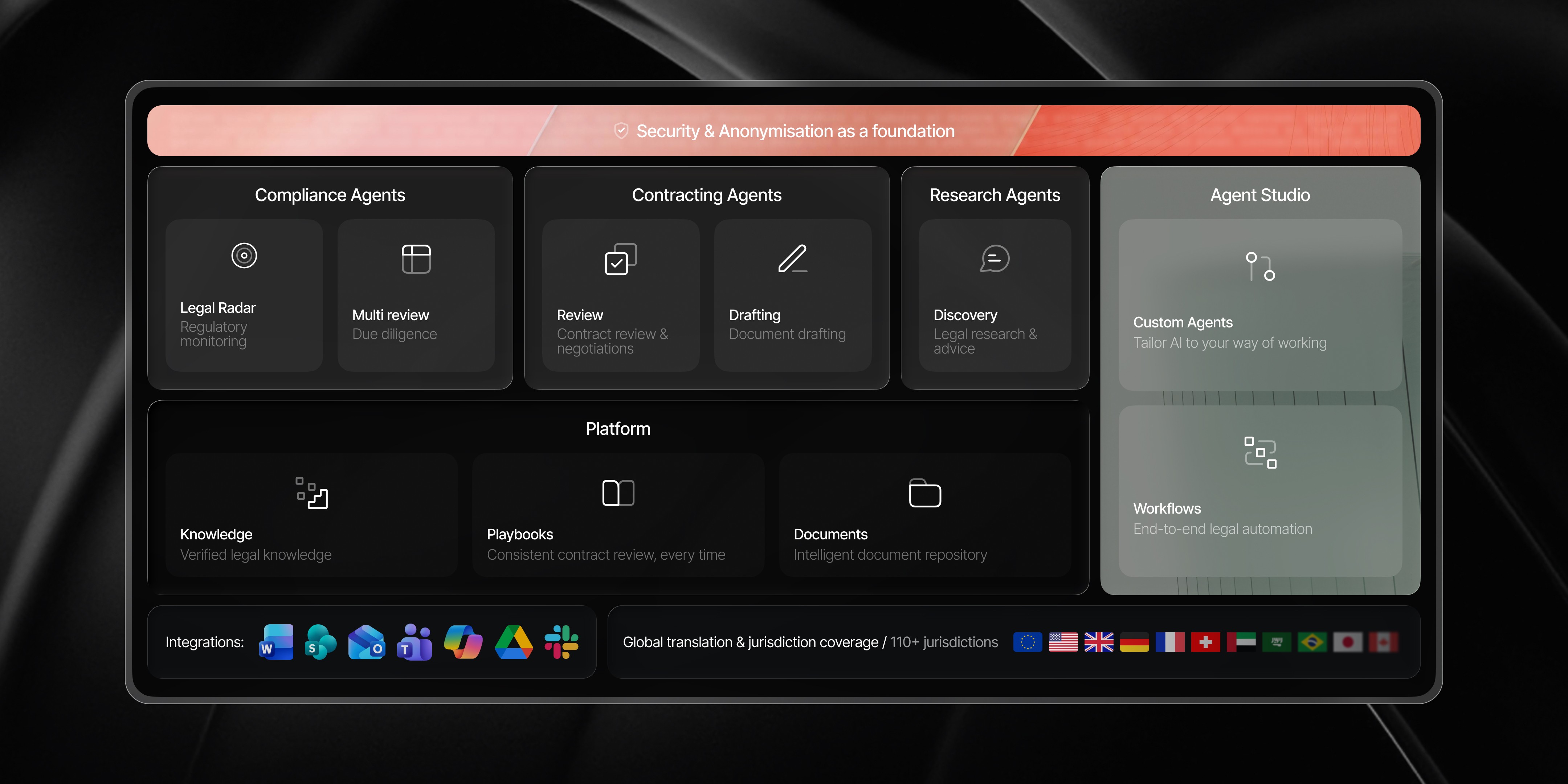
A few capabilities matter for consulting agreements specifically:
Consistent, automated contract review. Every agreement runs against the same 21-point playbook, so the standard does not drift between reviewers or across a busy week.
Contract drafting from approved language. The Drafting agent turns existing agreements into clean templates and populates them correctly, cutting drafting time by roughly 50% within the guardrails legal has set.
Legal research and case law you can cite. The Discovery agent supports advanced legal research across 250+ verified sources and 110+ jurisdictions, so a question on enforceability or a point of case law traces back to official material.
Portfolio due diligence at scale. When a regulatory change or acquisition means hundreds of agreements need checking, the Multi-Review agent scans them at once and flags the non-compliant ones.
Anonymisation runs before anything reaches an AI model, and the platform holds ISO 27001 and SOC 2 Type II certifications with on-premises deployment available. The Microsoft Word and Outlook add-ins keep the work where it already happens, which is usually what decides whether legal professionals use legal AI tools day to day.
Make consulting agreement review consistent across your team
A contract review checklist gives you the structure to apply consistent standards across every agreement in your organisation. The one below is a working version of the playbook LEGALFLY runs against consulting agreements. Adapt it to your preferred positions, share it across the team, and use it as the starting point for your own playbook.
Book a LEGALFLY demo. We will walk you through the consulting agreement playbook using contract types relevant to your portfolio.
Frequently asked questions
What should be included in a contract review checklist for a consulting agreement?
A complete contract review checklist for consulting agreements should cover the term of the agreement, the services description and Statement of Work, independent contractor status, payment terms and late payment interest, intellectual property ownership, confidentiality duration, limitation of liability and carve-outs, indemnification, insurance, termination for convenience and for cause, non-solicitation, assignment, force majeure, notices, governing law, jurisdiction and forum, and dispute resolution. The 21-point checklist at the end of this article covers each of these and is the basis of the contract review checklist LEGALFLY applies in practice.
What are the most common red flags in a consulting agreement?
The most common red flags are a missing or contradictory independent contractor clause, a vague services description with no Statement of Work, IP ownership that defaults to the consultant or is left unstated, a liability cap that is unreasonably low or one-sided with no carve-outs, no indemnification from the consultant, payment due regardless of whether deliverables are accepted, a consultant right to terminate for convenience on short notice, and unspecified governing law or dispute resolution. Each of these is straightforward to catch with a structured review and easy to miss without one.
Why is independent contractor status so important in a consulting agreement?
Because misclassification is expensive. If the agreement reads like an employment relationship, or is silent on the point, tax authorities can reclassify the consultant as an employee, exposing the client to back-taxes, penalties, and benefit claims. A clear independent contractor clause, with no contradicting language about working hours or supervision, is the single most important protection in the agreement and a regulatory compliance issue as much as a contractual one.
Can AI tools handle consulting agreement review?
Yes, with the right design. Legal AI tools that work from your own playbook can run the clause-by-clause review automatically and return tracked changes in Microsoft Word, each tied to the rule that triggered it, while leaving final judgment with a lawyer. The value of automated contract review is consistency and speed on the repetitive work, with the lawyer still reviewing, approving, and deciding. This is the model LEGALFLY uses, and it is where artificial intelligence earns its place: it handles the mechanical first pass so the reviewer can concentrate on the calls that need a human.


