





Construction contracts concentrate risk in a recurring set of places: scope, payment, change orders, liquidated damages, indemnity, the cap and its carve-outs, insurance, defects, termination, disputes. This is a checklist of what to look for in your contracts to manage that risk. First, we will quickly explain how you can do this with LEGALFLY in minutes, not hours.
A checklist that LEGALFLY uses for construction contract review is included at the end of this article, ready to download and adapt for your own team.
To see how your could review construction contracts 87% faster with AI, schedule a demo with LEGALFLY
Run a construction contract review in LEGALFLY in 5 steps
In-house teams using LEGALFLY can apply a 22-point construction contract review playbook against every contract they receive. A review that would take a senior lawyer two hours takes just 15-minute, with the same review logic applied consistently across every contract. There's a good reason why LEGALFLY is a top contract review tool.
Here is how it works.
Open the contract in Word
Launch the LEGALFLY add-in. Before any AI processing, sensitive data is anonymised at the point of ingestion: counterparty names, project references, and identifiers become tokens, and the original document stays under your control.
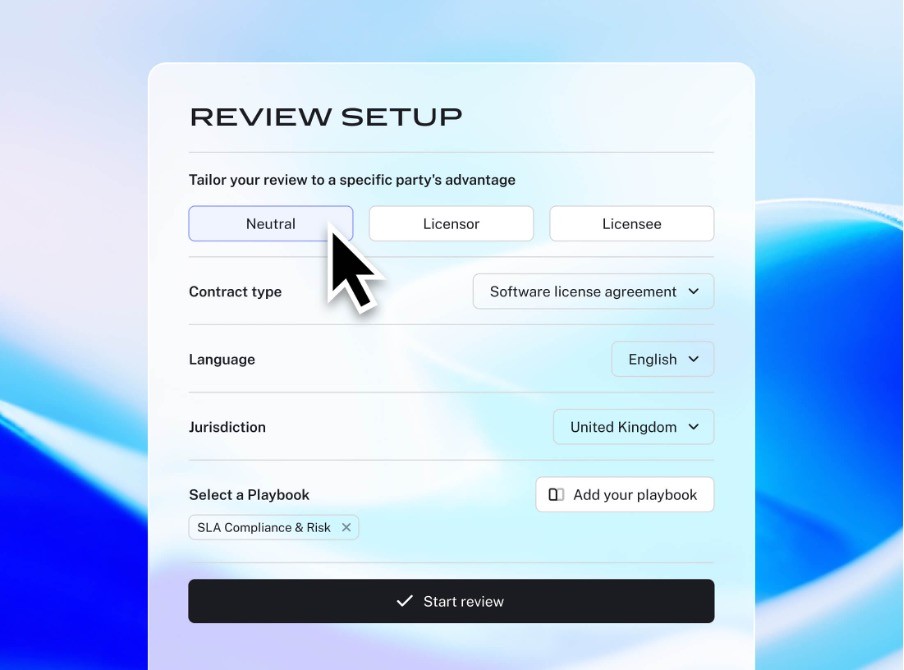
Select the construction contract playbook
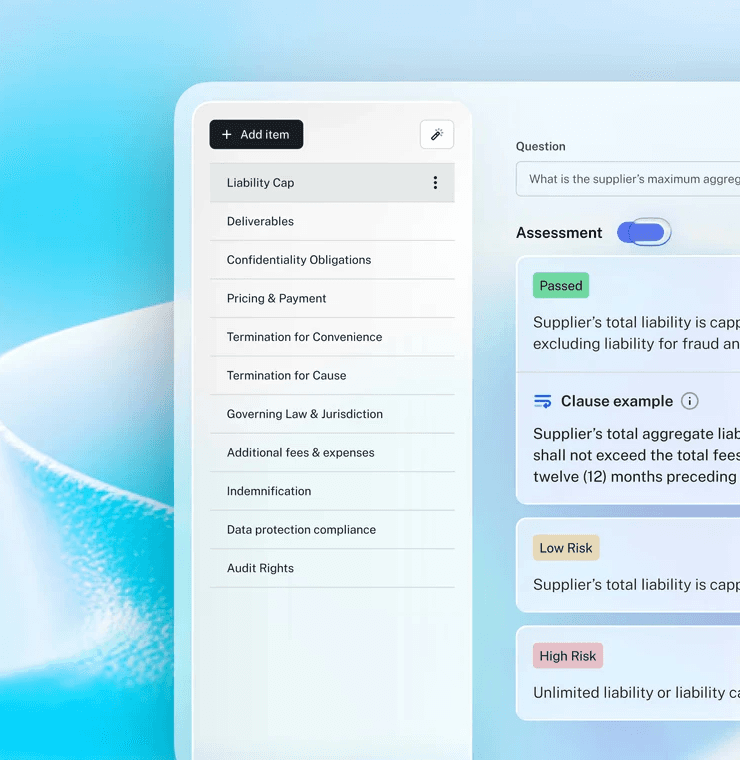
The playbook contains the 22 review points covered in this article, configured with your organisation's preferred positions and fallback wording. If you have variants for different contract types (lump sum, cost-plus, GMP), select the relevant one.
Run the review
LEGALFLY simplifies construction contract review. The tool analyses the contract clause by clause against the playbook, applying your organisation's risk thresholds consistently and flagging deviations from your preferred positions.
Review tracked changes with rationale
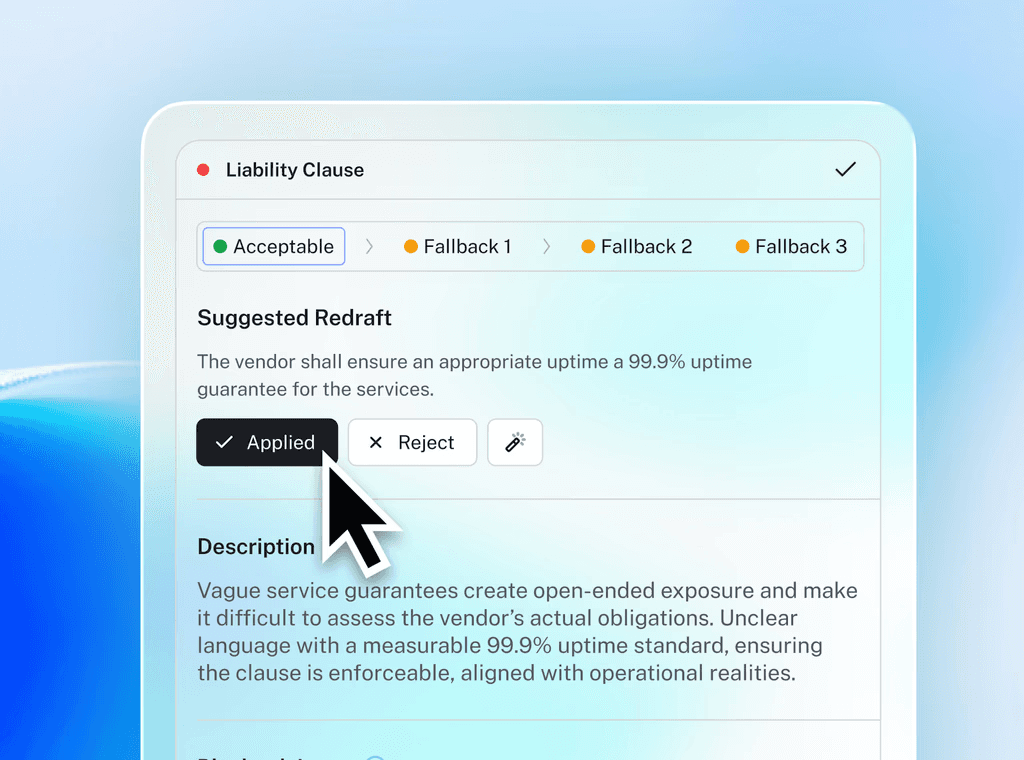
Each suggested edit appears as a tracked change in Word, linked to the specific playbook rule that triggered it. You see what was flagged, why it was flagged, and the redraft language proposed. Accept, modify, or reject each change individually.
Export with a full audit trail
The final document exports with a complete record of changes made, rules applied, and approvals given, ready for internal governance or external audit.
For high-volume contract types, the review can run as an automated workflow through Agent Studio. Business teams raise requests through Slack, Teams, or email. LEGALFLY captures the request, runs the review against the construction contract playbook, and routes the output to the right lawyer based on contract type, value, or counterparty. Final approval stays with you throughout.
In depth construction contract review checklist: everything to verify before signing
Signing a construction contract without proper review can expose you to costly disputes, scope creep, payment delays, and liability issues that derail projects.
Whether you're a contractor, subcontractor, or project owner, a thorough contract review upfront protects your interests and clarifies expectations with all parties involved.
Verify the scope of work and commercial terms first
Most construction contract red flags surface in the first three sections of the agreement: scope, price, and the change order procedure. These set the commercial frame for everything that follows.
Scope of work
The scope of work should explicitly reference all relevant specifications, drawings, and a complete list of deliverables, attached as exhibits. A scope defined in general terms, without specific drawings or a complete deliverables list, leaves room for disputes about what the contractor was actually obliged to perform.
A vague or missing scope is the single most common source of cost and timeline overruns in construction work, and should not be accepted.
Contract price and payment schedule
The contract price will usually be a fixed-price contract (also called lump sum), a cost-plus arrangement, or a guaranteed maximum price (GMP). Each carries different risk for the employer. A fixed-price contract caps cost exposure but transfers performance risk to the contractor. Cost-plus allocates cost risk to the employer and is appropriate where scope cannot be fully defined upfront. GMP sits between the two.
Whatever the structure, the payment schedule should be tied to specific, verifiable milestones rather than fixed time intervals. Milestone-based payment links cash flow to performance and gives the employer leverage if work falls behind. Confirm retainage terms, the schedule of values, and what evidence is required for each interim payment to be released.
Change order process
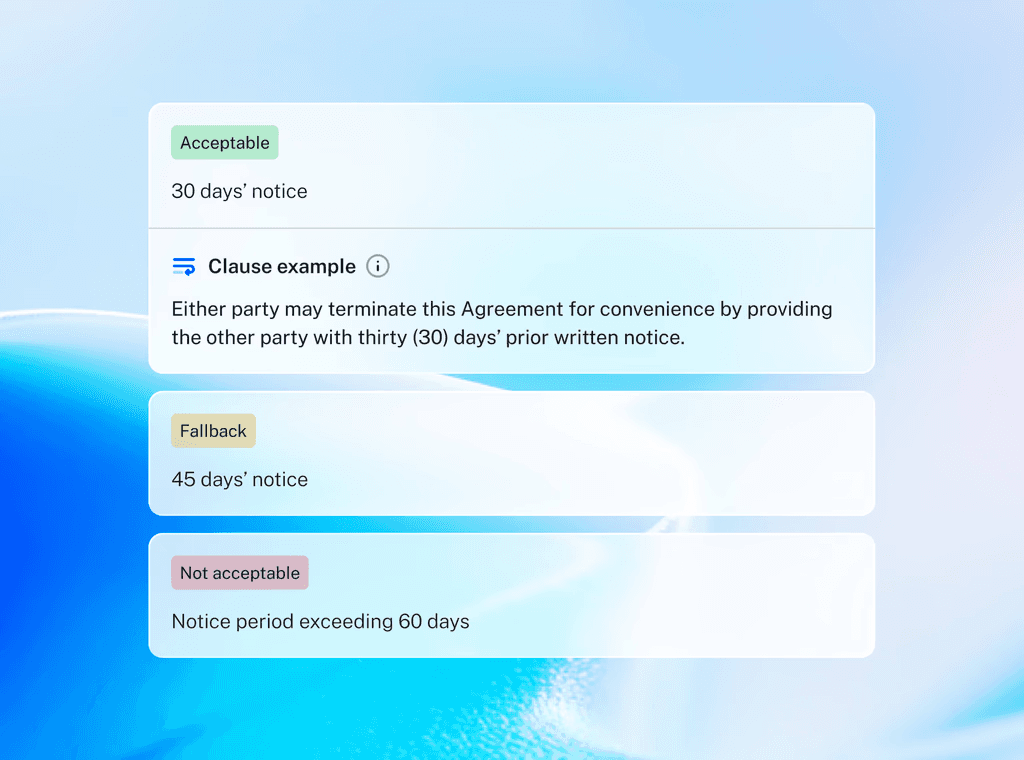
A formal change order procedure is non-negotiable. The contract should require all variations to be documented in writing, signed by an authorised representative of each party, and priced according to a defined mechanism before the work proceeds. Verbal instructions create disputes.
So does an open-ended pricing approach for variations. Verify the approval authority for change orders and confirm the contractor cannot unilaterally claim additional cost or time without going through the agreed process.
Check schedule, delay, and liquidated damages provisions
Schedule provisions get tested when the project slips. The contract should make clear what happens when it does.
Substantial completion date
The substantial completion date should be specific, and tied to a defined standard for what substantial completion means in the context of this project. This is typically the point at which the works can be used for their intended purpose.
On larger projects, the contract should address float (the schedule buffer between activities) and the critical path (the sequence of activities that drives the completion date). Silence on either point creates arguments when delays happen, particularly about who owns the buffer time and whether a specific delay actually affected completion.
Liquidated damages for delay
Liquidated damages clauses set a daily or weekly rate the contractor pays for each day of delay beyond the substantial completion date.
The rate should be a genuine pre-estimate of the employer's loss from delay, not a penalty.
Common practice is a daily rate calibrated to actual costs of delay (financing costs, lost revenue, holdover costs) with an aggregate cap, often expressed as a percentage of the contract price.
A rate that is plainly punitive may be unenforceable in some jurisdictions, and a clause without a cap exposes the contractor to open-ended liability they may resist or price aggressively for. Both create problems.
Most teams using LEGALFLY cut their contract review time in half within a few weeks of onboarding. Book a short demo to see how it works for your business.
Extension of time
The extension of time (EOT) provisions should specify the events that entitle the contractor to additional time without liquidated damages exposure. Standard categories include force majeure, employer-caused delay, and unforeseen ground conditions.
Verify the notice requirements: most contracts require the contractor to notify the employer of a delay event within a defined period, often as a condition precedent to claiming an extension. Missing the notice can extinguish the entitlement.
Review risk allocation, indemnity, and liability clauses against project value
Risk allocation is where construction contracts are heavily negotiated. The principle to apply is straightforward: each risk should sit with the party best able to manage it, and any risk transfer should be matched by appropriate compensation.
Indemnification
The contractor's indemnification obligations should be clearly defined and proportionate to the risks they control. Mutual indemnity, where each party indemnifies the other for losses arising from its own acts, is the standard starting point.
One-sided indemnity, where the contractor indemnifies the employer for losses arising from anyone's acts, is aggressive and should be pushed back on.
Verify the indemnity covers third-party claims for personal injury, property damage, and intellectual property infringement, and confirm the exclusions are appropriate.
Limitation of liability
The limitation of liability cap is the contractor's maximum exposure under the contract. Caps are usually expressed as a percentage of the contract price (commonly 100% to 150%) or as a fixed sum. The cap should be reasonable in light of the project value and the risks transferred. Verify the carve-outs, which are the categories of liability the cap does not apply to. Standard exclusions include indemnification obligations, breach of confidentiality, gross negligence, willful misconduct, and fraud.
Without these carve-outs, the cap can shield contractors from liability for the most serious failures.
A consequential damages waiver is common and excludes liability for indirect losses such as lost profits and lost business opportunity. Confirm the waiver does not exclude direct losses you would expect to recover, and that it carves out the categories that should fall outside the waiver (typically indemnity obligations and breach of confidentiality).
Unforeseen site conditions and hazardous materials
Unforeseen or differing site conditions, conditions a reasonable contractor could not have anticipated from a site investigation, are a standard area of risk allocation. Verify which party bears the cost and time impact.
Allocating this risk to the contractor without a corresponding investigation right is unfair and tends to inflate prices.
Hazardous materials should be addressed separately. The contract should specify how the discovery of pre-existing hazardous materials is handled, who pays for remediation, and how schedule and cost impacts are allocated. The employer typically retains responsibility for pre-existing contamination.
Title and risk of loss
Title and risk of loss provisions determine when ownership of the work, and the risk of damage to it, transfers from the contractor to the employer. The standard position is that risk of loss transfers on substantial completion or handover, with the contractor responsible for damage during construction. Verify this aligns with the insurance arrangements: the party bearing the risk should also hold the relevant insurance.
Calibrate insurance and security to the project's risk profile
Insurance and bonds protect the employer when the contractor cannot meet its obligations. Both need to be sized to the project's value and the risks transferred.
Insurance requirements
The contract should require the contractor to maintain general liability, builder's risk insurance, workers' compensation, and professional indemnity (where the contractor performs design work), at coverage levels appropriate to the project.
Verify the contract requires the contractor to name the employer as an additional insured under the relevant policies, to provide a certificate of insurance before work begins, and to include a subrogation waiver in favour of the employer. These three points are commonly missed and significantly weaken the practical value of the cover.
LEGALFLY helps your team move faster: less time buried in contracts, more time on the work that actually matters. Book a call to see it in action.
Performance and payment bonds
Performance bonds and payment bonds give the employer recourse if the contractor fails to perform or fails to pay subcontractors. A performance bond should typically be at least 10% of the contract price, with higher percentages for higher-risk projects.
Verify the bond requirements are clearly specified, the form of bond is acceptable, and the issuing surety meets your credit standards.
Set warranty and defects liability periods to match the works
The defects liability period is the window after completion during which the contractor must return to remedy defects in the work, at its own cost.
Twelve months from substantial completion is the most common position for general construction. More complex projects (mechanical and electrical systems, specialist installations) may justify longer periods.
Verify the period reflects the nature of the works.
The warranty provisions should cover both workmanship and the contractor's responsibility for materials and equipment supplied by manufacturers. Latent defects, defects not discoverable on reasonable inspection at completion, are typically covered for longer periods under statutory or contractual provisions, and the contract should make this position explicit.
Confirm how warranty work interacts with the limitation of liability cap: warranty obligations are usually carved out, but this needs to be checked.
Get termination and dispute resolution provisions right at the drafting stage
Termination and dispute clauses determine what happens if the relationship breaks down.
Termination for convenience
A termination for convenience clause allows the employer to end the contract without cause, typically on notice and with payment for work performed plus a reasonable margin on work in progress.
Verify the notice period is workable (30 days is common), the compensation formula is clearly defined, and the clause does not expose the employer to claims for lost profit on uncompleted work.

Termination for default
Termination for default rights apply when the contractor fails to perform. Verify the default events are clearly defined (failure to progress the work, abandonment, insolvency, persistent breach), the cure rights are reasonable (typically a notice period during which the contractor can remedy the default), and the termination process is workable.
Governing law and dispute resolution
The governing law clause determines which jurisdiction's law applies to the contract. The dispute resolution forum determines where and how disputes are resolved. The two should be considered together and aligned with the project location and the parties' commercial preferences.
Binding arbitration is common in cross-border projects and offers confidentiality and enforceability benefits, but limits appeal rights.
Litigation in a specified court offers more procedural certainty but is public. Some jurisdictions require statutory adjudication for construction disputes, with the contract dispute resolution sitting on top. Verify the dispute resolution clause works with any applicable statutory regime.
Check permits, subcontractors, and confidentiality
These operational clauses sometimes get less scrutiny than the commercial and risk provisions, but matter once the project is underway.
Permits and approvals
The contract should specify which party is responsible for obtaining and paying for the permits and governmental approvals the project requires. The default position is that the contractor obtains construction-related permits while the employer obtains project approvals (planning, environmental). Verify the allocation reflects who is best placed to secure each category.

Subcontractor approval
Verify the employer's right to approve subcontractors and key personnel.
Subcontractor approval rights are particularly important on projects involving specialist work or where the contractor's principal capabilities sit with named individuals.
Confirm the approval process is workable and the contractor cannot substitute approved subcontractors without consent.
Confidentiality
A confidentiality clause should cover commercial terms, design information, and any sensitive information disclosed during the project. The duration should be appropriate, typically extending beyond contract completion. Confirm the carve-outs (information already in the public domain, information independently developed, disclosures required by law) are standard and do not undermine the protection.
Make construction contract review consistent across your team
A construction contract review checklist gives you the structure to apply consistent standards across every contract in your organisation. The checklist below is a working version of the playbook LEGALFLY runs against thousands of construction contracts. Adapt it to your organisation's preferred positions, share it across the team, and use it as the starting point for your own playbook.
Book a LEGALFLY demo. We will walk you through the construction contract playbook using contract types relevant to your portfolio.
Frequently asked questions
What should be included in a construction contract review checklist?
A complete construction contract review checklist for in-house counsel should cover scope of work, contract price and payment schedule, change order procedure, substantial completion date, liquidated damages, indemnification, limitation of liability and carve-outs, warranty and defects liability, insurance, performance and payment bonds, governing law, dispute resolution forum, termination for convenience and default, confidentiality, unforeseen site conditions, permits and approvals, subcontractor approval, hazardous materials, and title and risk of loss. The 22-point checklist at the end of this article covers each of these.
What are the most common red flags in a construction contract?
The most common red flags are a vague or incomplete scope of work, payment schedules tied to time rather than verifiable milestones, no formal change order procedure, liquidated damages clauses without a cap or with a punitive rate, one-sided indemnification, a limitation of liability cap without standard carve-outs (gross negligence, wilful misconduct, indemnity obligations), insurance requirements without additional insured or subrogation waiver provisions, and dispute resolution clauses that do not align with the governing law or any applicable statutory regime.
What is a reasonable liquidated damages cap in a construction contract?
Liquidated damages caps are usually expressed as a percentage of the contract price or as a fixed sum. There is no single market-standard cap, and what is reasonable depends on the project value, the consequences of delay for the employer, and the jurisdiction's enforceability rules. The daily rate should be a genuine pre-estimate of the employer's loss from delay rather than a penalty. A rate that is plainly punitive may be unenforceable in some jurisdictions.
How long should a defects liability period last?
Twelve months from substantial completion is the most common defects liability period for general construction work. Longer periods (24 months or more) are appropriate for mechanical and electrical systems, specialist installations, and complex projects where defects may take longer to manifest. Latent defects, those not discoverable on reasonable inspection at completion, are typically covered for longer periods under statutory or contractual provisions, and the contract should make this position explicit.