




Legal professionals are spending too much time on work that should move faster. Contracts pile up, regulatory changes land without warning, and the pressure to deliver more with flat headcount keeps growing. Most legal teams are not short of work. They are short of time.
AI tools are now a genuine part of how legal professionals respond to that pressure. But the market is wide and the gap between a general-purpose AI tool and one built specifically for legal work is significant, particularly when sensitive legal data and defensible decisions are involved. This guide runs through the best AI tools for lawyers in 2026, what each one does well, and which teams they are built for.
If you are evaluating AI tools for in-house legal work specifically, the platform you choose matters more than the AI model underneath it. General AI tools can handle basic legal tasks. Specialised legal AI tools handle your work, your policies, and your jurisdiction.
Note: If you want to see how a purpose-built legal AI platform compares to the generic tools your team is already using — book a demo. We'll walk through contract review, compliance checks, and drafting inside Microsoft Word, on your documents, in your jurisdiction.
The best legal AI tools, organised by what your team actually needs
The tools below cover a range of use cases, from contract review and legal research to practice management and deal workflows. We've grouped them by what they do best and who they're built for. We start with the one we know best.
LEGALFLY: best for in–house teams
LEGALFLY is the strongest choice for enterprise in-house legal, compliance, and procurement teams. Founded in Belgium in 2023, it is ISO 27001 and SOC 2 Type II certified and already used by teams at SAP, Lufthansa, AXA, Bosch, and KPMG.
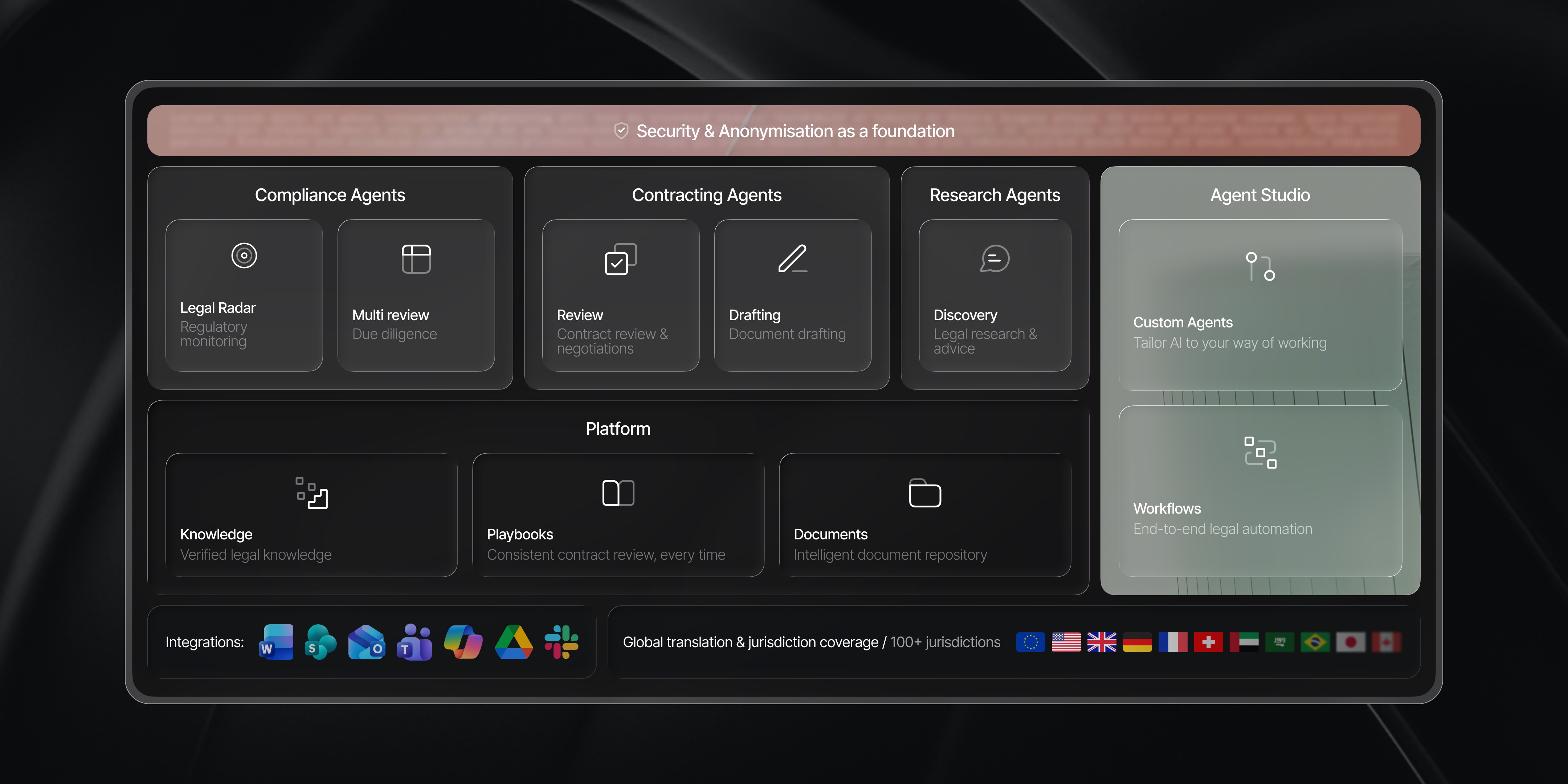
While most AI tools on this list are general-purpose tools adapted for legal contexts, LEGALFLY is built from the ground up for how in-house legal teams and lawyers actually work. That distinction matters most when it comes to data security, jurisdiction coverage, and the ability to apply your own legal policies consistently at scale. As one of the only specialised legal AI tools to anonymise all documents before any AI processing begins, it sets a different standard for enterprise use.
If your team is still spending two hours on contract reviews that should take 15 minutes, LEGALFLY was built to fix exactly that. Book a demo with one of our experts.
Customer reviews
I use Legalfly to summarise legal articles, give specific legal examples or ask general legal questions to get me started. Overall, I am very satisfied with how it works and with the output.
Verified User in Banking | Enterprise - G2
Great, with LegalFly, we are able to automate manual processes that take a lot of time. That enables us to shift our focus from reading to controlling!
Pjotr M. | ERP Controller - Capterra
Privacy-first architecture, not a setting
Every document processed in LEGALFLY is anonymised before any AI model sees it. Sensitive data, including names, financials, and confidential commercial information, is stripped before processing begins. This is not optional. It is built into the core architecture, with no training on customer documents and no exposure of sensitive legal data to external AI processing in identifiable form.
For legal teams at regulated enterprises, this is the difference between a tool that is technically compliant and one that is built around confidentiality from the ground up. LEGALFLY is available as cloud SaaS, single tenant, or single tenant with on-premises anonymisation for organisations with strict data residency requirements.
Most teams using LEGALFLY cut their contract review time in half within a few weeks of onboarding. Book a short demo to see how it works for your business.
Contract review that works inside Microsoft Word
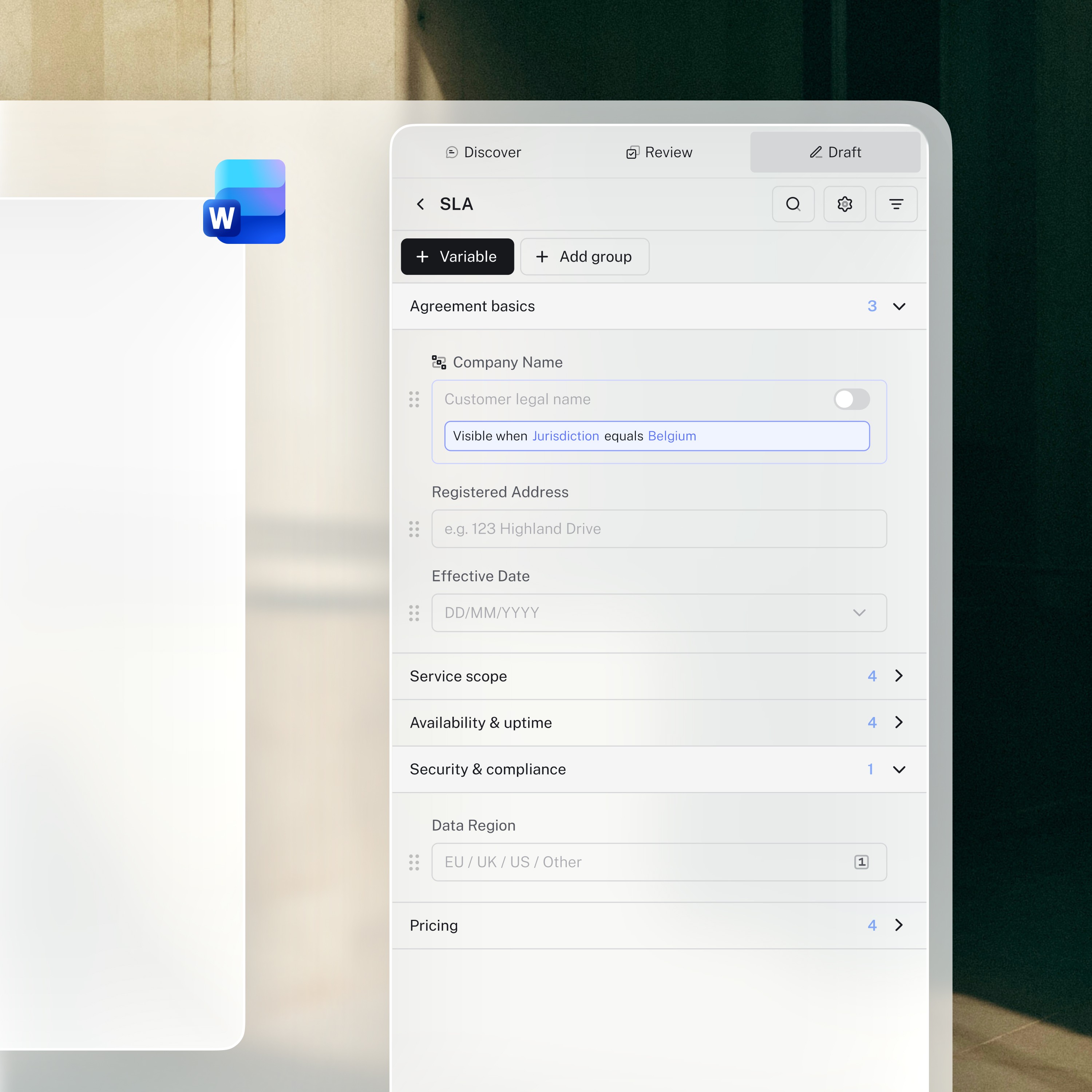
LEGALFLY reduces contract review time by 87.5%, from two hours to 15 minutes, working directly inside Microsoft Word where your team already reviews legal documents. It draws on 120+ pre-built playbooks covering 100+ document types. Every suggested change is explained with a rationale tied to a specific playbook rule. Nothing is a black-box recommendation.
The Multi-Review Agent extends this to scale: it scans hundreds of contracts simultaneously, applying your playbooks consistently across a full document set. For regulatory compliance audits or portfolio reviews, this changes what your team can deliver without adding headcount.
Legal document drafting in half the time
LEGALFLY reduces drafting time by 50%. Legal teams can generate complete contracts from their own legal document templates or from LEGALFLY's built-in library, customised to match organisational language and standards.
Clause suggestions are grounded in your policies, with fallback positions and escalation rules already encoded. The result is a first draft that reflects how your organisation works, not generic boilerplate.
Legal research grounded in verified sources
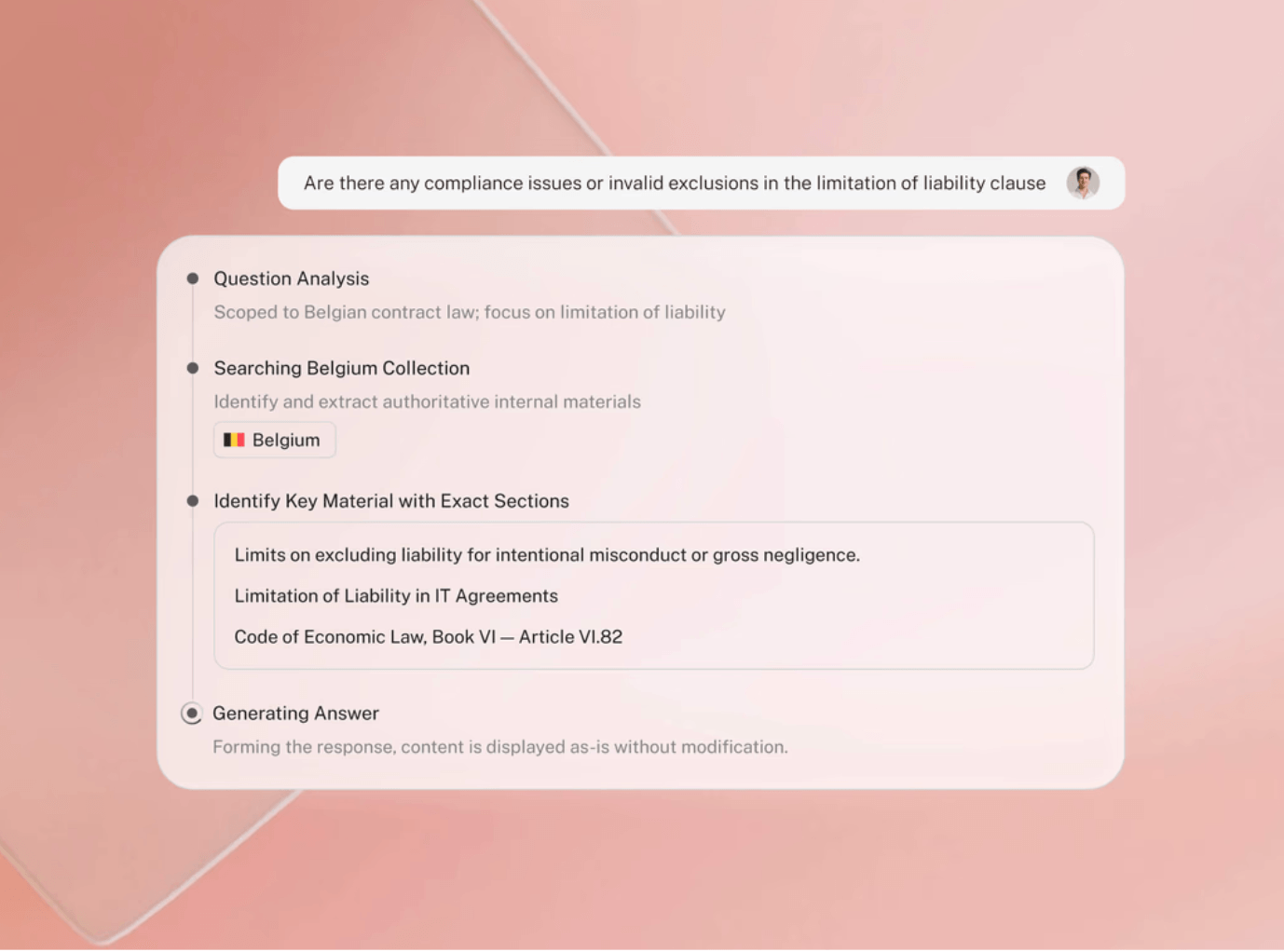
LEGALFLY's Discovery feature provides instant answers to legal questions, grounded in your documents and verified legal sources. It supports expert-level analysis across 100+ jurisdictions, enabling teams to get jurisdiction-specific answers without switching tools. For legal professionals dealing with multi-jurisdictional contracts or jurisdiction-specific requirements, this is a meaningful advantage over general AI tools that draw on publicly available data without legal grounding.
Legal Radar adds proactive regulatory monitoring, sourcing updates directly from legislative and official bodies and delivering a tailored impact assessment for your organisation. Legal teams stay ahead of regulatory change rather than reacting to it after the fact.
AI agents that automate the whole workflow
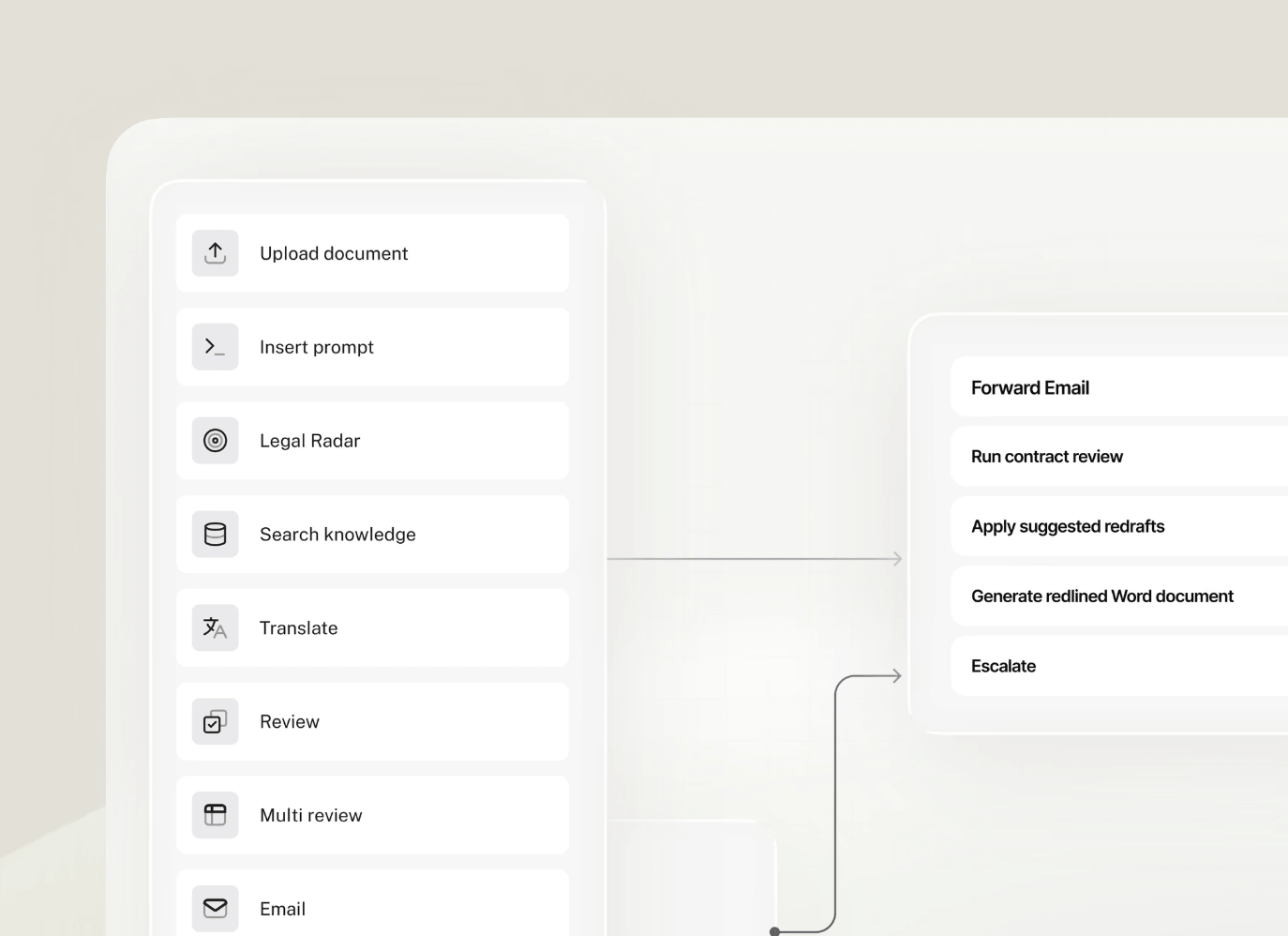
LEGALFLY goes further than individual AI tasks. Agent Studio lets teams build multi-step legal workflows, defining the steps, escalation logic, and approval routing, then letting LEGALFLY execute automatically. Legal retains final sign-off at all times. This is how AI tools should work in legal contexts: handling the coordination and repetition while keeping human judgment where it belongs.
How to use LEGALFLY for contract review
The following steps outline how LEGALFLY handles contract review from start to finish. Each step is designed to keep your team in control while the AI handles the volume.
Step 1: Import your document
Pull directly from SharePoint or Google Drive, open in Microsoft Word, or trigger a review from Teams, Outlook, or Slack. Sensitive data is anonymised automatically before any AI processing begins, no manual redaction required. The platform detects the contract type, jurisdiction, language, and party roles.
Step 2: Select your playbook
Choose from 120+ pre-built playbooks or a custom playbook built from your golden contracts in approximately two minutes. Playbooks encode your accepted positions, fallback positions, and escalation rules.
LEGALFLY helps your team move faster: less time buried in contracts, more time on the work that actually matters. Book a call to see it in action.
Step 3: Run the AI review
LEGALFLY reviews every clause against your playbook, flags risks, and generates suggested redrafts in your organisation's language and style.
Step 4: Review tracked changes
Tracked changes appear in Word, each with a clear rationale tied to the specific playbook rule that triggered it. Final judgment stays with your team throughout.
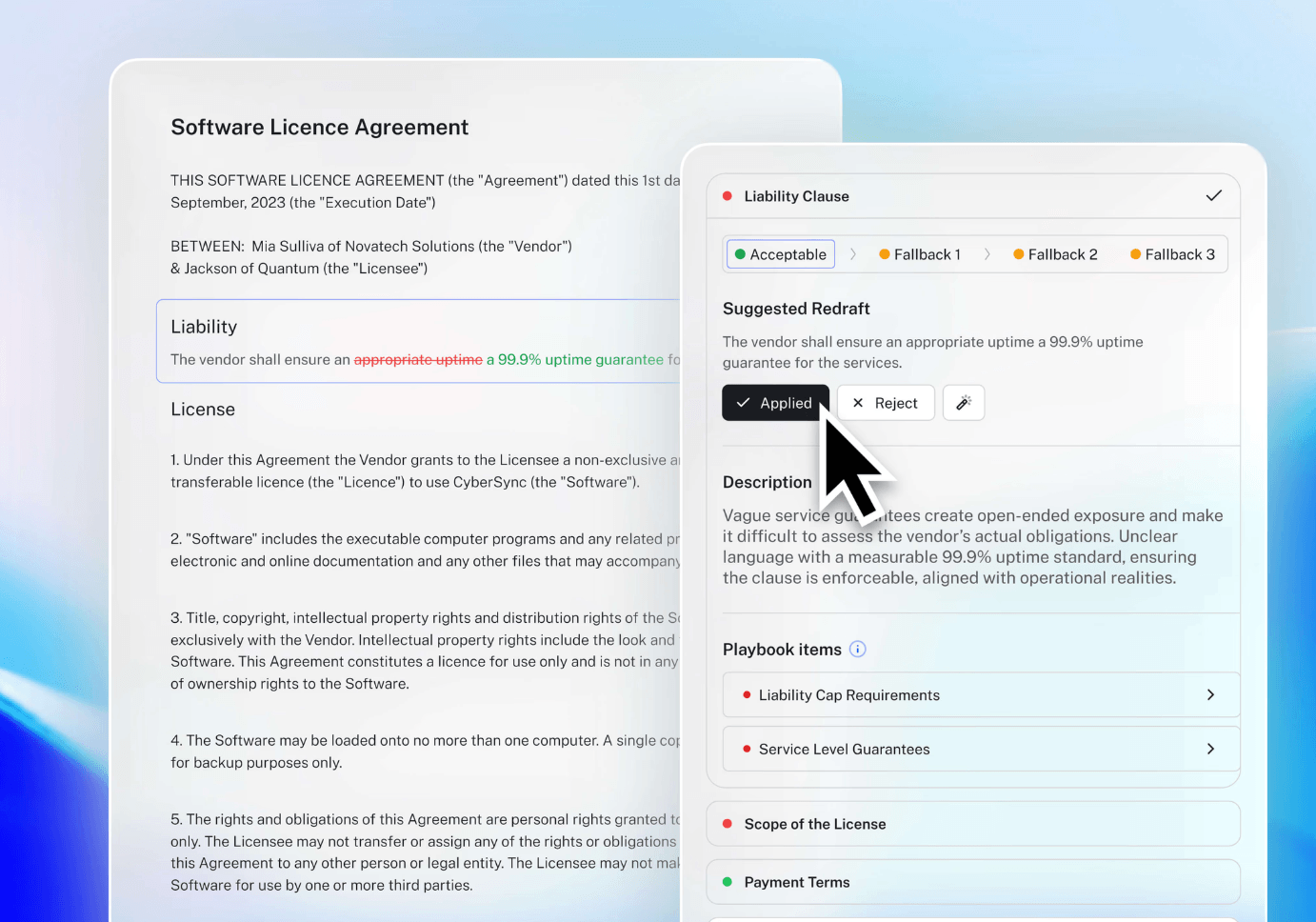
Step 5: Approve, escalate, or route
Low-risk contracts can be routed for business team self-service. Higher-risk items escalate according to your rules.
Step 6: Export with audit trail
Every session is logged. Every change applied or rejected is recorded, giving you a full, defensible audit trail.
See it on your own contracts
LEGALFLY cuts contract review time by 87.5%, with expert-level analysis across 100+ jurisdictions and every output tied to your playbook. If your team is ready to move from hours to minutes, book a demo and we'll walk through it on your documents, in your jurisdiction, inside Microsoft Word. Book a demo.
If your team is still spending hours on contract reviews or struggling to apply AI safely, then it’s time to upskill with LEGALFLY’s free professional AI training. If you want to turn AI into real time savings across drafting, review, and compliance, this shows you exactly how. If you’re serious about working faster without increasing risk, this is the fastest way to get there.
Harvey AI
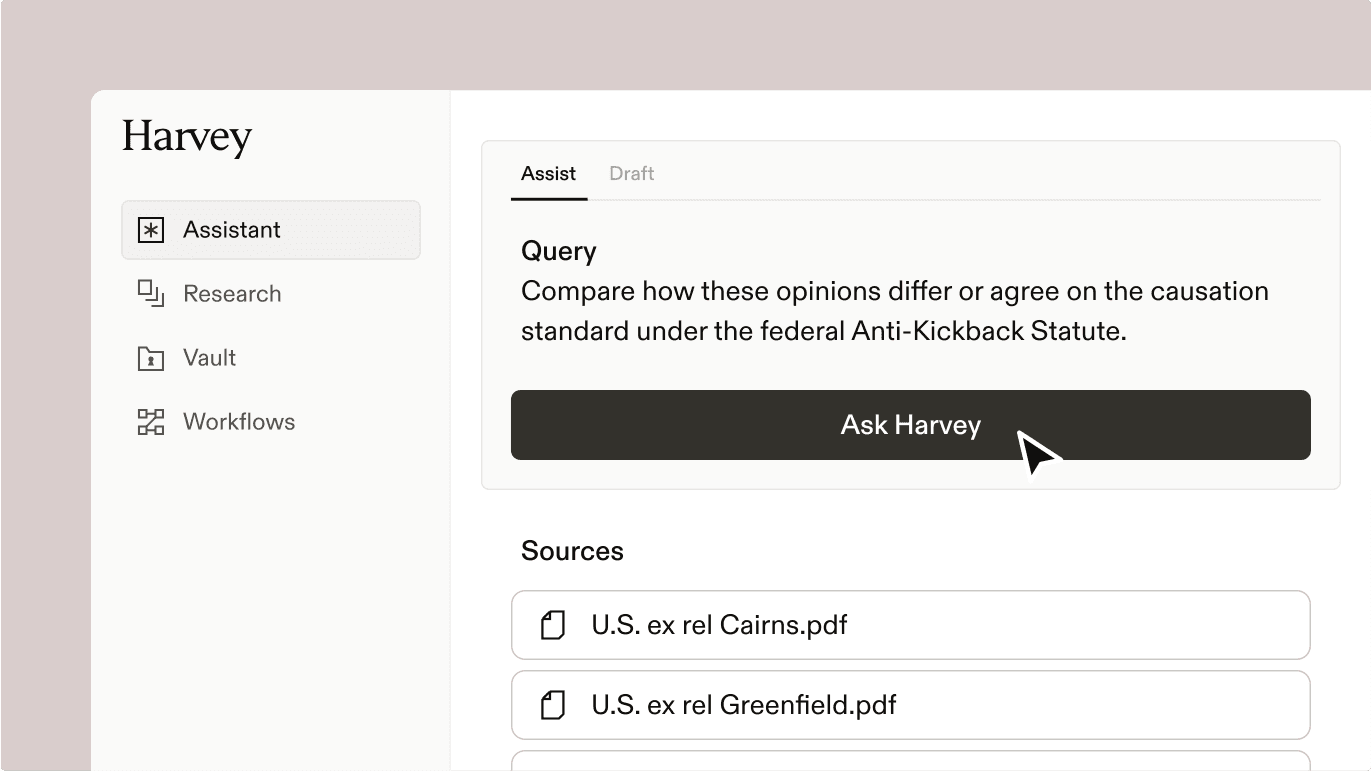
Harvey AI is a legal AI platform built primarily for law firms. It supports legal research, document drafting, and contract analysis, and is particularly strong for legal professionals who need to locate relevant case law, reason through legal precedents, and develop litigation strategy. Harvey is assistant-first, built around a chat interface where you work through legal questions matter by matter.
For law firms and attorneys conducting case-by-case legal research where reasoning from historical case data matters, Harvey is a credible and capable tool. For in-house teams that need consistent policy-driven contract review at volume, it is built for a different context.
CoCounsel
CoCounsel, developed by Casetext, is an AI-powered legal assistant built for document-heavy legal research and document review. It integrates with Westlaw and Microsoft 365 and can help legal professionals conduct thorough research, locate relevant case law, and analyse legal texts.
CoCounsel is a good starting point for teams whose primary use case is research rather than high-volume contract review. Human oversight remains important for all outputs used in legal practice.
ChatGPT
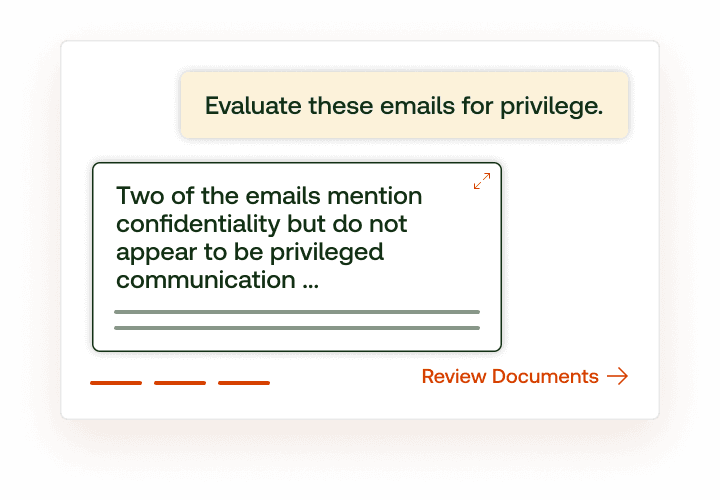
ChatGPT is a general-purpose artificial intelligence tool used across industries. For legal work involving non-sensitive tasks, it can support basic document drafting, summarisation, and answering general legal information questions. It functions as a basic AI assistant for low-stakes legal tasks.
The limitation for legal practice is data security. ChatGPT is not designed to handle sensitive legal data or enforce client confidentiality. Inputs are processed without the security architecture that legal professionals require for commercially sensitive documents. For anything involving confidential information, a purpose-built legal AI tool is the appropriate choice. There are also risks involved with using ChatGPT for legal research.
Lawgeex
Lawgeex automates contract review by analysing and redlining agreements against company policies. It enhances consistency and compliance while reducing manual errors, saving legal teams time and effort.
With integration options for most CRM systems and analytics to track review processes, Lawgeex is a good choice if you frequently handle high volumes of contracts and need to maintain strict policy adherence.
ClickUp
ClickUp is a productivity platform that enables legal professionals to manage their work through customisable views and dashboards. Features like time tracking, billable hours, and the AI-powered ClickUp Brain help streamline invoicing, draft legal documents, and generate reports.
If you want an all-in-one tool to manage tasks and automate repetitive admin, ClickUp is a good option.
Ansarada
Ansarada streamlines complex transactions, including mergers, acquisitions, and compliance workflows. With features like document self-destruct and granular access controls, sensitive information remains protected throughout the transaction process.
It offers AI-powered Virtual Data Rooms (VDRs) that provide secure file-sharing and advanced tools for governance, risk, and compliance management. It can show real-time insights into bidder engagement and document activity, enabling teams to make informed decisions during transactions.
Ansarada is designed for teams involved in deal-making or regulatory compliance, offering reliability and robust features to simplify intricate workflows.
ContractSafe
ContractSafe simplifies contract management with features like AI-enabled search, deadline tracking, and secure user access. Its integration with tools like DocuSign and Salesforce makes execution and monitoring relatively easy.
If you need an affordable and intuitive solution to organise contracts and reduce risks tied to missed obligations, ContractSafe is a practical choice.
Claude
Claude, developed by Anthropic, focuses on context-awareness, and could be used to help draft legal documents and analyse queries. It handles longer inputs, making it suitable for legal texts.
However, data inputs are not stored privately, which means it shouldn’t be used for confidential information. Like ChatGPT, its outputs require human oversight to ensure compliance and precision. Compare Claude for legal vs LEGALFLY.
Gemini
Gemini, Google DeepMind’s AI, uses advanced NLP and real-time data access for drafting, summarising, and analysing. Integrated with Google Workspace, it’s convenient for teams already using Google's ecosystem.
The best AI tools for legal work in 2026: at a glance
Tool | Best for | Primary capability |
LEGALFLY | In-house legal, compliance, procurement | End-to-end legal workflow automation |
Harvey AI | Law firms | Litigation support and legal research |
CoCounsel | Research-heavy legal work | Document review and case law analysis |
ChatGPT | Non-sensitive general tasks | Drafting and summarisation |
Claude | Long-form document analysis | Legal document review and drafting |
ClickUp | Practice management | Workflow and billing automation |
Ansarada | Deal teams | Secure transaction data rooms |
Lawgeex | High-volume contract teams | Automated contract redlining |
ContractSafe | Contract management | Contract organisation and tracking |
What to look for in legal AI tools
The global legal tech market was estimated at $20.81 billion in 2025 and is expected to reach $65.51 billion by 2034. More options will continue to enter the market. The best legal AI tools share several qualities that separate them from the rest.
Security architecture
Legal work involves confidential information at every step. The best legal AI tools anonymise data as a core architectural requirement, not as an optional feature. Client confidentiality is not a setting.
Jurisdiction-specific grounding
General AI tools draw on publicly available data. Specialised legal AI tools constrain their sources to legal codes, case law, and jurisdiction-specific requirements. If your work spans multiple jurisdictions, coverage and accuracy across those jurisdictions is non-negotiable.
Integration with existing workflows
Legal AI tools are most effective when they integrate directly into existing legal workflows rather than requiring a separate platform. For legal professionals working in Microsoft Word and Microsoft 365, native integration removes adoption friction.
Customisation depth
Generic AI analysis applies general legal standards. Playbook-driven platforms apply your standards: your accepted positions, fallback positions, and escalation rules. The quality and consistency of output depends on how well the tool can encode your organisation's legal policies.
LLM-agnostic architecture
The best AI tools are not locked to a single AI model. LLM-agnostic platforms use advanced AI by selecting the right model for each specific task, which produces better results across different types of legal work.
Legal AI tools by use case
Different AI tools serve different parts of legal practice. Understanding this helps legal professionals choose the right tool for their context.
Contract review and drafting
In-house legal teams managing high volumes of NDAs, service agreements, and commercial contracts benefit most from specialised legal AI tools with playbook-driven review. Legal document drafting tools that work inside Microsoft Word reduce the need to switch between applications and keep the process grounded in your own legal document templates.
Legal research and case law
For law firms and legal professionals who need to locate relevant case law, analyse legal precedents, and build arguments from historical case data, tools like Harvey AI and CoCounsel support attorneys with research-intensive workflows. These tools provide cited answers grounded in verified legal databases.
Regulatory compliance
For compliance teams tracking regulatory change, platforms that source updates directly from legislative bodies rather than third-party feeds provide more reliable and timely coverage. Proactive monitoring reduces the risk of being caught by a regulatory change after it has already taken effect.
Due diligence
For transactional lawyers working on M&A and deal processes, AI-powered tools that can apply consistent risk criteria across hundreds of documents simultaneously are far better suited than general AI assistants. Document analysis at scale is where specialised legal AI outperforms general-purpose tools most clearly.
Immigration lawyers and multilingual work
Legal professionals handling immigration law and cross-border matters need AI tools validated across multiple jurisdictions and capable of processing contracts in multiple languages. LEGALFLY supports documents in 80+ languages across 60+ jurisdictions.
Ethical considerations when using AI in legal practice
In 2026, over 90% of legal professionals now use at least one AI tool, according to Wolters Kluwer’s Future Ready Lawyer Survey. With adoption growing fast across the legal industry, a few principles are worth holding.
Legal professionals have an obligation to understand the technology they use and ensure it supports, rather than undermines, competent representation. That means understanding how an AI tool reaches its conclusions, and maintaining oversight of every output before it influences a legal decision.
Natural language processing tools have improved significantly, but they still require human judgment to manage edge cases, weigh context, and make the calls that matter. The best AI tools make this easier by being transparent: tying every output to a source, flagging the reasoning, and keeping the legal team in control throughout.
Data security is also an ethical matter, not just a compliance one. Sensitive legal data processed through tools without appropriate safeguards creates risks for clients and counterparties who have not consented to that exposure. Choosing the right legal AI tools is part of meeting the standard your clients and your organisation expect.
The bottom line
The adoption of AI in law firms and in-house teams has grown sharply, and shows no signs of slowing down. The question is no longer whether to use AI tools, but which ones are built for the demands of legal work.
For in-house legal teams that need to move faster without adding risk, LEGALFLY offers contract review that cuts time by 87.5%, expert-level analysis across 100+ jurisdictions, and a privacy-first security architecture built for regulated enterprises.
If you want to see how it works on your documents, in your jurisdiction, book a demo with one of our experts.
Disclaimer: This article reflects the state of the legal AI market as of 2026. Features and capabilities of third-party tools are subject to change. Verify current functionality directly with vendors before making procurement decisions.
Frequently asked questions
What is an AI lawyer?
An AI lawyer, sometimes called an AI legal assistant or AI lawyer tool, refers to software that uses artificial intelligence to perform legal tasks such as contract review, document drafting, legal research, and compliance monitoring. AI lawyer tools support legal professionals; they do not replace the judgment and accountability that legal work requires.
Are AI tools safe for sensitive legal work?
It depends on the tool. General AI tools are not designed to handle sensitive legal data securely. Purpose-built legal AI platforms with mandatory anonymisation, ISO 27001 and SOC 2 Type II certification, and no training on customer documents are in a different category. For regulated industries, the security architecture of any AI tool should be evaluated before use.
Can AI tools support attorneys with legal research?
Yes, with caveats. AI-powered legal research tools can rapidly identify and synthesise relevant authorities, helping legal professionals conduct thorough research faster than traditional methods. The quality of the output depends on whether the tool is grounded in verified legal databases or drawing on general publicly available data without legal grounding.
What is the difference between general AI tools and specialised legal AI tools?
General AI tools are trained broadly and can assist with many tasks. Specialised legal AI tools are built to understand legal document structure, apply jurisdiction-specific requirements, enforce organisational legal policies, and handle sensitive data with appropriate security controls. For in-house legal teams at regulated enterprises, that distinction is material.
How do I choose between AI tools for my legal team?
Start with your primary use case: contract review, legal research, compliance monitoring, or practice management. Then evaluate security architecture, jurisdiction coverage, integration with your existing tools, and the ability to customise to your legal standards. A tool that fits how your team works will drive more consistent adoption than the most capable tool in a generic demo.