






AI Hallucinations in Legal Work: Why They Happen and How to Verify Every Citation
AI hallucinations in legal work are not a quirk of early tools that has since been fixed. They are a result of how large language models produce text, and there are now numerous examples of them in court filing, client advice and contract reviews.
The issue is not the mistake itself, as junior lawyers get things wrong too, but that a hallucinated case, quote or clause reads exactly like a real one, with correct formatting, plausible party names and a confident summary of the holding, and nothing on the page signals that it was invented.
The following guide explains why hallucinations happen, where they hide in legal automation, and what your professional obligations are. It also provides you with a practical checklist for verifying every citation before it leaves your desk, and a set of questions to ask any legal AI vendor about how its system keeps answers tied to real sources.
If you’d rather skip the theory and see how a specialised legal AI tool keeps hallucinations to a minimum, book a LEGALFLY demo.

غابي ماكسويني
نائب رئيس قسم التسويق

للتعرف على كيفية استفادتكم من خدمات LEGALFLY، يُرجى حجز موعد للتحدث مع أحد خبرائنا.
What an AI hallucination looks like in legal work
An AI hallucination is information presented as fact when it is not drawn from any source. A case, quote, provision or contract term that the model generated rather than found is a hallucination, and in legal work they fall into a few recognisable categories.
In court filings, fabricated citations are the most common, while contract misreading matters most for in-house teams. However, hallucinations are not limited to legal research, as AI can produce them whenever reading, summarising or extracting information.
Why AI hallucinations happen
A large language model does not look facts up but, instead, predicts the most likely next piece of text based on patterns in its training data. While this text makes sense and is correct for most cases, it can still lead to mistakes that the model has no mechanism to verify. Legal text adds a layer of complexity:
They follow a very predictable shape: Case names, neutral citations and statutory references follow strict formats, which allows the model to produce something that has the exact form of a citation without any underlying case.
Training data is incomplete and out of date: Many judgments, especially from lower courts and smaller jurisdictions, are thin or absent in training data. The law also changes after the training cut-off. When information is missing, the model fills the gaps with something plausible.
Models are built to answer: A general chatbot is optimised to be helpful, so when asked for authority supporting a proposition, it tends to produce some even if none exists.
No grounding in sources: Hallucination rates fall sharply when a model must answer from retrieved, verified sources and cite where each statement came from rather than answer from memory alone.
Long and complex documents: When reviewing contracts, AI models can blend clauses, confuse parties or carry a term from one agreement into the summary of another, especially across long documents or large batches.
Leading prompts: A prompt that assumes the answer, such as "find the case that says...", pushes the model to confirm it.
In Ayinde v London Borough of Haringey and Al-Haroun v Qatar National Bank, handed down together on 6 June 2025, the Divisional Court stated it plainly: freely available generative AI tools such as ChatGPT are not capable of conducting reliable legal research. It does not mean AI should be avoided when handling legal cases, only that tools built specifically for legal work have an advantage and that their output should still be verified.
The scale of the problem
The AI Hallucination Cases database maintained by Damien Charlotin, which tracks court and tribunal decisions that identified AI-fabricated material, lists 2,202 decisions worldwide.
It also shows steep growth in the United States, from 11 cases in 2023 to 37 in 2024, 526 in 2025 and 574 in the first half of 2026 alone. The database updates continuously, so treat these counts as a floor rather than a final tally.
Where AI hallucinations hide in legal automation
Headlines always show judges catching the errors in court filings, but in-house teams face the same risks in work that might never be read by a judge. In legal automation, AI hallucinations are mainly found in four places:
Legal research and advice memos: The classic case of an answer to a legal question citing either an authority that does not exist, or a real authority for the wrong point. As this hallucination might end up in a board paper or a note to the business rather than a court bundle, it can sit unchallenged for months.
Contract review and extraction: AI review tools report on clauses, values, dates and obligations, and may hallucinate a liability cap not found in the agreement, a notice period copied from another contract, or a "no change of control clause found" that is wrong. These errors are harder to spot than a fake case, because the reviewer has no external database to check against, only the contract itself.
Drafting: Tools that generate documents can insert statutory references, defined terms or boilerplate that do not match the governing law or the rest of the document. A reference to a repealed provision or a non-existent section is easy to miss in a long draft.
Multi-step and agentic workflows: When AI agents chain tasks, such as triage, review, redline and summary, an error early in the chain is carried forward and restated with growing confidence. By the time a summary reaches the business, the original mistake can be several steps removed from any source. This is why every step in an automated workflow must keep its link back to the source text, and why human review and approval are crucial.
How LEGALFLY keeps AI output tied to its sources
Verification is not about reading the AI's answer a second or third time, but about checking it against a primary source, and having someone accountable for the result.
LEGALFLY helps enterprises build the design choices above into every workflow, so the output stays grounded, every answer can be checked, and in-house legal stays in control.
LEGALFLY, the legal operating system for in-house teams, is built to move legal work from request to outcome inside the guardrails legal sets. It relies on five tools to ensure every answer you see arrives with the source you need to check.
Most teams using LEGALFLY cut their contract review time in half within a few weeks of onboarding. Book a short demo to see how it works for your business.
Agent Studio

In Agent Studio, legal teams design how work moves: which agent handles a request, which playbook applies, what escalates to a lawyer and what needs approval. Conditional routing, escalation thresholds and approvals are part of the workflow from the very first step, and every action is auditable, with transparent reasoning, source links and full activity logs.
That is how legal workflow automation avoids the chained-error problem, since each step keeps its link back to the source and documents are approved by humans at every necessary step.

للتعرف على كيفية استفادتكم من خدمات LEGALFLY، يُرجى حجز موعد للتحدث مع أحد خبرائنا.
Anonymisation

Anonymisation answers what the SRA treats as the second AI risk alongside hallucinations: confidentiality. LEGALFLY is the only legal AI that anonymises documents before analysis, which is the company's own claim, and it is an architectural decision rather than a setting.
Documents are anonymised at import, before any analysis begins, so personally identifiable data never leaves your environment. It is available in SaaS, single tenant or with on-premise anonymisation, and the platform is ISO 27001 certified and SOC 2 Type II.
للتعرف على كيفية استفادتكم من خدمات LEGALFLY، يُرجى حجز موعد للتحدث مع أحد خبرائنا.
Discovery

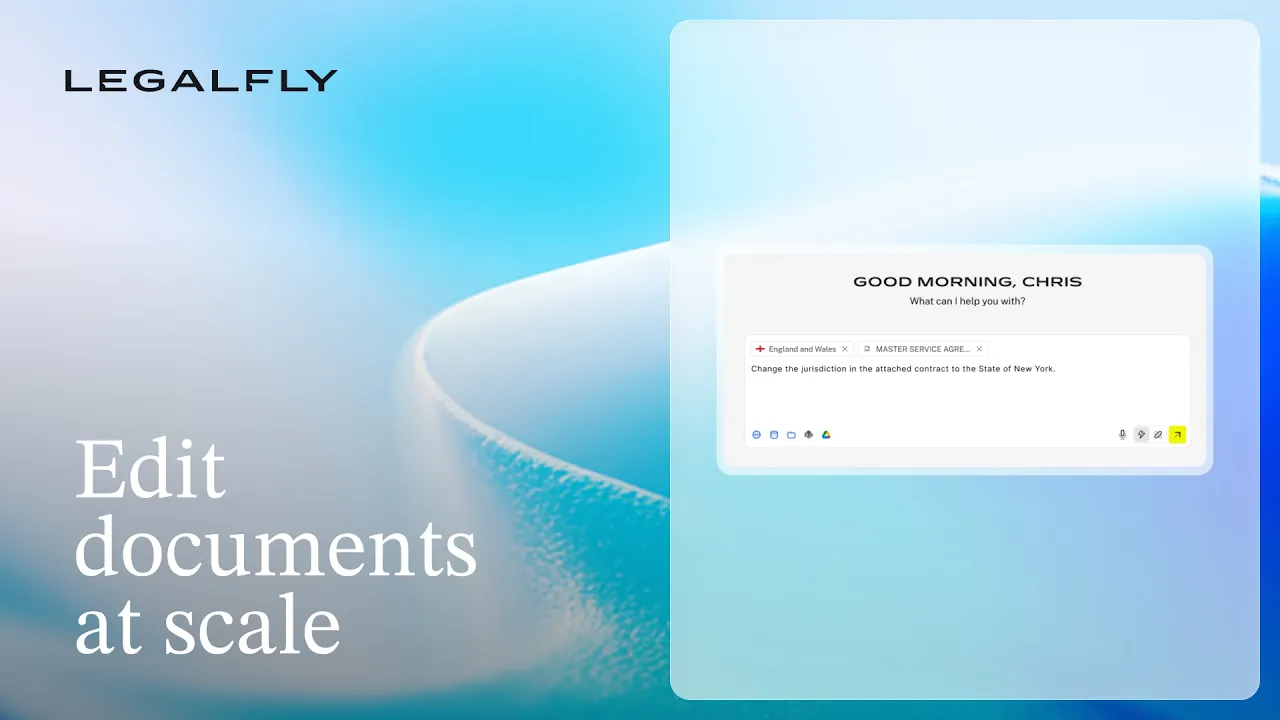
LEGALFLY's Discovery agent is grounded in 1000+ official legal sources across 130+ jurisdictions, plus your own knowledge collections of policies, playbooks and clauses, before it answers a prompt.
Users can choose the sources and set the jurisdictions, and every answer carries citations and reasoning that can be audited.
للتعرف على كيفية استفادتكم من خدمات LEGALFLY، يُرجى حجز موعد للتحدث مع أحد خبرائنا.
Review

The Review agent checks contracts against your own playbooks, with 120+ lawyer-built playbooks covering 100+ document types.
It explains every flagged clause with the reasoning, the supporting sources and a transparent trail, so a reviewer can check each finding against the contract rather than trust a summary.
LEGALFLY helps your team move faster: less time buried in contracts, more time on the work that actually matters. Book a call to see it in action.
Contract Intelligence

Extraction errors do not stop being dangerous once a contract is signed. A notice period misread during review becomes a missed deadline two years later, and nobody goes back to the source to check it.
Contract Intelligence covers the full contract lifecycle, starting at the draft rather than at signature. It shows the status of every contract and what to act on next, through negotiation, approval and e-signature to renewals, expirations, notice periods and obligations, with each one tied to the document it came from.
Most teams using LEGALFLY cut their contract review time in half within a few weeks of onboarding. Book a short demo to see how it works for your business.
How to verify every citation: a step-by-step checklist
If your team relies on generic AI to read and analyze their cases, they should follow this checklist to review every authority, quotation and contract reference that it produces before sending out your legal documents:
1. For case law and legislation
Treat every citation as unverified: Start from the assumption that nothing has been checked, however confident the output reads.
Find it in an authoritative source: Look the case up in an official or recognised database, such as Find Case Law at The National Archives, BAILII, the official law reports or your subscription service. For legislation, use legislation.gov.uk or EUR-Lex. Do not verify a citation by asking the same AI about it, or by trusting a search engine snippet.
Match the details: Check party names, neutral citation, court, date and paragraph numbers against the source. A mismatch in any of them is a warning sign.
Read the passage you are relying on: Confirm that it supports the proposition, that it is part of the reasoning rather than a dissent or passing remark, and that the facts are close enough to apply.
Check quotations word for word: Every quoted phrase must appear in the source exactly as quoted. If it does not, paraphrase the source accurately or remove it.
Check that the law is current: Confirm the case has not been overruled, reversed or doubted on appeal, and that the legislative provision is in force, unamended, and in its current form.
Check the jurisdiction: Confirm the authority applies where you need it: England and Wales, Scotland, Northern Ireland, an EU member state, or elsewhere.
2. For contract review and extraction
Click through to the clause: Every reported term, value, date and obligation should link to the exact text in the document. If it does not, find it yourself.
Check absence claims: When the AI says a clause is missing, search the document and its schedules. "Not found" claims need evidence too.
Check the right document: In batch reviews, confirm the output relates to the right agreement, version and party.
3. For sign-off
Record the verification: Note who checked what, when and against which source, so the work can be audited later.
Escalate high-stakes output: Anything going to a court, regulator or board should have a second, senior review.
Be aware of cases you have never heard of that fit your argument perfectly, citation formats that do not match the court's style, quotes that are unusually on point, authorities that only appear in the AI's answer, and summaries that are very confident but cite no specific passage.
How to reduce AI hallucinations in legal work?
Better than spotting errors is designing systems that produce fewer of them and make it easier to catch any that remain.
To do so, there are some critical design choices you must adopt alongside human verification, which is a must at all times:
Ground answers in verified sources
Outputs are grounded in both internal documents and external legal frameworks.
Research draws on 100+ verified legal sources: legislation, case law, and trusted legal publishers, including FromCounsel.
Users choose the scope: trusted curated web sources, internal knowledge collections (including access to legal publishers), or a combination of both.
Unreliable sites such as Wikipedia are excluded so they never inform responses.
Citations and traceability
For document questions, LEGALFLY points to where in the text the answer comes from, and references external legal sources where relevant.
Every segment of an answer shows the exact source (document, clause or web source) and its collection, and users can click through to preview the full source.
Explainability
Users can see step by step how LEGALFLY reached its conclusions.
A full report on AI-driven decisions can be downloaded, covering the playbook rules and external sources applied (which can be used in any future audits)
Constraining the model’s freedom
Review follows defined legal playbooks rather than just suggesting changes.
Teams can specify exact replacement clauses or structured guidelines instead of getting a generic revision.
Knowledge collections let teams query curated sets of internal documents, approved templates, and external sources consistently.
Review now waits for the user’s answers before redrafting, so it doesn’t fill gaps by guessing.
Questions to ask a legal AI vendor
Before you rely on any tool for legal work, you should ask how it handles hallucinations. You can use the following list to evaluate your provider, and keep in mind that vague answers are an answer in themselves.
The last question is the most telling, as no responsible vendor will promise that its system never hallucinates. The right answer explains how the system reduces the risk and how it makes errors visible.
Question | What a good answer includes |
What sources does the system answer from? | Named, verified legal sources and your own documents, with the option to choose sources and set jurisdictions |
Does every answer show its sources? | Citations and links to the exact passage, for research and for contract extraction |
How current is the legal content? | A stated update frequency for case law, legislation and publisher content |
How does it behave when it cannot find an answer? | It says so, rather than generating a plausible one |
Can we audit the reasoning? | Transparent reasoning and full activity logs |
Where can a human step in? | Configurable approvals and escalation in workflows |
What happens to our documents? | Anonymisation, no training on your data, clear retention and deployment options |
Does the vendor claim zero hallucinations? | It should not. Any vendor that promises 100% accuracy is overstating what the technology can do |
From request to outcome
Hallucinations are a design problem before they are a diligence problem. The checks above catch what reaches a reviewer, and the system around them decides how much ever gets that far.
Book a demo and see how LEGALFLY routes, executes and governs legal work end to end, across every team, jurisdiction and workflow.

FAQs about AI hallucinations in legal work
What are AI hallucinations in legal work?
They are outputs that an AI tool presents as fact but that have no basis in the sources: fabricated cases, real cases cited for the wrong point, invented quotations, non-existent statutory provisions, or contract terms that are not in the document.
Why do AI tools invent legal citations?
Language models predict likely text rather than look facts up. Legal citations follow strict formats, so a model can produce something that looks exactly like a real citation without any underlying case, especially when it answers from memory instead of verified sources.
How do you verify an AI-generated citation?
Find the authority in an official or recognised source, match every citation detail, read the passage to confirm it supports the point, check quotations word for word, and confirm the law is still current and applies in your jurisdiction.
Can AI hallucinations in legal automation be avoided entirely?
No. They can be reduced by grounding answers in verified sources, linking every statement to its source, keeping tasks narrow and building human approval into workflows. Verification is still required.

