



That last part is the difference that matters. Most regulatory intelligence products are very good at telling you what changed, and stop there.
A feed tells you a rule moved. It does not tell you which of your contracts now conflict with it, which policy needs redrafting, or who has to approve the new wording.
Closing that gap is where teams lose weeks. This comparison covers ten products and separates them on exactly that line: monitoring, versus monitoring that connects to your own documents and does something about them.
We built LEGALFLY, so read the first entry with that in mind. The other nine draw on published product information, and on verified reviews where enough of them exist.
Most teams using LEGALFLY cut their contract review time in half within a few weeks of onboarding. Book a short demo to see how it works for your business.
Key Takeaways (TL;DR)
What Horizon Scanning Software Does: Monitors regulators, legislatures, courts and official publishers for changes that affect your organisation, then summarises what changed, assesses impact and tracks that someone acted on it.
Why Most Teams Are Unhappy With Theirs: Coverage is usually strong and impact analysis usually is not. Teams receive alerts, then do the work of mapping each change to affected contracts and policies by hand, which is the part that consumes compliance capacity.
Best Overall Horizon Scanning Software: LEGALFLY. Legal Radar covers 130+ jurisdictions and then tests each change against your own contracts and policies, with the redraft and approval workflow running in the same system.
What Sets LEGALFLY Apart: Whole legal workflows run end to end from a detected regulatory change through to a redrafted document and legal sign-off, on documents that are anonymised before analysis begins, on an architecture designed before the current generation of models existed. No competitor on this list replicates that combination.
How to Choose the Right Tool: Establish whether your gap is coverage or impact analysis, check the tool covers your actual jurisdictions rather than a headline count, and ask what happens after the alert lands.
Best Horizon Scanning Tools in 2026 at a Glance
Tool | Best For | Key Features | Pros | Cons |
LEGALFLY | In-house legal and compliance teams that need change monitoring connected to their own documents | End-to-end agentic workflows through Agent Studio, anonymisation before analysis, Contract Intelligence across the lifecycle, Legal Radar across 130+ jurisdictions, playbook-driven review | Workflows carry a detected change through to a redrafted document and approval; anonymisation applied at import; impact tested against your own contracts and policies | Sales-led evaluation, so the first step is a scoped demo rather than a self-serve trial |
Thomson Reuters Regulatory Intelligence | Large financial institutions needing broad global regulatory content with analyst commentary | Global regulatory change feeds, expert analysis, obligation libraries, integration with wider Thomson Reuters research | Depth of editorial analysis and brand trust with regulators and boards | Heavyweight for non-financial organisations, and impact mapping to your own documents remains largely manual |
Wolters Kluwer OneSumX Regulatory Change Management | Banks and insurers mapping regulatory change to an internal controls library | Curated regulatory content, obligation mapping, control linkage, workflow and audit reporting | Strong controls mapping for regulated financial institutions with formal governance structures | Built around financial services taxonomies, with implementation effort to match |
LexisNexis Regulatory Compliance | Compliance teams wanting obligation-level content tied to business activities | Obligation registers, jurisdiction-specific regulatory content, change alerts, activity mapping | Obligation-level granularity that suits regulated operational businesses | Coverage is strongest in a handful of jurisdictions, so multi-region teams should test their own list |
CUBE (RegPlatform) | Global banks and payment firms needing automated regulatory intelligence at scale | Automated regulatory data capture, taxonomy classification, obligation mapping, policy linkage | Built for very large regulatory footprints across many jurisdictions | Enterprise scale and implementation, which is more than most in-house legal teams need |
Corlytics | Financial institutions wanting regulatory risk analytics and enforcement intelligence | Regulatory taxonomy, enforcement action data, risk scoring, policy management | Enforcement and risk analytics that few competitors attempt | Financial services focus, and no public review base to sense-check the buying experience |
Regology | Compliance teams wanting AI-led regulatory discovery and an obligation library | AI regulatory discovery, law library, obligation mapping, alerting and task assignment | Modern interface and an AI assistant layer over the regulatory library | No public reviews on G2, so references have to come from the vendor |
Vixio Regulatory Intelligence | Gambling and payments businesses needing sector-specific regulatory tracking | Sector regulatory updates, jurisdiction reports, compliance workflows, analyst commentary | 4.9 rating from reviewers who praise the analyst input alongside the data | Vertical by design, so it is the wrong tool outside gambling and payments |
Ascent | Financial services teams wanting regulations broken into specific obligations automatically | Automated obligation extraction, rule mapping, change alerts, integration APIs | Obligation-level automation that reduces manual rule interpretation | Very small public review base, and reviewers describe a learning curve in the first months |
Compliance.ai | US-focused compliance teams wanting machine-learning change monitoring mapped to internal policy | Regulatory change monitoring, policy mapping, expert-in-the-loop review, workflow tracking | Policy mapping built into the monitoring workflow | Coverage skews to US financial regulation, and the G2 profile is unclaimed with no reviews |
Why Legal and Compliance Teams Need Horizon Scanning Software
Regulatory change moves fast, and manual monitoring does not scale. One person can realistically follow one or two jurisdictions, and most regulated businesses now operate across considerably more than that.
The consequence is not usually a missed rule. It is a team that finds out late, then spends the remaining window working out what the change touches.
What Horizon Scanning Software Does
Horizon scanning software watches official sources continuously: gazettes, supervisory authorities, national banks, regulatory authorities, courts, councils and official legal databases. When something relevant publishes, it summarises the change and routes it to the people who need to know.
The better products add structure on top. Changes are classified by topic and jurisdiction, mapped to the obligations they affect, and tracked through to somebody confirming action was taken.
That audit trail is often the real purchase. When a supervisory authority asks how you knew about a change and what you did about it, a search history is not an answer.
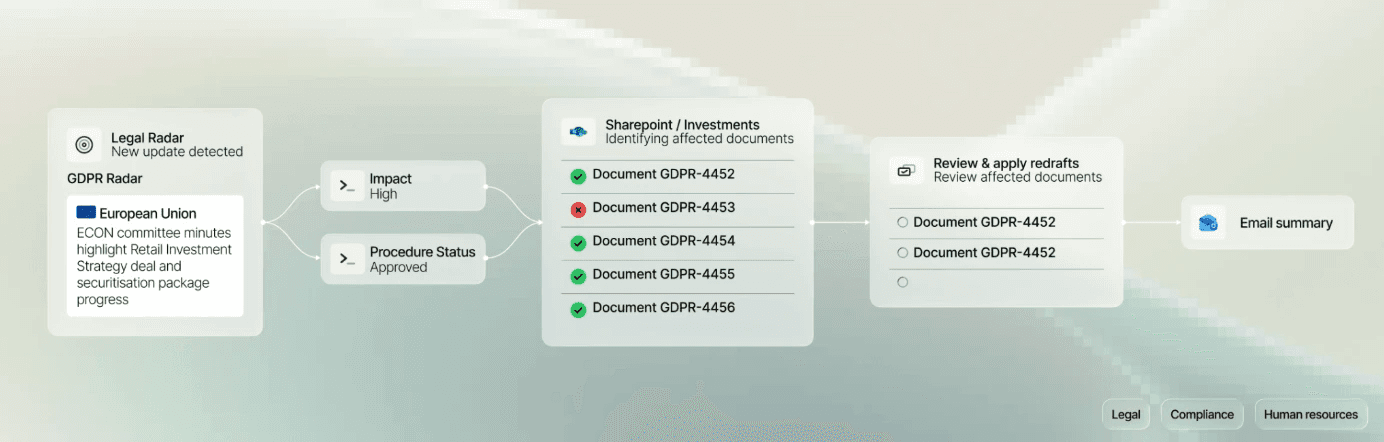
Where Most Horizon Scanning Tools Fall Short
Coverage is rarely the problem. Most established vendors monitor more sources than any single organisation needs, and they compete on the size of that number.
Impact analysis is where the gap opens. Knowing that a rule changed is a fraction of the work, because the question your business asks next is which of our contracts, policies and processes now conflict with it.
Answering that means reading your own documents against the new requirement, which most regulatory intelligence products cannot do. They monitor the outside world well and have no view of your paper at all.
The result is a familiar pattern. A well-run feed produces a steady stream of accurate alerts, and a compliance team spends its week manually working out which ones matter, then a legal team redrafts whatever they find.
Best Horizon Scanning Tool Overall
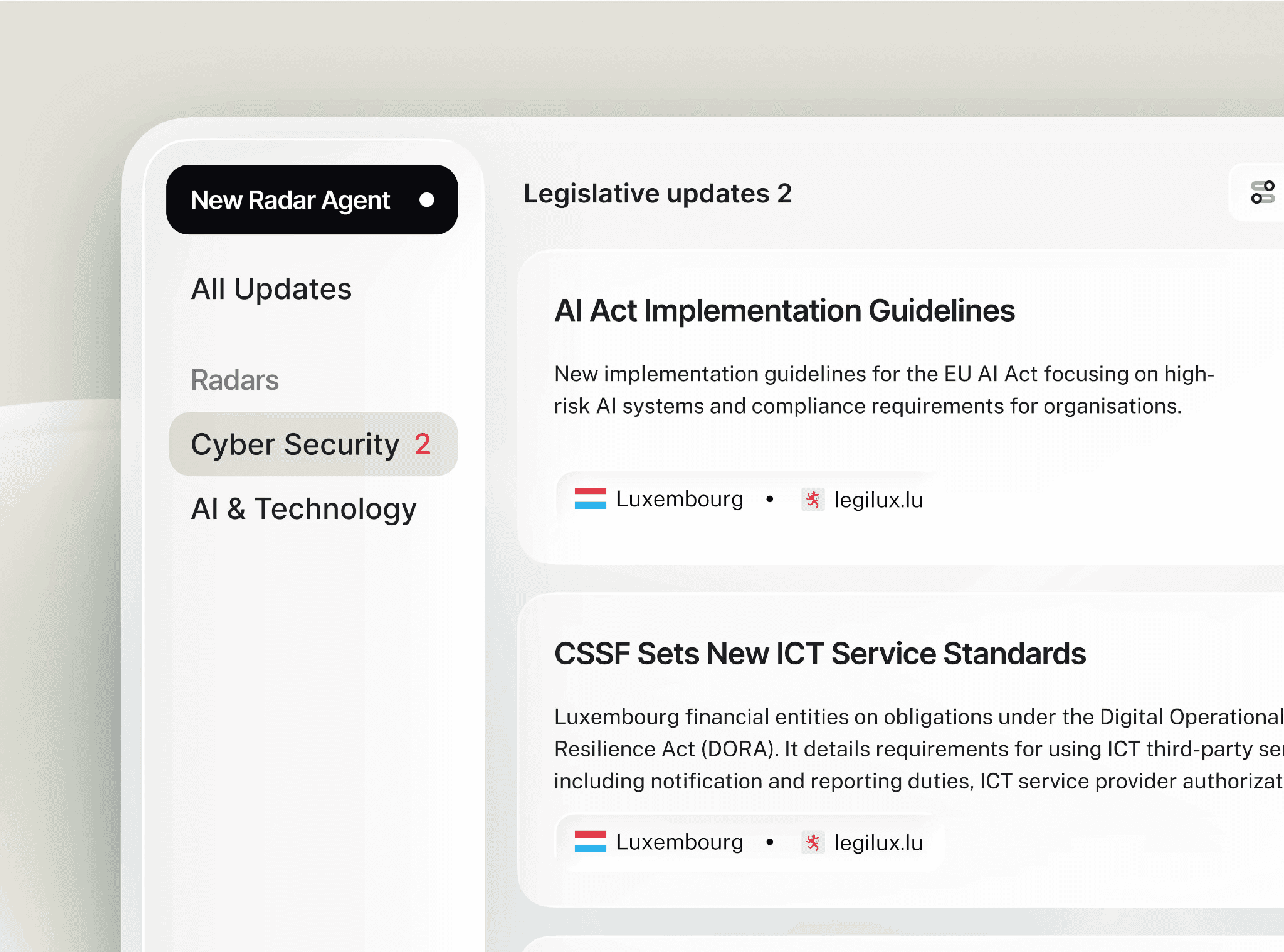
LEGALFLY is the best horizon scanning tool for in-house legal and compliance teams because it closes that second gap rather than the first.
Legal Radar monitors 130+ jurisdictions, delivers plain-English summaries with business impact and recommended next steps, and then tests the change against the customer's own contracts and policies.
From there the workflow keeps going. A high-impact change identifies the affected documents in SharePoint, Google Drive or LEGALFLY, redrafts them, routes the redraft for legal review and uploads the approved version, with an audit trail across every step.

Best Horizon Scanning Software: In-Depth Review & Comparison
The best horizon scanning platforms fall into three groups. There are financial services regulatory intelligence suites, AI-led regulatory change tools, and legal operating systems where monitoring is one capability among several.
Each entry covers what the product does, who it fits, its strongest capabilities, why it belongs on this list, and where it stops.
1. LEGALFLY
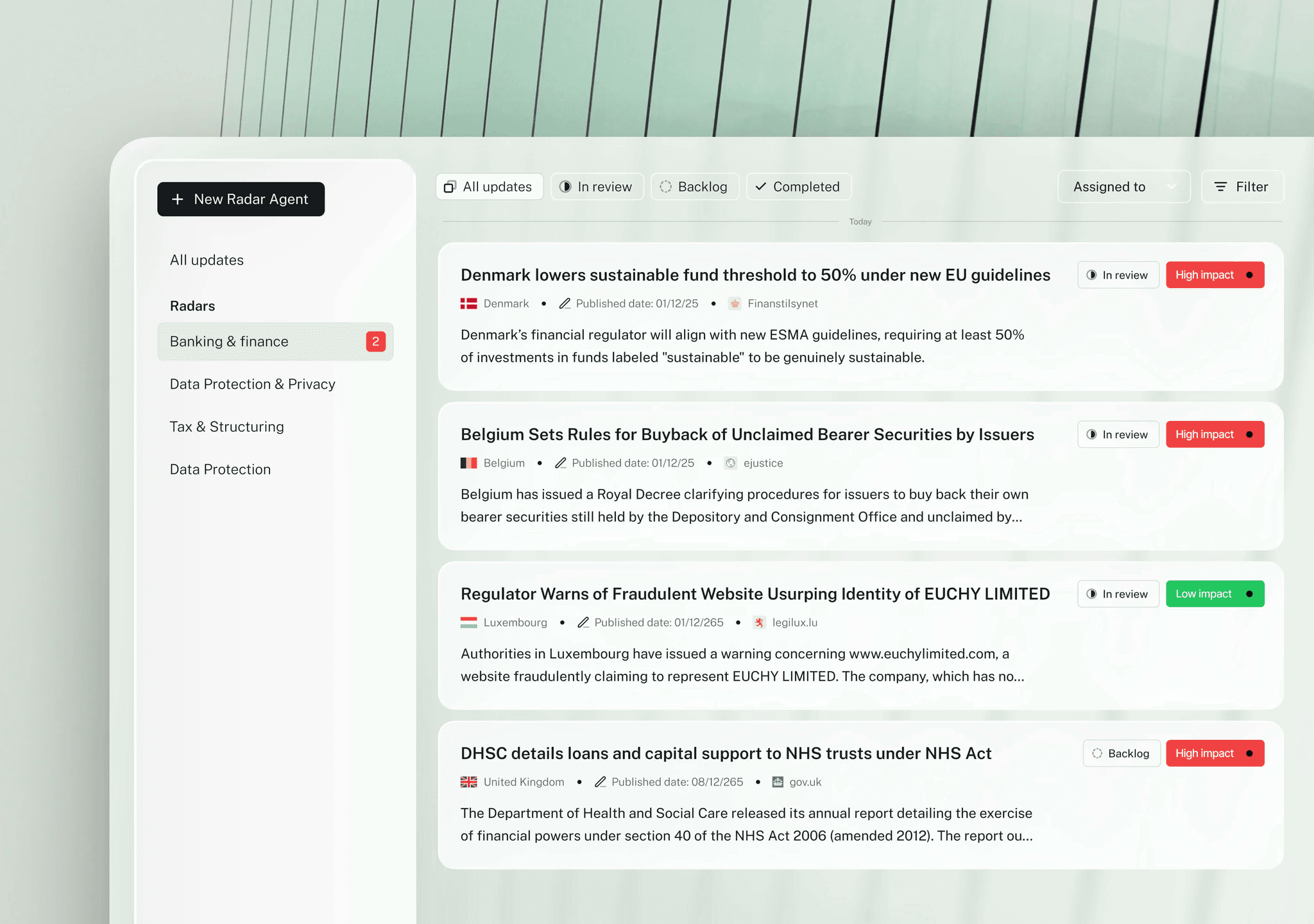
Overview
LEGALFLY is the legal operating system for corporates. It gives in-house teams AI-native workflows for intake, contract review, drafting, due diligence and legal research, with security and anonymisation underneath all of it.
Legal Radar is the horizon scanning capability inside that system, and its position matters more than its feature list. Because monitoring sits in the same place as contract review, drafting and document storage, a regulatory change can be carried through to a redrafted clause without leaving the system or opening a ticket.
Customers include SAP, Lufthansa, Bosch and KPMG, alongside a partnership with the European Commission's HR Directorate-General, across banking, insurance, technology and manufacturing.
Ideal For
In-house legal and compliance teams of 3 to 200 people supporting enterprises of 200 to 100,000 employees
Multi-jurisdiction organisations facing the EU AI Act, DORA, NIS2, CSRD and CSDDD across several regions at once
Compliance functions that have to prove they acted, not only that they knew
Banking, insurance, technology, manufacturing and transport businesses where the security review decides the shortlist
Teams whose regulatory work stalls at the point where change has to become a redrafted document
Pros
Turns updates into decisions: impact is tested against your own contracts and policies, what needs updating is flagged, and the redraft and approval run end to end in the same system.
Impact you can act on: every update carries a plain-English summary, the business impact and the recommended next steps, so the output tells you what to do rather than only what changed.
High-signal alerts across 130+ jurisdictions: new and upcoming rules are tracked 24/7 from official regulators and publishers, and you choose the jurisdictions, topics and frameworks that matter, with alerts delivered in LEGALFLY or by email.
Every alert is defensible: source links, rationale and ownership sit on each alert, with an audit trail across every compliance action, and documents are anonymised before analysis begins.
One system beyond horizon scanning: LEGALFLY is a full legal operating system, so the same place that monitors regulatory change also handles contract review and drafting, due diligence across entire data rooms, and the end-to-end workflows that connect them.

Cons
Sales-led evaluation, so the first step is a scoped demo and a discovery conversation rather than a self-serve trial
Focused on tracking regulatory change and mapping its impact to your own contracts and policies, rather than on comprehensive change management programmes built around controls libraries and formal obligation governance
Built for in-house legal and compliance teams rather than as a standalone regulatory data feed for a financial services risk function
Why We're the Best Horizon Scanning Tool
The honest version of this argument is that we are not competing on coverage. Thomson Reuters, Wolters Kluwer and CUBE have been building regulatory content operations for years, and a team that only needs a high-quality feed of financial services regulation has excellent options on this list.
We compete on what happens after the alert. A change detected by Legal Radar is tested against your own contracts and policies, the affected documents are identified across your repositories, and the redraft and approval run in the same system with an audit trail behind them.
That is a workflow rather than a notification, and it is the part most teams currently do by hand.
The second argument is scope. Legal Radar sits alongside contract review, drafting, research and document handling, so the same purchase answers the regulatory question and the contract backlog rather than adding another single-purpose tool to the compliance stack.
Anonymisation is the third. Documents are anonymised before analysis begins, which is what clears the security reviews that stop other AI tools in regulated environments.
Top Features
Legal Radar, regulatory tracking software monitoring official regulators and publishers across 130+ jurisdictions, 24/7. Source types include Official Gazettes, Supervisory Authorities, National Banks, Regulatory Authorities, Official Legal Databases, Courts, Councils and Non-Profits, with in-product categories for Banking and Finance, Data Protection and Privacy, Tax and Structuring, Cyber Security, and AI and Technology.
Agent Studio for end-to-end legal workflow automation. A detected regulatory change triggers a workflow that identifies affected documents in SharePoint, Google Drive or LEGALFLY, redrafts them, routes the redraft for legal review and uploads the approved version, with conditional logic and escalation thresholds throughout.
Anonymisation before analysis. Names, roles, company details and identifiers are pseudonymised at import, with context and structure intact, so identifiable data never reaches a third-party model. This is applied by default rather than configured per workflow.
Contract Intelligence across the full lifecycle, from drafting and negotiation through approval and e-signature to renewals, expirations, notice periods and obligations. Announced with a waitlist open, launching October 2026.
Playbook-driven AI contract review with playbooks configured for new rules, so existing agreements can be checked against a regulation that did not exist when they were signed.
Multi Review for bulk analysis across entire data rooms, applying one playbook to hundreds of documents at once, which is how a portfolio gets checked against a new requirement inside a deadline.
Discovery, AI for legal research grounded in 600+ official legal sources across 130+ jurisdictions, with citations and auditable reasoning on every answer, plus Drafting for AI contract drafting that produces the updated document.
Integrations with Microsoft Word, SharePoint, Outlook, Teams, Google Drive, Slack, NetDocuments and Microsoft Copilot, each carrying automatic anonymisation.
Customer Reviews
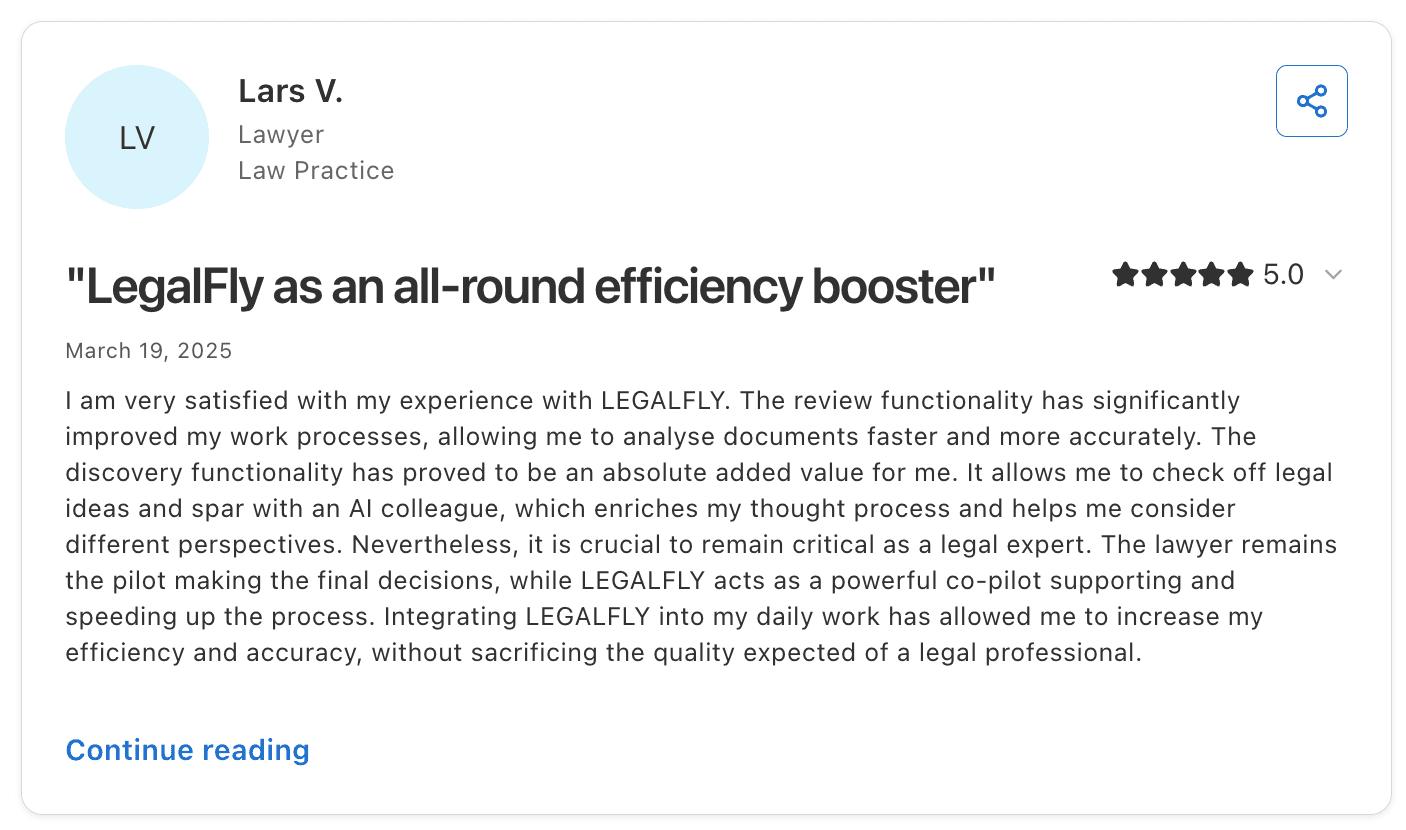
LEGALFLY holds 4.7 out of 5 across eight Capterra reviews, with value for money rated 4.8, customer service 4.7 and features 4.4.
Reviewers describe faster document review and legal research, and the strongest entries come from a general counsel in hospitality and several practising lawyers who describe it as part of their daily work.
Final Verdict
If your regulatory work stalls at the point where a change has to become a redrafted contract or policy, this is the strongest option here. Monitoring, impact testing, redrafting and approval sit in one system, and the same system handles the contract review workload underneath.
If what you need is a pure regulatory data feed for a financial services risk function, with analyst commentary and enforcement history, the specialist suites further down this list were built for exactly that and we would say so in the demo.
To find out how LEGALFLY could work for you, schedule a call with one of our experts.
2. Thomson Reuters Regulatory Intelligence
Overview
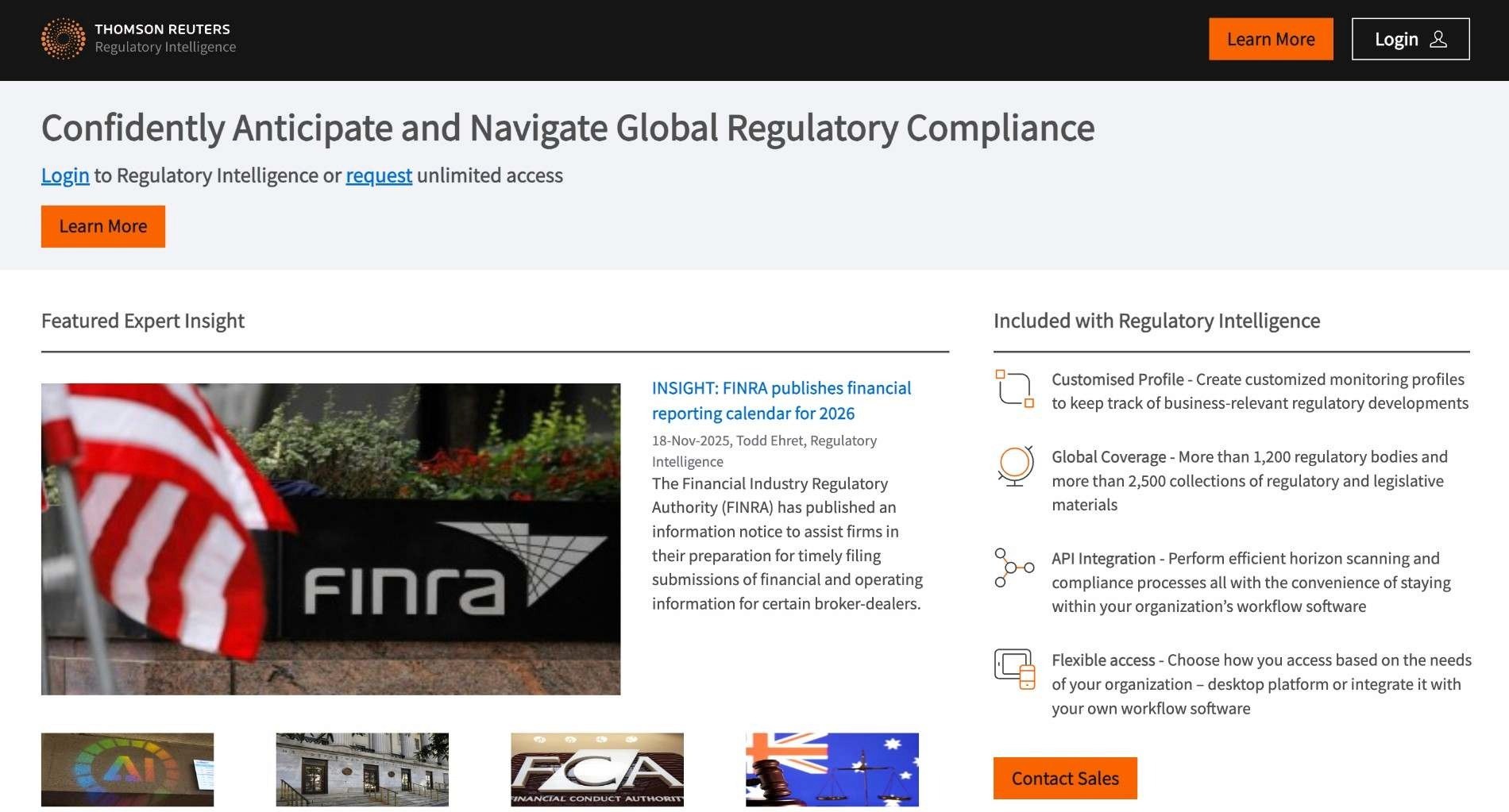
Thomson Reuters Regulatory Intelligence is the incumbent in this category, built on the editorial operation behind the wider Thomson Reuters business. It tracks regulatory developments across global markets and pairs the raw change data with analysis written by people who understand what the change means in practice.
The product is aimed squarely at financial institutions. Content is organised around the regulators that matter to banks, insurers and asset managers, and the obligation libraries reflect that orientation.
Brand weight is part of what is being bought here. When a compliance function has to defend its monitoring approach to a board or a supervisor, the Thomson Reuters name does work that a newer vendor’s cannot.
Ideal For
Large banks, insurers and asset managers with formal regulatory monitoring obligations
Compliance functions that need expert commentary alongside the change itself
Organisations already using Thomson Reuters research and practical guidance products
Teams defending their monitoring approach to supervisors and boards
Global institutions tracking regulatory developments across many financial jurisdictions
Pros
Editorial analysis alongside the regulatory data, which few competitors match
Deep coverage of financial services regulators globally
Established trust with supervisors, boards and legal buyers
Fits naturally alongside other Thomson Reuters research products
Long operating history in regulatory content
Cons
Built around financial services, so the fit weakens for manufacturing, technology or healthcare
Impact mapping to your own contracts and policies remains a manual exercise
Heavyweight for in-house legal teams that need monitoring as one capability among several
Commercial model suits large institutions rather than lean compliance functions
No public review base for this specific product to sense-check the buying experience
Top Features
Global regulatory change feeds across financial services regulators
Analyst commentary interpreting what a change means in practice
Obligation libraries structured for financial services compliance
Alerting and reporting for regulatory change workflows
Integration with the wider Thomson Reuters research estate
Why It's a Strong Horizon Scanning Option
Thomson Reuters is one of the strongest choices where editorial depth is the requirement. A raw feed tells you a rule published, and an analyst note tells you whether it changes anything for an institution like yours.
Credibility is the second argument, and it is not a soft one. Legal researchers cite Thomson Reuters constantly, which means its interpretation of a regulatory change often becomes the reference point other people work from.
Final Verdict
Thomson Reuters Regulatory Intelligence is recommended for large financial institutions that need authoritative regulatory content with expert interpretation, and have the compliance headcount to act on it.
It is a weaker fit for in-house legal teams outside financial services, and for any team whose bottleneck is connecting change to their own documents. The product is built to tell you what happened, in considerable depth, and the work after that stays with your people.
3. Wolters Kluwer OneSumX Regulatory Change Management
Overview
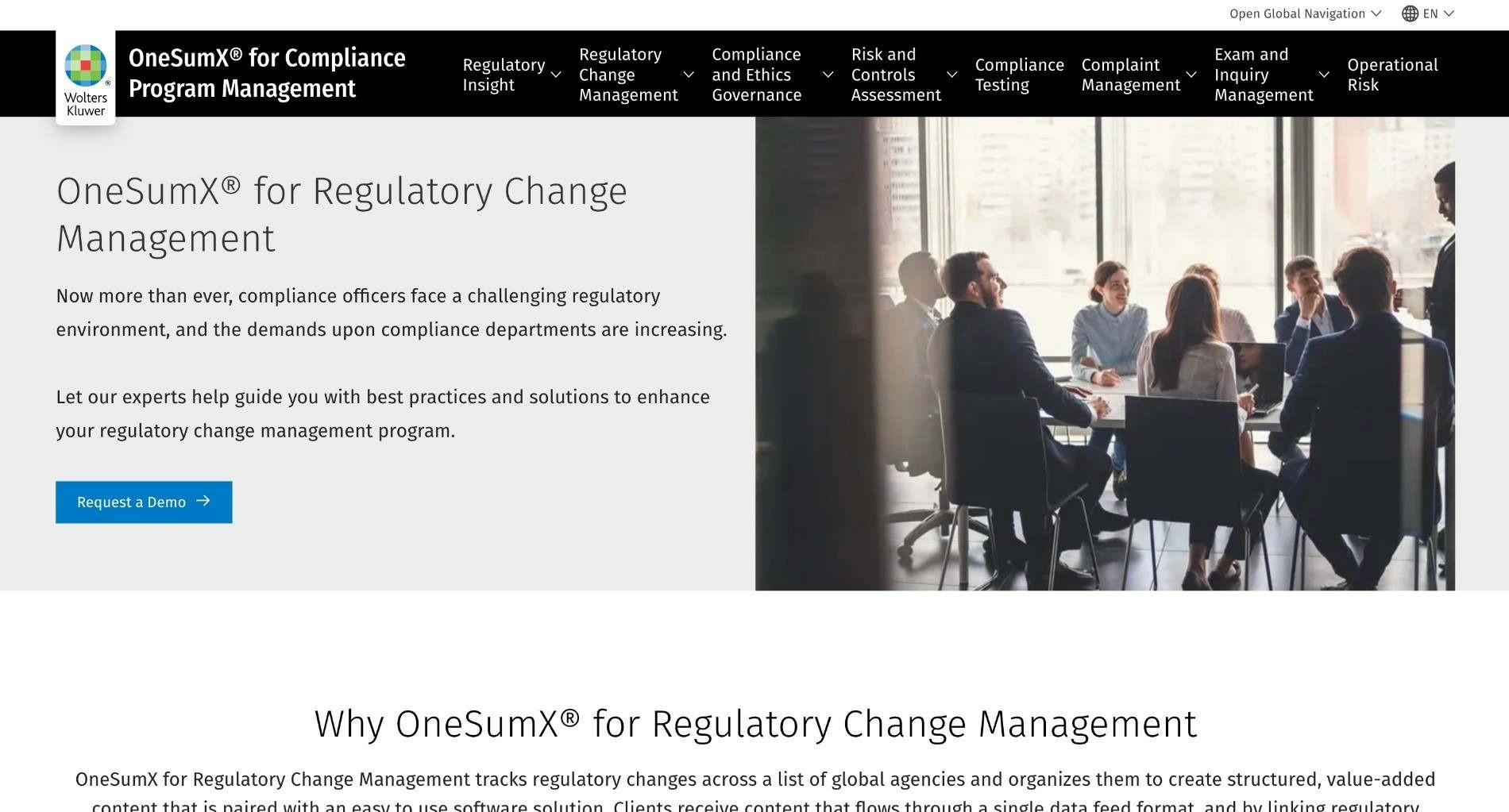
OneSumX Regulatory Change Management approaches the problem from the controls side. Regulatory content is curated and structured, then mapped to the internal controls and obligations a financial institution already maintains, so a change surfaces against the specific control it affects.
That design assumes a mature compliance function. There has to be a controls library to map to, with owners attached, which is normal in a bank and unusual almost everywhere else.
Wolters Kluwer brings the same editorial heritage as Thomson Reuters, with a stronger orientation towards finance, risk and regulatory reporting as a connected set.
Ideal For
Banks and insurers with an established internal controls library
Compliance functions running formal regulatory change governance
Institutions already using OneSumX for finance or risk reporting
Teams needing audit-ready evidence that change was assessed and actioned
Organisations where regulatory change management is a defined programme rather than a task
Pros
Controls mapping that turns monitoring into an auditable governance process
Strong curated content for banking and insurance regulation
Fits institutions with formal three-lines-of-defence structures
Established vendor with deep financial services credibility
Connects to wider finance and risk reporting capabilities
Cons
Requires an existing controls library, which many organisations do not have
Financial services taxonomies make it an awkward fit elsewhere
Implementation effort is substantial relative to lighter monitoring tools
No connection to your contracts, so document-level impact stays manual
The Wolters Kluwer G2 profile covers the wider product estate rather than this product, so it offers no usable signal on this one
Top Features
Curated regulatory content structured for financial services
Mapping from regulatory change to internal controls and obligations
Workflow for assessment, assignment and sign-off
Audit reporting across the change management process
Connection to the wider OneSumX finance and risk suite
Why It's a Strong Horizon Scanning Option
OneSumX is one of the smartest choices for institutions whose problem is governance rather than awareness. Mapping change to a controls library turns monitoring into an auditable process, which is what a supervisor actually asks to see.
The suite argument is the second one. For an institution already running OneSumX for regulatory reporting, adding change management to an existing relationship avoids another vendor assessment.
Final Verdict
OneSumX Regulatory Change Management is recommended for banks and insurers with a controls library, formal governance and the programme resource to run it properly. In that setting the controls mapping is genuinely valuable.
It is a poor fit for lean in-house legal teams. The product assumes an operating model that exists in regulated financial institutions and almost nowhere else, and without that structure most of its value is inaccessible.
4. LexisNexis Regulatory Compliance

Overview
LexisNexis Regulatory Compliance breaks regulation into obligations rather than documents. Instead of alerting you that an act was amended, it maintains registers of the specific duties that apply to a business activity, and flags when one of those duties changes.
That framing suits operational businesses. A logistics company cares less about the shape of a statutory instrument than about whether its driver licensing duties moved.
Coverage is strongest in a defined set of jurisdictions, with the United Kingdom and Australia particularly well developed, which reflects where the product was built out first.
Ideal For
Compliance teams managing obligations tied to specific business activities
Operational businesses in transport, energy, healthcare and manufacturing
Organisations needing an obligations register they can assign and evidence
UK and Australia-centred businesses where coverage is deepest
Teams that think in duties rather than in legislation
Pros
Obligation-level content that operational teams can act on directly
Strong editorial maintenance behind the registers
Suits regulated operational sectors outside financial services
Assignment and evidencing built around the obligations themselves
Backed by one of the largest legal content operations in the market
Cons
Coverage depth varies considerably by jurisdiction, so multi-region teams must test their own list
Obligation registers require configuration against your activities before value appears
No view of your contracts, so document-level impact remains manual
The LexisNexis G2 presence covers research products rather than this one, giving no direct review signal
Interface and workflow are less modern than newer entrants in the category
Top Features
Obligation registers mapped to business activities
Jurisdiction-specific regulatory content maintained by legal editors
Change alerts at the obligation level
Assignment and evidencing of obligation ownership
Access to the wider LexisNexis legal research estate
Why It's a Strong Horizon Scanning Option
LexisNexis is one of the strongest choices where the requirement is operational compliance rather than financial regulation. Obligation-level granularity means the output is already in the form an operations manager can act on.
The editorial base is the second argument. LexisNexis maintains legal content at scale, and the obligation registers inherit that maintenance discipline rather than relying on automated extraction alone.
Final Verdict
LexisNexis Regulatory Compliance is recommended for operational businesses in regulated sectors, particularly in the UK and Australia, where obligations rather than legislation are the working unit.
It is less suitable for multi-jurisdiction organisations whose regulatory footprint sits outside the well-developed coverage areas. Check your own jurisdiction list against the register before shortlisting, because that single test decides the product's usefulness.
LEGALFLY helps your team move faster: less time buried in contracts, more time on the work that actually matters. Book a call to see it in action.
5. CUBE (RegPlatform)

Overview
CUBE built its position on automating the capture of regulatory content at scale. Rather than relying primarily on editorial teams reading and summarising, the product ingests regulatory material from a very large number of sources and classifies it against a structured taxonomy.
That approach suits organisations with enormous regulatory footprints. A global bank operating in dozens of markets cannot rely on a curated set of jurisdictions and needs breadth first.
The company has grown through acquisition as well as product development, consolidating regulatory intelligence capabilities that were previously separate.
Ideal For
Global banks and payment institutions with very large regulatory footprints
Compliance functions covering dozens of markets simultaneously
Organisations needing regulatory content classified against a consistent taxonomy
Institutions linking regulatory obligations to internal policy libraries
Teams with the scale to justify an enterprise regulatory intelligence programme
Pros
Automated capture across a very large number of regulatory sources
Consistent taxonomy that makes cross-jurisdiction reporting possible
Built for the scale of global financial institutions
Policy linkage connects regulation to internal documentation
Established presence among large regulated enterprises
Cons
Enterprise scale and implementation effort exceed what most in-house legal teams need
Financial services orientation limits the fit in other sectors
Automated capture produces volume, so tuning is required to avoid alert fatigue
No public G2 review base exists for this product to sense-check the buying experience
Contract-level impact analysis is outside the product's scope
Top Features
Automated capture and classification of regulatory content at scale
Structured taxonomy for consistent categorisation across jurisdictions
Obligation mapping and policy linkage
Alerting and workflow for regulatory change assessment
Enterprise integrations into governance and risk systems
Why It's a Strong Horizon Scanning Option
CUBE is one of the strongest choices where breadth is the binding constraint. For an institution operating across dozens of regulatory regimes, automated capture scales in a way that editorial curation does not.
Taxonomy consistency is the second argument. When the same classification applies across every jurisdiction, regulatory data becomes reportable rather than only readable, which matters to a group compliance function consolidating across regions.
Final Verdict
CUBE is recommended for global banks and payment institutions whose regulatory footprint is too large for curated coverage, and who have the compliance function to absorb the volume.
It is the wrong tool for a lean in-house legal team. The product solves a scale problem, and a team covering a handful of jurisdictions will pay for breadth it cannot use while still doing the document-level work by hand.
6. Corlytics
Overview
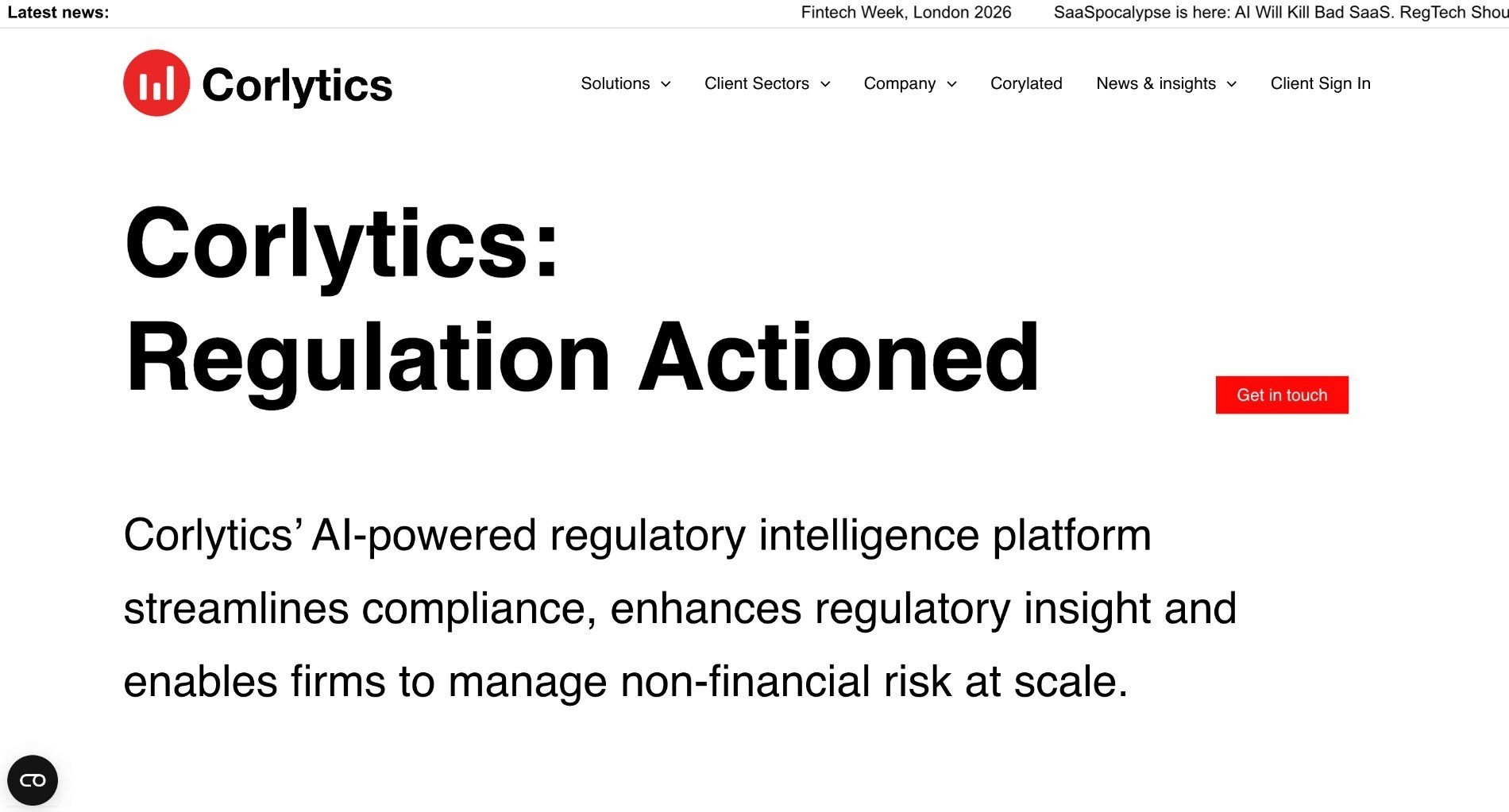
Corlytics approaches regulation as risk data. Alongside tracking change, it analyses enforcement actions, fines and supervisory priorities to build a picture of where regulators are actually focusing attention rather than only what they have published.
That enforcement layer is genuinely differentiated. Knowing that a regulator has fined three firms for the same failing this year tells a compliance function more about priority than a rule change does.
The Dublin-based company has expanded through acquisition into policy management, connecting regulatory intelligence to the internal policies that respond to it.
Ideal For
Financial institutions prioritising compliance effort by regulatory risk
Compliance functions that need enforcement trends alongside change data
Organisations connecting regulatory intelligence to policy management
Risk teams building supervisory exposure into planning
Institutions under active supervisory scrutiny
Pros
Enforcement and fine analytics that few competitors offer
Risk scoring that supports prioritisation rather than only awareness
Policy management connects regulation to internal documentation
Board-level reporting suited to supervised institutions
Strong standing among European financial regulators and institutions
Cons
Financial services focus limits use in other regulated sectors
No reviews on its G2 profile, so buyer experience cannot be verified independently
Enforcement analytics depend on data availability, which varies by jurisdiction
Implementation and taxonomy alignment require compliance resource
Contract-level impact analysis is outside the product's scope
Top Features
Regulatory taxonomy across jurisdictions and topics
Enforcement action and fine data with trend analysis
Regulatory risk scoring to prioritise attention
Policy management connecting rules to internal documentation
Reporting for boards and risk committees
Why It's a Strong Horizon Scanning Option
Corlytics is one of the smartest choices where the question is not what changed but what to do first. Risk scoring against enforcement data answers a prioritisation problem that pure monitoring tools leave to judgement.
The policy connection is the second argument. Linking a regulatory obligation to the internal policy that implements it is a step towards closing the gap between knowing and acting, even if it stops short of the contracts themselves.
Final Verdict
Corlytics is recommended for supervised financial institutions that need to prioritise compliance effort against real regulatory risk, and for teams reporting supervisory exposure upwards.
It is less suitable outside financial services, and the absence of any public reviews means references have to come from the vendor. Ask for two in your own sector and jurisdiction before committing.
7. Regology
Overview
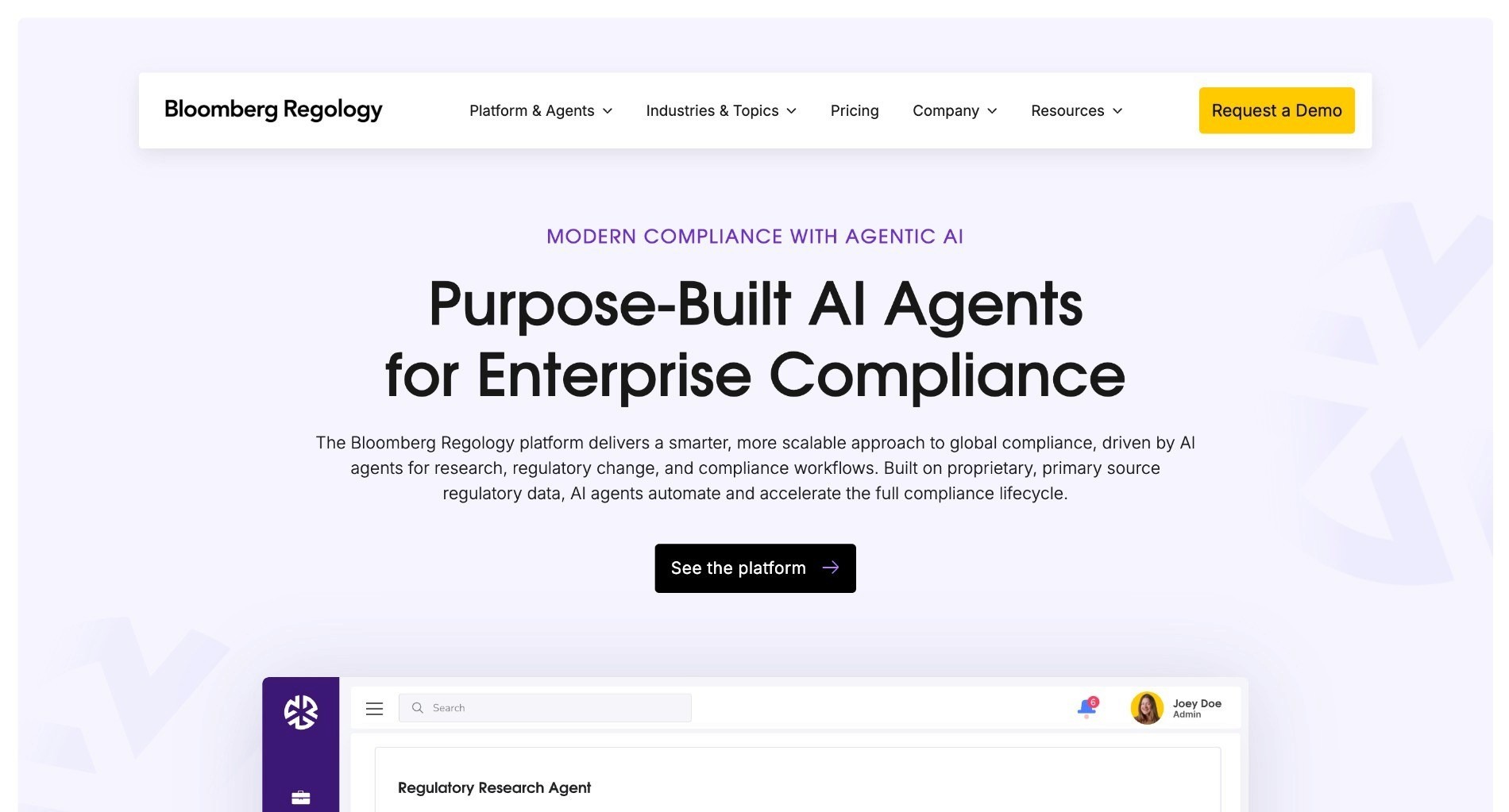
Regology positions itself as an AI-led approach to regulatory intelligence, with a law library that maintains regulatory content and an assistant layer that answers questions against it. The pitch is that compliance teams should be able to ask what applies to them rather than reading a feed.
The product covers discovery of applicable regulation, mapping to obligations, and task assignment when something needs doing. It is aimed at compliance functions that want a modern interface over the regulatory library rather than an enterprise governance programme.
Ideal For
Compliance teams wanting conversational access to regulatory content
Organisations building an obligation library from scratch
Mid-market regulated businesses without a dedicated regulatory intelligence function
Teams assigning and tracking regulatory tasks alongside monitoring
Businesses wanting AI assistance without an enterprise implementation
Pros
Modern interface that a compliance generalist can operate
AI assistant reduces the reading burden on the regulatory library
Discovery helps organisations establish what actually applies to them
Obligation mapping and task tracking in the same product
Lighter implementation than enterprise regulatory suites
Cons
No reviews on its G2 profile, so buyer experience cannot be verified independently
Smaller vendor, which matters when procurement assesses continuity risk
AI-led content maintenance should be tested against jurisdictions you know well
No connection to your contracts, so document impact remains manual
Enterprise governance features are lighter than the financial services suites
Top Features
AI-led discovery of regulations applicable to the organisation
Law library maintaining regulatory content across jurisdictions
Obligation mapping and task assignment
Alerting on changes to tracked regulations
AI assistant for querying the regulatory library
Why It's a Strong Horizon Scanning Option
Regology is one of the smartest choices for teams that find the established suites heavier than their problem. The interface assumes a compliance manager rather than a regulatory intelligence analyst, which widens who can actually use it.
The discovery capability is the second argument. For an organisation that does not yet know its full regulatory footprint, working out what applies is a genuine first problem, and most incumbents assume you already have that answer.
Final Verdict
Regology is recommended for mid-market regulated businesses that need to establish and track their regulatory footprint without standing up a formal programme.
It is harder to recommend without independent evidence. The G2 profile carries no reviews at all, so any evaluation should lean heavily on references in your own sector and a trial against jurisdictions your team can check for accuracy.
8. Vixio Regulatory Intelligence
Overview
Vixio is a vertical product, and unapologetically so. It covers gambling compliance and payments compliance in depth rather than attempting general regulatory coverage across every sector.
That narrowness is the point. Gambling regulation is jurisdiction-specific, fast-moving and poorly served by generalist tools, and a product built only for it can go deeper than one covering forty sectors.
The offering combines regulatory updates with analyst commentary and jurisdiction reports, so a compliance officer entering a new market gets an assessment rather than a document dump.
Ideal For
Gambling operators and suppliers tracking licensing and regulatory change
Payments businesses navigating multi-jurisdiction financial regulation
Compliance teams assessing new market entry in regulated verticals
Organisations needing analyst interpretation alongside regulatory data
Businesses where sector-specific depth outweighs breadth
Pros
4.9 rating from reviewers, the highest in this comparison
Analyst expertise paired with the regulatory data, praised repeatedly in reviews
Jurisdiction reports support new market entry decisions
Account management draws consistent positive comment
Depth in gambling and payments that generalist tools cannot match
Cons
Vertical by design, so it is the wrong product outside gambling and payments
Only six public reviews, so the sample is small despite the high rating
Reviewers ask for more supplier presence data in specific markets
No connection to your own contracts or policies
Coverage outside its two verticals is not the product's purpose
Top Features
Sector-specific regulatory updates for gambling and payments
Jurisdiction reports covering licensing requirements and market rules
Analyst commentary interpreting change in sector context
Compliance workflow and alerting
Market entry assessments for new jurisdictions
Why It's a Strong Horizon Scanning Option
Vixio holds 4.9 out of 5 on G2, the highest rating in this comparison. Reviewers describe it as the first place they go for market research, which is a stronger endorsement than a monitoring tool usually earns.
Depth in a defined vertical is the argument. For a gambling operator, a generalist regulatory feed produces noise and misses the licensing detail that actually governs the business.
Customer Reviews
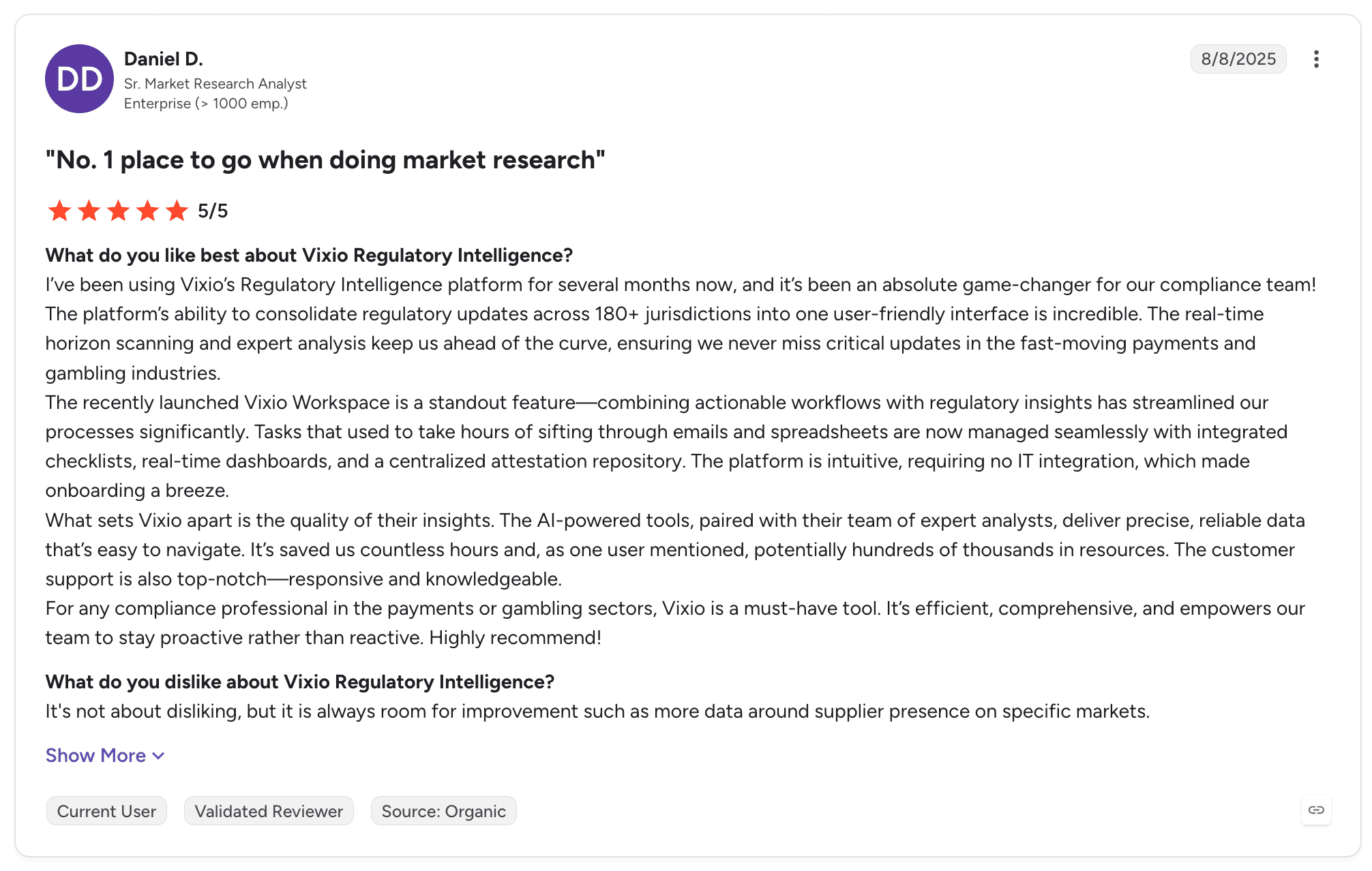
Vixio holds 4.9 out of 5 across six G2 reviews.
Reviewers describe it as the place they go first for market research, and single out the combination of real-time regulatory updates with analyst interpretation as the reason it works for them.
Praise for the account teams is unusually consistent, with reviewers describing responsive support and training for new users. The only substantive request is for more supplier and market presence data in specific jurisdictions, which is a narrow ask rather than a structural complaint.
Final Verdict
Vixio is recommended for gambling operators, suppliers and payments businesses, where its depth is genuinely difficult to replicate. The rating and the review content both support that.
It is not a general horizon scanning tool and does not present itself as one. For a legal team tracking data protection, employment or AI regulation across Europe, it is the wrong product regardless of how well it performs in its own lane.
9. Ascent
Overview
Ascent applies automation to a specific problem: turning regulatory text into the discrete obligations a business has to satisfy. Rather than delivering a rule for someone to interpret, it extracts the requirements inside it and maps them to the organisation.
That focus is aimed at financial services, where the gap between a published rule and an actionable obligation consumes significant compliance time. The product is designed to close that interpretation step.
Integration APIs allow those obligations to flow into governance and risk systems rather than staying in a separate interface.
Ideal For
Financial services compliance teams converting regulation into obligations
Organisations feeding obligation data into existing GRC systems
Teams reducing manual interpretation of regulatory text
Regulated businesses with structured obligation management processes
Compliance functions with technical capacity to work with APIs
Pros
Obligation-level automation reduces manual interpretation of regulatory text
API-first design fits organisations with established GRC systems
Focused on a real and expensive step in the compliance process
Financial services depth in its core coverage area
Reviewers describe it as well suited to banking and financial sector complexity
Cons
Only four public G2 reviews, with G2 noting there is not enough to provide buying insight
Reviewers describe a learning curve in the early months, particularly for new users
Integration with third-party tools is raised as an area needing work
Financial services orientation limits use elsewhere
No connection to your own contracts or policies
Top Features
Automated extraction of obligations from regulatory text
Rule mapping against the organisation's regulatory profile
Change alerts at the obligation level
APIs for integration into governance and risk systems
Reporting across obligation coverage and change
Why It's a Strong Horizon Scanning Option
Ascent is one of the smartest choices where the expensive step is interpretation rather than awareness. Converting a rule into obligations automatically removes work that compliance analysts otherwise do line by line.
The integration model is the second argument. Obligations delivered through an API into an existing GRC system avoid the familiar problem of regulatory intelligence sitting in a tool nobody opens.
Final Verdict
Ascent is recommended for financial services compliance teams whose bottleneck is turning regulation into obligations, and who have the technical capacity to integrate it into existing systems.
The evidence base is too thin to recommend confidently beyond that. Four reviews, one of which describes a steep initial learning curve, is not enough to plan an enterprise purchase around, so weight references and a structured trial accordingly.
10. Compliance.ai

Overview
Compliance.ai applies machine learning to regulatory change monitoring, with a model that combines automated classification and expert review. Changes are captured, categorised and mapped against the organisation's internal policies and controls.
The orientation is towards United States financial regulation, where the volume of federal and state-level regulatory activity makes automated triage genuinely necessary.
The policy mapping is the part that distinguishes it from a straight feed, connecting each change to the internal document that would need updating.
Ideal For
US-focused financial services compliance teams
Organisations mapping regulatory change to internal policies and controls
Teams managing high volumes of federal and state regulatory activity
Compliance functions wanting automated triage with expert review
Businesses building a documented regulatory change process
Pros
Automated classification suited to high-volume US regulatory activity
Expert review layered over the machine learning output
Policy mapping built into the monitoring workflow
Workflow tracking supports a documented change process
Focused product without enterprise implementation overhead
Cons
Coverage skews heavily to US financial regulation
The G2 profile is unclaimed and carries no reviews at all
European and Asia-Pacific coverage is not the product's strength
No connection to your own contracts, so document-level impact stays manual
Smaller vendor, which procurement will weigh on continuity grounds
Top Features
Machine learning classification of regulatory changes
Expert-in-the-loop review of automated categorisation
Mapping from change to internal policies and controls
Workflow tracking for assessment and action
Alerting across federal and state regulatory sources
Why It's a Strong Horizon Scanning Option
Compliance.ai is one of the smartest choices for US regulatory volume specifically. The combination of federal agencies and fifty states produces more activity than manual triage can absorb, and automated classification is a reasonable response.
The policy mapping is the second argument. Connecting a change to the internal policy it affects is a step most monitoring tools leave to the compliance team, and doing it inside the product saves the handoff.
Final Verdict
Compliance.ai is recommended for US-focused compliance teams managing high federal and state regulatory volume, where automated triage and policy mapping save real time.
It is a poor fit for European or multi-region legal teams. The coverage orientation is wrong for that use case, and an unclaimed G2 profile with no reviews gives a procurement team nothing independent to assess.
What Makes Good Horizon Scanning Software?
The best horizon scanning platforms are separated by what happens after the alert, not by how many sources they watch. Coverage is where vendors compete and impact analysis is where teams actually struggle.
The five criteria below are written as outcomes. Each one is testable in a demo.
1. It Covers the Jurisdictions You Actually Operate In
Headline source counts are close to meaningless on their own. A product monitoring thousands of sources is no use if it covers three of your seven markets properly and skims the rest.
Write down every jurisdiction where you hold a licence, employ people or sign contracts. Then ask each vendor to show live coverage for the three you consider most awkward, rather than the ones they lead with.
2. It Tells You What Changed for You, Not Just What Changed
A regulatory feed reports a publication. Useful software reports the consequence, which means a plain-English summary, an impact assessment and a recommended next step rather than a link to a gazette entry.
Ask to see the output for a change you already handled. If your team's own assessment took two days and the tool would have produced the same conclusion, that difference is the value.
3. It Connects Change to Your Own Documents
This is the criterion most products fail, and it is the expensive one. Once a rule changes, somebody has to work out which contracts, policies and templates now conflict with it.
Ask directly whether the tool can read your own contracts and policies against a new requirement. Most regulatory intelligence tools have no view of your documents at all, which means the work lands back with your team every time.
4. It Carries the Change Through to a Redraft and an Approval
Knowing which documents are affected is still not the finish line. The change becomes real when the wording is updated, a lawyer approves it and the new version replaces the old one.
Software that identifies affected documents, produces the redraft and routes it for legal review closes that loop. Software that emails you a list starts a project.
5. It Leaves an Audit Trail Somebody Else Can Follow
When a supervisor asks how you knew about a change and what you did, the answer needs to exist in a system rather than in somebody's inbox. Every step should be logged: what was detected, who assessed it, what was decided and which documents were updated.
Test this by asking for the evidence pack rather than the dashboard. A product built for supervised environments will produce it without a services engagement.
To find out how LEGALFLY could work for you, schedule a call with one of our experts.
How to Choose Between the Best Horizon Scanning Tools in 2026?
1. Establish Whether Your Gap Is Coverage or Impact
These feel like the same problem and have different answers. If your team is genuinely missing changes, you need broader monitoring and the specialist suites on this list are strong at it.
If you find out about changes in good time but then lose two weeks working out what they touch, coverage is not your constraint. Buying more of it will not recover that fortnight.
Ask your compliance lead which of the two described the last three regulatory changes you handled. The answer usually settles the shortlist.
2. Test Against a Change You Have Already Handled
Pick a regulation your team worked through in the last year, ideally one that was awkward. Ask each vendor to show what their product would have produced at each stage.
You know the right answer, the real timeline and the documents it touched. That makes it the only evaluation where you can grade the output rather than take the demo on trust.
3. Count the Steps That Stay Manual
Map your current process from detection through to an updated, approved document. Then mark which steps each product removes and which it leaves with your team.
Many tools remove the first step and none of the rest. That is worth knowing before the business case is written, because the time saving you can claim is only as large as the steps that actually disappear.
4. Check Whether It Reads Your Own Paper
Ask each vendor whether the tool can test a regulatory change against your contracts and policies, and ask to see it happen. Watch for the answer that describes an integration where you export documents somewhere else.
This is the single biggest dividing line in the category. A product that monitors the outside world and a product that also reads your own documents are solving different halves of the same problem.
5. Get Security Involved in Week One
If the tool is going to read your contracts and policies, the security review applies in full. Bring your CISO or IT security lead into the first round rather than month four.
They need three answers: what happens to a document before a model reads it, where data is processed and stored, and which deployment models are offered. Single-tenant, regional data residency and on-premise processing change which vendors survive that conversation.
6. Decide Whether You Want a Feed or a System
A specialist regulatory data feed is a single-purpose purchase that sits alongside everything else your legal and compliance teams use. A legal operating system handles monitoring as one capability among contract review, drafting and document management.
The second option means one vendor assessment, one security review and one set of integrations rather than three. For lean teams that consolidation is often worth more than a marginal gain in source coverage.
7. Check the Evidence Behind the Vendor
Public review coverage in this category is unusually thin, and several products here have no independent reviews at all. That does not make them bad, but it does mean you are relying on vendor-supplied references.
Ask for two references in your own sector and your own jurisdictions, and speak to them about the implementation rather than the product. Where a G2 or Capterra profile exists, read the two-star and three-star reviews first.
Everything You Need to Know About Horizon Scanning Software
Category | Key Considerations |
Top 3 options | LEGALFLY for in-house legal and compliance teams needing change connected to their own documents, Thomson Reuters Regulatory Intelligence for editorial depth in financial services, CUBE for global institutions with very large regulatory footprints |
Best overall option | LEGALFLY. Legal Radar covers 130+ jurisdictions and tests each change against your own contracts and policies, with redrafting and approval in the same system |
Why teams replace their current tool | Coverage is adequate but impact analysis is manual, alert volume creates noise, and no product connects the change to the contracts and policies that have to be updated |
How to choose | Establish whether your gap is coverage or impact, test against a change you have already handled, count the steps that stay manual, and involve security in week one |
Ease of switching | Days to weeks for tools that run inside Microsoft 365, since there is no content library to migrate. Enterprise regulatory suites take months and usually require taxonomy and controls alignment |
Must-have features | Coverage of your actual jurisdictions, plain-English impact assessment, testing against your own documents, redraft and approval workflow, and an audit trail a supervisor can follow |
Mistakes you should not make | Buying on headline source counts, evaluating on the vendor's sample regulation, leaving security until month four, and assuming an alert is the same thing as an action |
Ready to Act on Regulatory Change, Not Just Read About It? Try LEGALFLY
Three things separate LEGALFLY from everything else on this list. Legal Radar monitors 130+ jurisdictions and then tests each change against your own contracts and policies rather than reporting it in the abstract.
Whole workflows then carry that change through to a redrafted document and legal sign-off, with an audit trail at every step. Every document is anonymised before analysis begins, on an architecture designed before the current model generation rather than added later.
It is built for one buyer in particular: the in-house legal or compliance team inside a regulated enterprise, operating across several jurisdictions, facing the EU AI Act, DORA, NIS2, CSRD and CSDDD with the same headcount as last year.
Bring a regulatory change your team has already worked through to a demo of our legal AI software, then compare what comes back against what it actually cost you. You can also see how contract intelligence keeps the obligations inside those contracts visible after the change lands.
To find out how LEGALFLY could work for you, schedule a call with one of our experts.
FAQs About Horizon Scanning Software
What is horizon scanning software?
Horizon scanning software monitors regulators, legislatures, courts and official publishers for changes that affect an organisation, then summarises what changed and routes it to the people responsible. Better products add impact assessment, obligation mapping and an audit trail showing that someone acted. LEGALFLY's Legal Radar covers 130+ jurisdictions across gazettes, supervisory authorities, national banks, courts and official legal databases, and tests each change against the customer's own contracts and policies.
What are the best horizon scanning tools in 2026?
The best horizon scanning tool in 2026 is LEGALFLY, for in-house legal and compliance teams of 3 to 200 people inside enterprises of 200 to 100,000 employees. Legal Radar monitors 130+ jurisdictions, delivers plain-English summaries with business impact and recommended next steps, then identifies the affected documents in SharePoint or Google Drive, redrafts them and routes the redraft for legal approval. The differentiator no competitor replicates is anonymisation applied at import, before any model reads the document. Thomson Reuters, Wolters Kluwer, CUBE and Corlytics remain strong choices for financial services teams that need a specialist regulatory data feed.
What should I consider when choosing the right horizon scanning software for me?
Consider five things when choosing horizon scanning software: coverage of the jurisdictions you actually operate in, plain-English impact assessment rather than a link to a gazette, the ability to test a change against your own contracts and policies, a redraft and approval workflow, and an audit trail a supervisor can follow. The third is where most regulatory intelligence products stop, because they have no view of your documents. Test each shortlisted tool against a regulatory change your team already worked through, since you know the right answer and the real timeline. Ask any vendor to demonstrate live coverage for your three most awkward markets rather than the ones they lead with.
How does LEGALFLY differ from similar alternatives?
LEGALFLY differs from similar alternatives because the monitoring connects to your own documents instead of ending at the alert. Legal Radar covers 130+ jurisdictions, then tests each change against your contracts and policies, identifies the affected documents across SharePoint, Google Drive and LEGALFLY, redrafts them and routes the redraft for legal approval. Thomson Reuters, Wolters Kluwer, CUBE and Corlytics compete on coverage depth and analyst commentary in financial services, and none of them read your paper. LEGALFLY also handles contract review, drafting and legal research in the same system, so monitoring is one capability rather than another single-purpose tool.
How do I get started with LEGALFLY?
Getting started with LEGALFLY begins with a scoped demo and a discovery conversation, since the evaluation is sales-led rather than self-serve. Bring a regulatory change your team has already worked through, along with the contracts and policies it affected, so the output can be graded against what the work actually cost you. Deployment is measured in days, and Agristo saw results within days of a single kickoff. Most teams begin with one jurisdiction set and one playbook before extending across the rest of the estate.
How easy is it to switch to LEGALFLY?
Switching to LEGALFLY is straightforward because there is no regulatory content library to migrate and no new interface for the team to learn. It runs inside Word, Outlook, Teams, SharePoint, Google Drive, Slack and NetDocuments, with anonymisation applied automatically in each. Teams typically run it alongside an existing feed for one regulatory cycle, comparing what each surfaces before switching fully. That parallel period is also the cleanest way to test coverage on the jurisdictions you care about most.
We already have a regulatory newsfeed. Why do we need horizon scanning software?
A regulatory newsfeed tells you what changed, and horizon scanning software of this kind tells you what it changes for you. Legal Radar delivers plain-English summaries with business impact and recommended next steps across 130+ jurisdictions, then tests the change against your own contracts and policies rather than reporting it in the abstract. If your team finds out about changes in good time but then loses two weeks working out which documents they touch, the feed is not your constraint. Wealins recovered up to a fifth of working time and moved from searching for regulatory change to judging whether it is relevant.
Is our data safe if the software reads our own contracts?
Data safety is the right question to ask once a tool reads your contracts rather than only public sources, and it decides most evaluations in regulated industries. LEGALFLY anonymises documents before analysis begins, with sensitive details stripped locally so no personal or client data leaves the environment. Security follows a framework aligned with ISO 27001, SOC 2 Type II and GDPR, with annual independent penetration testing and every step logged. Deployment runs from SaaS to single-tenant in your preferred Azure region, and single-tenant with on-premise anonymisation where identifiable data never leaves your environment.