






Most compliance teams know what is in force today. The harder job is knowing what arrives next year and which deadlines are about to shift, in every country where the business operates.
We built Legal Radar for that job, and we work every day with in-house legal and compliance teams who run it. This guide covers what horizon scanning is, how the process works step by step and how to run it across borders, plus what good evidence looks like when a supervisor asks how you knew.
Key Takeaways (TL;DR)
What horizon scanning is: The systematic examination of potential threats, opportunities and likely future developments. In compliance, that means spotting regulatory change early enough to prepare for it before it applies.
Three horizons: Every rule sits on a near horizon (applying now), a mid horizon (adopted, applying later) or a far horizon (proposals, consultations and signals). Items move inward over time, and their dates often move too.
The horizon scanning process: Define your regulatory perimeter, map your sources, scan and filter, assess impact, assign and act, then evidence and report.
Across borders: One EU directive lands 27 times. NIS2 had a transposition deadline of October 2024, and in July 2026 four member states were referred to the Court of Justice for missing it.
What sets LEGALFLY apart: Legal Radar scans 130+ jurisdictions and tests each change against your own contracts and policies, then Agent Studio carries it through redraft and legal approval, on documents anonymised before analysis begins.
Horizon Scanning in 2026: At a Glance
The table below sorts regulatory change by distance, with real 2026 examples for a European business.
Horizon | What sits there | 2026 example | What to do now | Review cadence |
Near | Rules that apply now or within roughly six months | EU AI Act Article 50 transparency obligations, applying since 2 August 2026 | Confirm compliance, assign owners for gaps, keep evidence | Continuous, with weekly review |
Mid | Rules adopted and published, applying later | EU AI Act Annex III high-risk obligations, applying from 2 December 2027 | Inventory what is affected, plan remediation, budget for it | Monthly |
Far | Proposals, consultations, draft guidance, national bills, political signals | Consultations and draft guidance that follow a new EU act | Assess likelihood, respond to consultations, watch for movement | Quarterly |
Moving | Items whose dates or content have changed since you logged them | CSDDD application, moved from July 2027 to July 2028, then to July 2029 | Update the register, tell the owners, re-plan | Whenever a change is detected |
What Is Horizon Scanning?

Horizon scanning is the systematic examination of potential threats, opportunities and likely future developments. That definition comes from the UK's Department for Environment, Food and Rural Affairs in 2002, which added that it looks at developments "at the margins of current thinking and planning".
The OECD later put it more briefly, calling horizon scanning "a technique for detecting early signs of potentially important developments". Both describe the same habit, which is looking further ahead than the day-to-day work requires, on a fixed schedule.
Where the Term Comes From
The phrase first appeared in futures studies in the mid-1990s. By 1997, European health technology assessment agencies were using it to spot new medical technologies before they reached hospitals, so planners could prepare budgets and guidance in advance.
Government foresight units, food safety agencies and biosecurity teams picked it up after that. Compliance teams arrived later and narrowed it to one subject: regulation.
Regulatory Horizon Scanning
Regulatory horizon scanning applies the same habit to law and supervisory expectations. It watches what regulators, legislators and courts are publishing and preparing, decides what applies to the business, and gives the right people enough notice to act.
The narrower version has one difficulty the foresight version mostly avoids. Regulatory deadlines are written down, so they look certain, and then they move.
Horizon Scanning vs Regulatory Monitoring
The two terms overlap, and many teams use them interchangeably. The useful distinction is time.
Regulatory monitoring catches rules the moment they are published. Horizon scanning looks further out, at proposals, consultations and phased deadlines, and keeps a forward view of what is coming. We explain the publication-day side in our guide to how real-time regulatory tracking works, from official gazette to impact assessment.

To find out how LEGALFLY could work for you, schedule a call with one of our experts.
Horizon Scanning in Business: Who Runs It and Why
Horizon scanning in business started in strategy and risk teams, looking at markets, technology and competitors. In regulated companies, the regulatory version usually sits with compliance, with legal interpreting what a change means and business owners carrying out the work.
The reason it matters is cost. A rule spotted eighteen months before it applies can be built into a product roadmap and a budget. The same rule spotted three weeks before it applies becomes an emergency project with external counsel on the clock.
Who Owns What
In most of the in-house teams we work with, the split looks roughly like this:
Compliance owns the register, the sources and the scanning cadence
Legal interprets changes and owns the contracts and policies that need updating
Business owners in procurement, HR, sales, claims and IT own the operational changes
The board or audit committee receives a periodic horizon report and challenges the priorities
When nobody owns the register, the scanning still happens, scattered across inboxes and newsletters. It leaves no record of who knew what and when.
Why Boards and Supervisors Ask About It
Insurance and banking rules require firms to run a system for identifying and managing risk, emerging risk included, and regulatory change sits squarely inside it. A horizon report is the most direct way to show a supervisor that the system works.
A good horizon report answers a board member's questions in a line each: what is coming, when it applies, what preparing for it involves and who owns it. If the report needs a meeting to explain, the register behind it needs work.
The Three Horizons of Regulatory Change

Every regulatory item sits at a distance from today. Sorting items by that distance tells you how much attention each one needs this week, this month and this quarter.
The Near Horizon: Applying Now
Near-horizon items apply today or within about six months. The work here is closing gaps and keeping evidence that you did.
The EU AI Act's Article 50 transparency obligations are a 2026 example. They have applied since 2 August 2026, covering disclosures when people interact with an AI system and the marking of AI-generated content, with a grace period to 2 December 2026 for marking on generative systems already on the market before August.
The Mid Horizon: Adopted, Applying Later
Mid-horizon items have been adopted and published, and the application date is still ahead. This is where most of the planning value sits, because the text is final and there is still time to budget and build.
The AI Act's high-risk obligations for systems listed in Annex III, which include AI used for risk assessment and pricing in life and health insurance, now apply from 2 December 2027. Obligations for high-risk AI embedded in regulated products follow on 2 August 2028.
The Far Horizon: Proposals and Signals
Far-horizon items are not law yet. They include Commission proposals, consultation papers, draft supervisory guidance, national bills going through parliament and the political signals that come before all of those.
Most far-horizon items change before they land, and some never land at all. The job is to judge how likely each one is and notice when it starts moving inward, responding to consultations where your view counts.
When the Dates Move
Deadlines move as well. When the date itself shifts, a register that logged the original date keeps planning around something that no longer holds.
The Corporate Sustainability Due Diligence Directive is the clearest recent case. Its first obligations were due to apply to the largest companies in July 2027. The "stop-the-clock" Directive (EU) 2025/794 pushed that to July 2028, and the Omnibus I directive published on 26 February 2026 moved application to 26 July 2029 and raised the scope to companies with more than 5,000 employees and over €1.5 billion in turnover.
The AI Act moved too. Regulation (EU) 2026/1744, published on 24 July 2026, shifted the Annex III high-risk deadline from 2 August 2026 to 2 December 2027, yet left Article 50 on its original date. A team that read only the headlines about the AI Act being delayed would have missed the part that still applied in August.
The Horizon Scanning Process: Six Steps From Source to Evidence

The horizon scanning process answers three questions in order: what to watch, what it means for us, and how we prove we acted. The six steps below are how we see in-house teams answer them in practice.
Step 1: Define Your Regulatory Perimeter
Your perimeter is the set of jurisdictions, activities and entity types that decide which rules can apply to you. Write it down before you choose a single source.
A Luxembourg life insurer selling into Switzerland, Italy and Sweden has a different perimeter from a Belgian logistics group with operations in Germany and the UAE. The insurer cares about insurance supervisors, distribution rules and tax treatment of policies in each market. The logistics group cares about transport, customs, employment and sanctions.
Revisit the perimeter whenever the business changes shape. A new market or an acquisition can add a regulator overnight.
Step 2: Map Your Sources
Once the perimeter is set, list the sources that publish within it. Official sources come first: Official Gazettes, Supervisory Authorities, National Banks, Regulatory Authorities, Official Legal Databases, Courts, Councils and Non-Profits.
Early-signal sources come second. These include consultation pages, legislative agendas, supervisory work programmes, published speeches by supervisors and industry association briefings. They are where far-horizon items show up first.
Mark each source with its language and how often it publishes. That tells you how often it needs checking and who on the team can read it.
Step 3: Scan and Filter
Scanning is the repetitive part, and the volume is high. Most items are irrelevant, yet missing the one that matters can be expensive.
Each new item gets one of three outcomes: no action, monitor, or assess. "No action" items are logged so you can show they were seen. "Monitor" items go on the register with a review date. "Assess" items move to Step 4.
This is the step that breaks first as jurisdictions are added. One person can follow one or two jurisdictions properly, and most regulated businesses now operate in considerably more.
Step 4: Assess Impact
Impact assessment asks three things about each item: does it apply to us, what does it change in our documents and processes, and when.
A simple score works well. Rate impact as high, medium or low, note the time to effect, and note how certain the item is (final text, agreed in principle, or proposal). A high-impact, final, six-months-out item outranks a high-impact proposal that may change shape twice.
The second question is where most teams lose their week, because answering it means reading your own contracts and policies against the new requirement. Regulatory monitoring that tests impact against your contracts and policies shortens that step from days of reading to a list of affected documents.
Step 5: Assign and Act
Every assessed item needs an owner and a date. An item without an owner is still on the horizon, however close it gets.
For changes that touch documents, the work is usually a redraft, a review and an approval. Legal workflow automation carries that sequence without anyone chasing it by email: in Agent Studio, a high-impact change identifies the affected documents in SharePoint, Google Drive or LEGALFLY, Drafting produces the redrafts, legal reviews them, and the approved versions are uploaded.
For changes that touch existing agreements, timing matters as much as wording. Contract Intelligence watches renewals, expirations, notice periods and obligations across the portfolio, so you can fold a new requirement into a renewal that is already coming up instead of reopening a contract mid-term.
Step 6: Evidence and Report
The last step is the one supervisors and auditors look at. For every item, you should be able to show when you saw it, what you decided, who acted and what changed.
Most teams also produce a periodic horizon report for the board or audit committee, usually quarterly. A good one fits on two pages: the items that moved horizon since last quarter, the high-impact items on the mid horizon with owners and dates, and the far-horizon items worth watching.
The report is only as good as the register behind it. If the register is a spreadsheet updated by memory, the report will be too.
A Sample Horizon Scanning Register
Here is what five rows might look like for a European insurer in October 2026.
The first four are real. The fifth is illustrative, to show how a far-horizon item is logged.
Item | Horizon | Key date | Certainty | Impact | Owner | Next action |
EU AI Act, Article 50 transparency | Near | Applying since 2 August 2026 | Final | Medium | Head of Digital | Confirm disclosures on customer-facing AI tools |
EU AI Act, Annex III high-risk (life and health insurance pricing) | Mid | 2 December 2027, moved from 2 August 2026 | Final | High | Legal and Data | Inventory AI used in underwriting and pricing |
Mid | National transposition due 19 March 2027 | Final at EU level, national texts pending | Medium | Finance and Compliance | Re-check scope against the 1,000 employee and €450 million thresholds | |
NIS2, national transposition in a market still finalising its law | Near to Mid | Depends on national adoption | National text pending | Medium | CISO and Legal | Track the national bill and review supplier security clauses |
Supervisory consultation on cloud outsourcing (illustrative) | Far | Consultation closes Q1 2027 | Proposal | Medium | Compliance | Respond through the industry association, monitor for final guidance |
Two columns do most of the work, Owner and Next action, and a register without them works as a reading list.
Horizon Scanning Across Borders

For any company operating in more than a handful of countries, this is where horizon scanning gets hard: global operations multiply every source, every language and every date by the number of markets.
One Directive, 27 Timelines
An EU directive is adopted once and transposed 27 times, each time in a national law with its own text, date and occasional additions.
NIS2 is the example everyone in compliance knows. The transposition deadline was 17 October 2024. Roughly 20 of the 27 member states had finished by January 2026, and on 9 July 2026 the European Commission referred Ireland, Spain, France and the Netherlands to the Court of Justice, two days after the Netherlands adopted its law.
A team watching only Brussels would have logged NIS2 as done years ago. The national laws are where the obligations actually bite, and each one arrived on its own schedule.
Beyond the EU
Outside the EU, the pattern repeats with different mechanics. The UK has its own regulators and its own timetable, Switzerland follows EU developments without being bound by them, and Gulf jurisdictions publish in Arabic through their own official channels.
Each market needs a reader who can follow it, in its language, on its schedule. That is the ceiling most compliance teams hit, and it is usually reached long before the business stops expanding.
What It Looks Like at Wealins
Wealins, part of Foyer Group in Luxembourg, sells life insurance to clients across Europe and beyond, which means following legislation in Switzerland, Italy, Sweden and other markets. Before Legal Radar, the legal team monitored those websites themselves.
Luc Rasschaert, Wealins' CEO, describes the shift:
"LEGALFLY is giving them the signals of changes in legislation, and so their work is shifting from searching to more judgment."
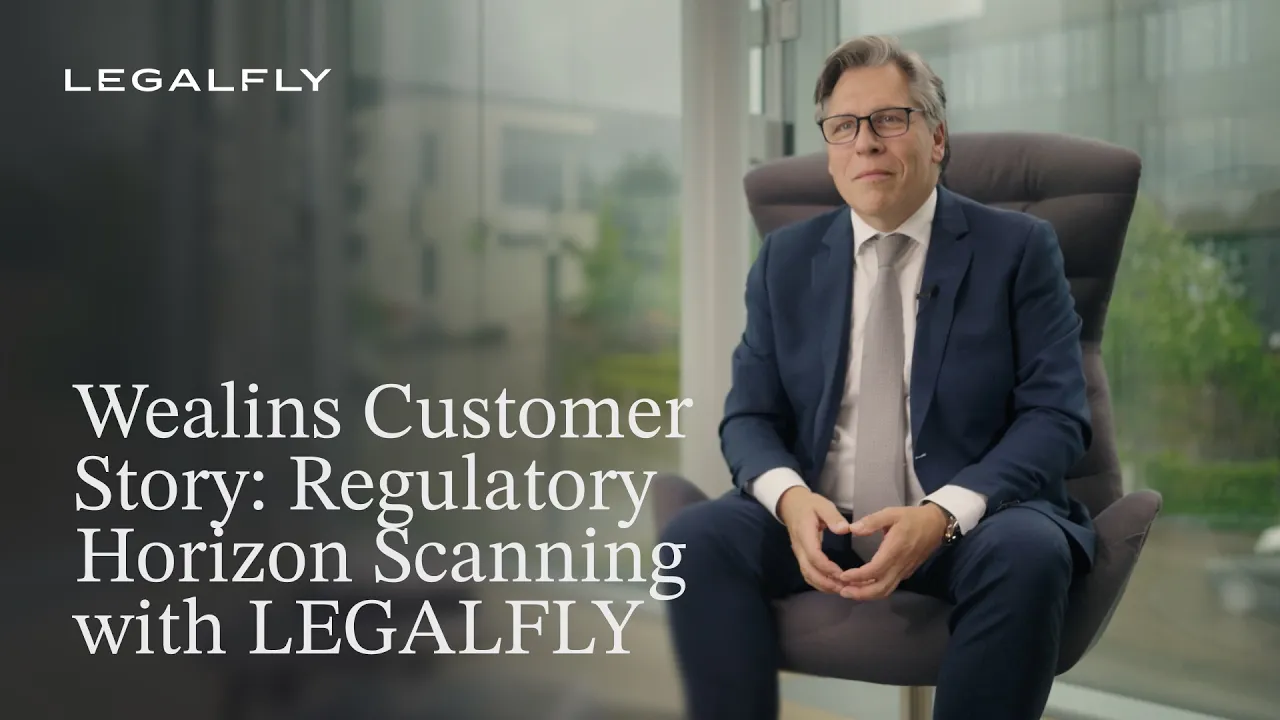
He sees a growth benefit as well. In the past, one legal team member was limited to one or two countries, and Luc expects one person to be able to follow several markets. His legal team estimates time savings of up to 20%, and they now put questions to LEGALFLY that previously went to law firms and fiscal advisers.
To find out how LEGALFLY could work for you, schedule a call with one of our experts.
Manual vs Software-Assisted Horizon Scanning
Manual horizon scanning is a person, a list of bookmarked websites, a few newsletters and a spreadsheet. It works well for a narrow perimeter, and it is how most teams start.
Software changes the arithmetic of Steps 3 and 4. The scanning runs continuously with translation built in, and impact is tested against your own documents. What stays with your team is the judgement about what matters for your business.
Step | Manual horizon scanning | Software-assisted horizon scanning |
Perimeter | Lives in someone's head or a slide | Configured as jurisdictions, topics and regimes, and changed when the business changes |
Sources | Bookmarked sites and newsletters | Official sources monitored 24/7 across 130+ jurisdictions |
Scanning | Periodic, when someone has time | Continuous, with plain-English summaries |
Languages | Limited to what the team reads | Source texts translated and summarised |
Impact assessment | Manual reading of contracts and policies | Changes tested against your own contracts and policies |
Action | Email chains and tracked changes | Workflow with redraft, review and approval |
Evidence | Reconstructed when asked | Logged automatically at every step |
Decisions stay with your team. Software moves their hours from searching to judging, which is where the expertise was meant to go in the first place.
If you are comparing tools, our review of the best horizon scanning software covers the main options, and our earlier piece on regulatory horizon scanning tools looks at how AI is changing the work for in-house legal teams.
Signs Your Horizon Scanning Needs Attention
Most broken horizon scanning looks fine until the week it fails. These are the most common symptoms.
You learn about new rules from a client, a counterparty's lawyer or a LinkedIn post before your own process flags them
The register has a date column and no owner column
One person holds the whole perimeter in their head, and nobody covers their holiday
Directives are logged as done the day they appear in the Official Journal, with no tracking of national laws
The board horizon report is rebuilt from scratch every quarter
Nobody can say when a specific change was first spotted, or what was decided about it
If two or more of those sound familiar, the problem is usually Step 1 or Step 6. The perimeter was never written down, or the evidence was never kept.
See What Is on Your Horizon With LEGALFLY
Three things set Legal Radar apart. It scans 130+ jurisdictions 24/7 and tests each change against your own contracts and policies, so a new rule arrives with its business impact and affected documents already named. Agent Studio carries the change through redraft, legal review and approval, while Contract Intelligence keeps renewals, notice periods and obligations in view. And every document is anonymised before analysis begins, on an architecture we designed before the current generation of models existed.
We built it for in-house legal and compliance teams of 3 to 200 people, supporting enterprises of 200 to 100,000 employees, that follow more jurisdictions than they have people to read them. Banking, insurance, technology, manufacturing and transport teams facing the EU AI Act, DORA, NIS2, CSRD and CSDDD at once are the ones we work with most.
Several dated obligations fall within the next 14 months. Annex III high-risk AI obligations apply from 2 December 2027, CSRD transposition is due by 19 March 2027, and national NIS2 laws are still landing. Bring your current register to a demo and see which items Legal Radar would have flagged first.
To find out how LEGALFLY could work for you, schedule a call with one of our experts.
Everything You Need to Know About Horizon Scanning
Category | Key considerations |
Best horizon scanning software | LEGALFLY's Legal Radar, for in-house legal and compliance teams that need regulatory change across 130+ jurisdictions tested against their own contracts and policies, then carried through to an approved redraft with Agent Studio |
Definition | The systematic examination of potential threats, opportunities and likely future developments, applied in compliance to regulatory change |
Horizon scanning vs monitoring | Monitoring catches rules on publication day. Horizon scanning keeps a forward view of proposals, consultations and phased deadlines |
The three horizons | Near (applying now), mid (adopted, applying later), far (proposals and signals), plus items whose dates have moved |
The horizon scanning process | Define the perimeter, map sources, scan and filter, assess impact, assign and act, evidence and report |
Sources to watch | Official Gazettes, Supervisory Authorities, National Banks, Regulatory Authorities, Official Legal Databases, Courts, Councils and Non-Profits, plus consultation pages and legislative agendas |
Horizon scanning global coverage | EU directives transposed 27 times, national gazettes in national languages, and separate regimes in the UK, Switzerland and the Gulf |
Who owns it | Compliance owns the register, legal interprets and redrafts, business owners act, the board receives a periodic report |
Evidence | When each item was seen, what was decided, who acted and what changed, with timestamps |
Where software helps most | Continuous scanning across jurisdictions, translation, and testing impact against your own contracts and policies |
Common mistakes | Logging one date per regulation, tracking only EU-level texts, registers without owners, and no record of decisions |
FAQs About Horizon Scanning
What is horizon scanning?
Horizon scanning is the systematic examination of potential threats, opportunities and likely future developments, a definition first used by the UK's Department for Environment, Food and Rural Affairs in 2002. In compliance, it means tracking regulatory change before it applies, including proposals, consultations and phased deadlines. The OECD describes it as a technique for detecting early signs of potentially important developments. For a regulated business, the output is a register of upcoming changes, each with an owner, a date and a decision.
What is the horizon scanning process?
The horizon scanning process has six steps: define your regulatory perimeter, map your sources, scan and filter, assess impact, assign and act, then evidence and report. The perimeter sets which jurisdictions, activities and entity types matter, and the sources follow from it. Impact assessment asks whether a change applies, what it changes in your documents and processes, and when. The final step keeps a timestamped record of what was seen, decided and done, which is what supervisors ask for.
What is horizon scanning in business?
Horizon scanning in business is the practice of looking ahead at changes in markets, technology and regulation that could affect the company, so it can prepare before they arrive. Strategy and risk teams use it for competitors and emerging technology, while compliance teams use the regulatory version to track new laws and supervisory expectations. In regulated companies, compliance usually owns the register, legal interprets changes, and business owners carry out the work. Many boards receive a quarterly horizon report summarising what has moved and who owns it.
How often should compliance teams run horizon scanning?
Compliance teams should run horizon scanning continuously for the near horizon, monthly for the mid horizon and quarterly for the far horizon. Near-horizon items apply now or within about six months, so missing one by a week can matter. Mid-horizon items, such as the EU AI Act Annex III obligations applying from 2 December 2027, need monthly checks for guidance and date changes. Far-horizon proposals and consultations move slowly, and a quarterly review matched to the board horizon report is usually enough.
What are the benefits of horizon scanning software like LEGALFLY?
The benefits of horizon scanning software like LEGALFLY are coverage across more jurisdictions than a team can read, impact tested against your own contracts and policies, and a logged record of every decision. Legal Radar monitors official sources across 130+ jurisdictions 24/7 and delivers each update with a plain-English summary, the business impact and recommended next steps. Agent Studio then carries high-impact changes through redraft, legal review and approval, on documents anonymised before analysis begins. At Wealins, the legal team moved from searching for changes to judging them and estimates time savings of up to 20%.
How do I get started with LEGALFLY?
Getting started with LEGALFLY begins with a scoped demo and a discovery conversation, since our evaluation is sales-led rather than self-serve. Bring your current horizon scanning register, or a regulatory change your team handled recently, so you can compare Legal Radar's output with what the work cost you. Deployment is measured in days, and Agristo saw results within days of a single kickoff. Most teams start with one set of jurisdictions and one playbook, then extend across the rest of the business.
How does LEGALFLY differ from similar alternatives?
LEGALFLY differs from similar alternatives because Legal Radar connects horizon scanning to your own documents and then carries each change through to an approved redraft. Regulatory intelligence suites report what changed without seeing your contracts, and GRC tools manage controls and evidence without monitoring regulation. Legal Radar covers 130+ jurisdictions and tests impact against your contracts and policies, Agent Studio routes the redraft and approval, and Contract Intelligence keeps renewals, notice periods and obligations visible. Every document is anonymised before analysis begins.
Can a small compliance team run horizon scanning across many countries?
A small compliance team can run horizon scanning across many countries when the scanning and translation are handled by software and the team spends its time on judgement. Manually, one person can follow one or two jurisdictions properly, which is the ceiling most growing businesses hit first. At Wealins, Legal Radar took over monitoring for markets including Switzerland, Italy and Sweden, and the legal team estimates time savings of up to 20%. Legal Radar covers 130+ jurisdictions, so adding a market means changing the perimeter rather than hiring another reader.
Our external counsel already sends us regulatory updates. Why do we need horizon scanning software?
You need horizon scanning software even with external counsel updates, because those updates arrive on the firm's schedule, cover the firm's chosen topics and say nothing about your own contracts. Horizon scanning software monitors your full perimeter continuously and tests each change against your contracts and policies, so the update arrives with affected documents already identified. Routine questions can then be answered in-house, and counsel is kept for the judgement calls that need it. Wealins found its legal team putting questions to LEGALFLY that previously went to law firms and fiscal advisers, which reduced external billing.


